Ancient Flesh, Modern Rivers: The American Paddlefish (Polyodon spathula)
Introduction

Introduction
Long before the Mississippi became a super-highway of barges and levees, a ghost of the Cretaceous still moved beneath its surface — the American paddlefish. With its sweeping rostrum and cartilaginous elegance, Polyodon spathula is among the last survivors of a lineage that predates the extinction of dinosaurs. Yet it is not only a biological marvel but a modern resource, connecting freshwater ecology, aquaculture innovation, and culinary refinement. To explore this species is to navigate between prehistory and the table, between ancient adaptation and the contemporary ethics of sustainable consumption.
Taxonomy
The American paddlefish belongs to Kingdom Animalia, Phylum Chordata, Class Actinopterygii, Order Acipenseriformes, Family Polyodontidae, Genus Polyodon (Lacépède, 1797), and Species Polyodon spathula (Walbaum, 1792). It is the only extant member of its family since the Chinese paddlefish (Psephurus gladius) vanished from the Yangtze. Vernacular names in English include “American paddlefish,” “spoonbill,” and “spoonbill cat.” In Chinese, the name 「匙吻鲟」 (shí wěn xún, “spoon-snout sturgeon”) is used in aquaculture contexts. In French, it is sometimes called « polyodon à rostre ». No edible subspecies or regional varieties are recognized.
Biology
This species embodies evolutionary endurance. Adults may reach 2.2 m (7 ft 3 in) in length and weigh as much as 72 kg (158 lb). Its body is soft and cartilaginous, its skin smooth, its eyes small, its mouth cavernous. The defining paddle-shaped rostrum, roughly one-third of total body length, houses tens of thousands of electroreceptors that sense the weak electric fields emitted by plankton. The paddlefish is a filter feeder, swimming with its mouth agape while gill rakers strain copepods and cladocerans from the water column.
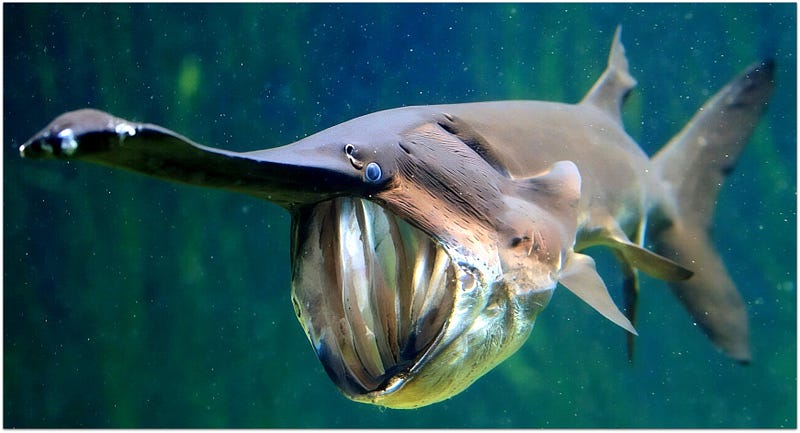
In aquaculture settings, paddlefish readily adapt to floating feed pellets. They use lateral body flexing and a slow, swiveling motion to intercept pellets drifting on the surface, showing behavioral plasticity uncommon among ancient filter feeders. This adjustment allows efficient feeding in managed ponds without damaging their delicate rostrum.
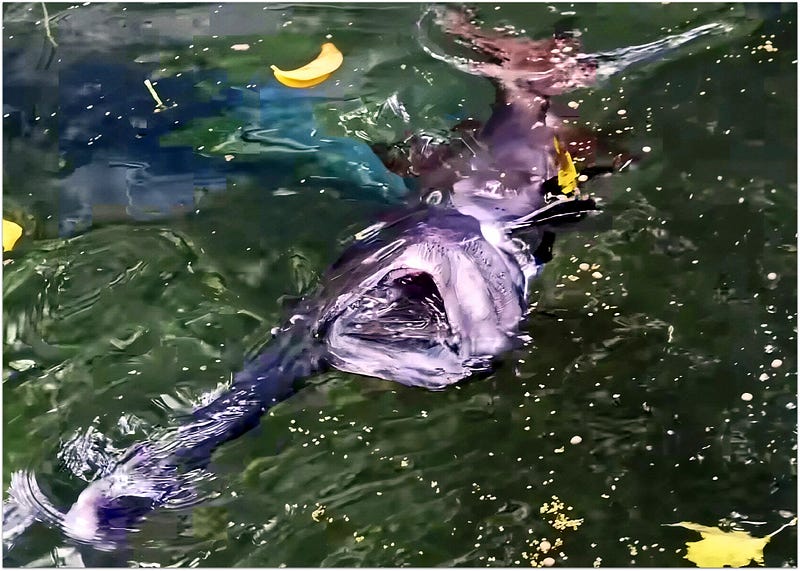
It is a creature of murk and motion, thriving in turbid, slow-moving rivers. Maturity arrives late: females often spawn for the first time at seven to ten years of age, sometimes not until sixteen. They do so only intermittently, every two or three years. Spawning occurs when spring waters rise and temperatures reach about 13 °C (55 °F). Eggs adhere to clean gravel bars, and larvae drift downstream before settling into quiet backwaters. This slow reproductive cycle explains why overharvesting and damming so easily disrupt population recovery.
Ecology
The species’ range once extended through the Mississippi, Missouri, Ohio, and Arkansas river basins, and still survives in fragmented populations across the U.S. Midwest and South. It prefers deep, silty pools of large rivers and oxbows where flow is steady but not swift. Its ecological role is subtle yet vital: it regulates zooplankton density, thereby contributing to water clarity and maintaining a balanced food web.
Human alteration has exacted a high toll. Channelization, dam construction, and sedimentation have stripped away spawning grounds, while invasive zebra mussels compete for the same planktonic food base. The paddlefish now occupies only a fraction of its former habitat and is listed as Vulnerable on the IUCN Red List. Aquaculture initiatives in the United States, Russia, and China now maintain broodstock for both commercial and conservation purposes, providing an ethical supply route while alleviating pressure on wild stocks.
Uses
Every part of Polyodon spathula can be incorporated into a value chain. The edible portions are the white, boneless fillet and the roe. Fresh flesh is marketed as fillets or steaks; roe is referred to as “paddlefish caviar,” a sustainable alternative to traditional sturgeon caviar. Smoked and grilled forms are the dominant regional cuisine.
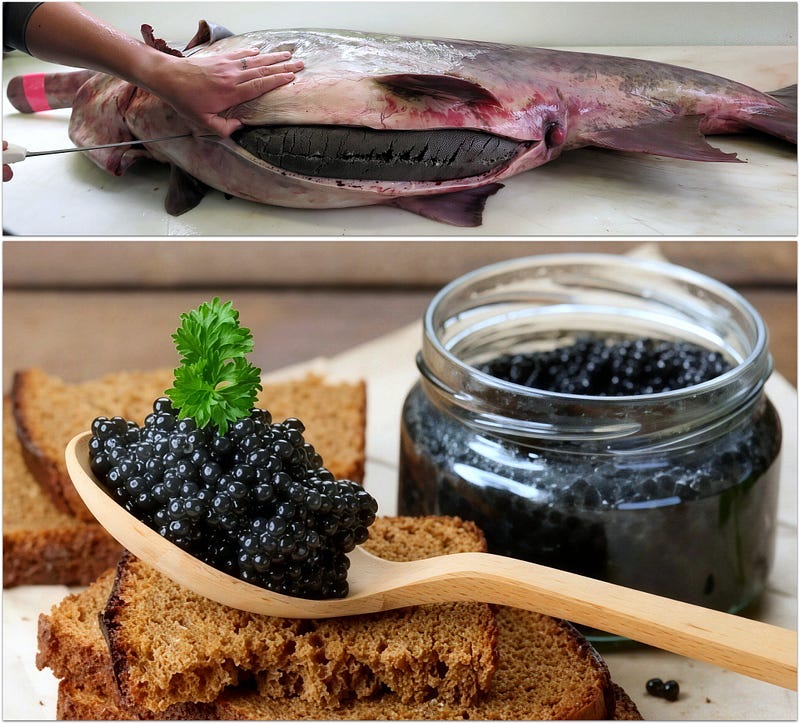
Harvest seasons are typically spring, coinciding with spawning migrations when snagging is permitted by license. The caloric content averages 983 kJ per 100 g (235 kcal), comparable to that of salmon, with approximately 22% of total fatty acids being polyunsaturated. The meat is protein-dense, low in carbohydrates, and rich in omega-3 fatty acids. No antinutritional or toxic compounds have been reported; however, heavy metal levels vary with the catch site.
Proper processing begins immediately after capture. Fish are bled and chilled to 4 °C (39 °F), and red muscle near the skin is trimmed to eliminate metallic flavor. In taste and structure, the flesh more closely resembles lean pork than conventional fish — firm, dense, and mildly sweet. Commercial derivatives include smoked fillets, vacuum-packed caviar, and cured strips for jerky production.
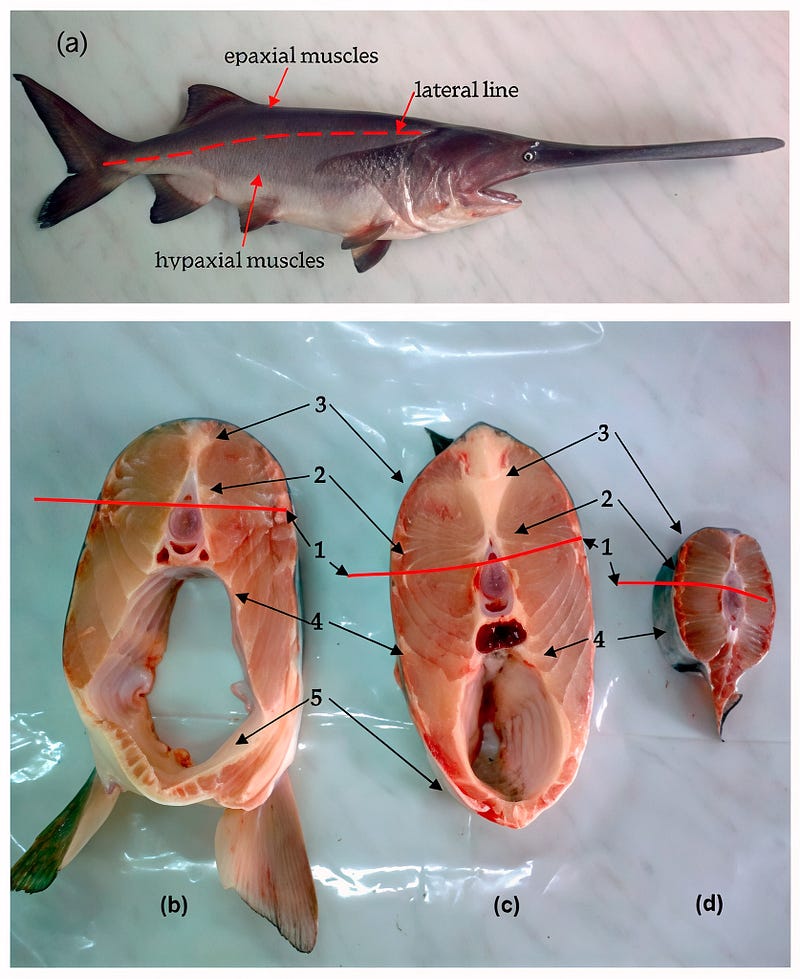
In aquaculture feed experiments, formulated diets substitute zooplankton, yielding flesh of comparable nutritional quality. Skin can be converted into pliable leather, and cartilage waste can be processed for the extraction of gelatin or collagen. Roe yields high-value lipids, and smoked paddlefish bones are sometimes rendered for stock flavoring.
Culturally, the paddlefish appears in Midwestern river festivals and culinary fairs as a regional delicacy. The value chain now includes licensed fishermen, caviar processors, cold-chain distributors, and boutique retailers in North America and Eastern Europe. The leading producers are the United States, China, and Serbia. Market prices range from $25 to $40 per 100g of caviar and $8 to $12 per 450g (1 lb) fillet.

Due to slow maturation and low reproductive frequency, responsible sourcing is crucial. State wildlife agencies regulate quotas, and trade is monitored under CITES Appendix II. Recommended practices include hatchery supplementation of river populations, habitat restoration, and the use of traceable labeling. Monitoring indicators encompass spawn counts, length–weight indices, and tagged-fish returns, forming part of adaptive management plans for sustainable harvest.
Culinary Aspects
To cook paddlefish well is to respect its density. Its flesh resists flaking and instead offers a muscular bite with a faintly nutty sweetness. When raw, the meat is pale ivory; when cooked, it turns opaque and slightly pearlescent. Its aroma is neutral and faintly briny, free from the typical odor of river fish.
A fillet about 2.5 cm (1 in) thick grills perfectly over medium-high heat for 8 minutes per side until internal temperature reaches 63 °C (145 °F). Smoked paddlefish, cooked at a low temperature of 90 °C (195 °F) for approximately 45 minutes, acquires a delicate amber hue and a clean finish. The mouthfeel is firm yet yielding, akin to swordfish but lighter.
Nutritionally, a 100 g serving provides roughly 20 g of protein, 11 g of fat, 0 g of carbohydrate, 235 kcal (983 kJ), and 500 mg of EPA + DHA combined — placing it among the more health-efficient freshwater proteins. Its moderate lipid content confers succulence while avoiding the greasiness of some pelagic fish.
Flavor development is influenced by smoke, heat, and acid. Lemon, black pepper, and mild wood smoke accentuate the mildness; garlic and caper butter add roundness. Paddlefish pairs well with side dishes that offer contrast, such as grilled sweet corn, wild rice, or pickled okra. Because oxidation dulls flavor, fillets should be consumed within 48 hours of thawing or vacuum-sealed for freezing at −18 °C (0 °F).
Wine Pairings
A fish with the structure of meat calls for wines of balance and precision—grilled paddlefish benefits from white wines that combine body and stone-fruit aromatics. A Viognier from Virginia or North Carolina, with floral lift and low acidity, mirrors the richness of the flesh while cutting through its oil. Its viscosity, typically 13% alcohol and 5.8 g/L acidity, matches the buttery mouthfeel of grilled fillets.
Smoked or peppered preparations find harmony with Grüner Veltliner from the Wachau. The wine’s peppery minerality, derived from loess soils, heightens the smoky nuances without heaviness. When paddlefish is pan-roasted with herb butter, a lightly chilled Vranec from Macedonia, which contains 6 g/L tartaric acid and soft plum tannins, balances the protein's weight with moderate structure.
For caviar service, a dry Crémant de Loire offers refined effervescence that scrubs the palate between spoonfuls. Its chalky minerality aligns with the roe’s brininess more naturally than Champagne’s assertive acidity, allowing the subtle saline sweetness of paddlefish eggs to linger.
Conclusion
The American paddlefish is an evolutionary relic transformed into a case study in sustainable luxury. Its prehistoric biology, delicate roe, and firm flesh illustrate how species once exploited to scarcity can be repositioned within responsible aquaculture. When harvested within strict quotas and traceable supply chains, Polyodon spathula becomes a living symbol of balance — between appetite and ecology, tradition and innovation. In the river’s quiet depths, an ancient lineage persists not as a relic of extinction but as proof that sustainability and gastronomy can share the same current.