Crimson Diver: The Red-breasted Merganser and Its Unruly Elegance
Introduction
Introduction
The Red-breasted Merganser (Mergus serrator) is a bird that looks like it’s been through a windstorm and came out prouder for it. With its spiky crest and striking colors, this diving duck lives on the edge — of continents, of rivers, of cold seas. Its world is a blend of turbulence and grace, a life spent plunging beneath the water’s surface in pursuit of fish. To naturalists, it is a master of adaptation. To chefs, it is a questionable guest at the table. To conservationists, it is a symbol of fragile balance in watery ecosystems.
Taxonomy
The Red-breasted Merganser belongs to the family Anatidae, within the genus Mergus, which houses the saw-billed ducks known for their serrated bills adapted to grasp slippery prey. Its Latin name, Mergus serrator, reflects this defining trait — serrator meaning “sawyer.” The species has no formally recognized subspecies, though regional populations from North America, Europe, and Asia display subtle differences in plumage and size. Common names include “sawbill” and “fish duck,” terms that speak to both its peculiar anatomy and its favored diet.
Biology
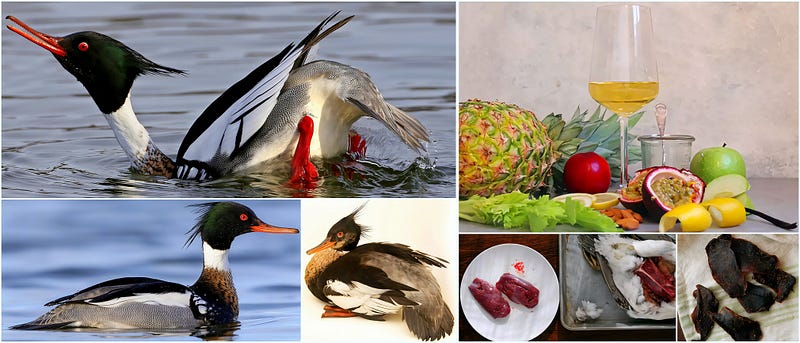
This duck is unmistakable in appearance. The male, during breeding season, sports a dark green head, a dramatic ragged crest, a white neck collar, and a chest washed in rusty red. Females wear subtler earth tones but share the same punkish head-feathers. Adults measure around 23 inches (58 cm) long with a wingspan of about 31 inches (79 cm). They are light-bodied for their length, weighing about 2.1 lb (0.95 kg), which allows them to take off quickly from water. Their most iconic feature — the long, thin red bill lined with sharp serrations — functions as a biological fishhook, making them lethal underwater hunters.
Mergansers dive with practiced efficiency, pursuing small fish at depths of up to 15 ft (4.6 m). They can stay submerged for about two minutes, powered by strong webbed feet placed far back on their bodies. Nesting typically occurs in late spring; females scrape shallow depressions in ground vegetation or nest in sheltered spaces near water. A clutch usually contains 6 to 12 eggs, which the female incubates alone while the male departs to molt. Ducklings hatch precocial, covered in down, and are capable of swimming within hours.
Ecology
The Red-breasted Merganser is a bird of cold and temperate zones, favoring freshwater lakes, rivers, estuaries, and coastal bays across the Northern Hemisphere. In winter, flocks can be found along rocky shorelines and brackish lagoons. They play an essential role in regulating fish populations, often feeding on small schooling species such as smelt and minnows. While not globally threatened, their dependence on clean, fish-rich waters makes them vulnerable to pollution, overfishing, and habitat destruction. Oil spills in particular have historically decimated flocks, coating feathers and robbing them of insulation.
Migratory by nature, some individuals travel thousands of miles between breeding and wintering grounds. A bird banded in Scotland was once found months later in Newfoundland, demonstrating their extraordinary range. Conservation status remains “Least Concern,” but the bird is often considered a bioindicator species for aquatic ecosystem health.
Uses
Historically, mergansers have been hunted for food, though they were never prized as highly as ducks such as teal or mallards. Their flesh, steeped in fish oils, carries a notoriously strong flavor. Indigenous peoples of the Arctic and boreal regions sometimes consumed mergansers out of necessity, while using their down-lined nests for insulation. Today, their economic relevance lies more in ecotourism and birdwatching, as their striking plumage and acrobatic diving make them sought-after sightings for wildlife enthusiasts.
Culinary Aspects
Among waterfowl, mergansers have perhaps the poorest culinary reputation. Hunters describe the taste as intensely fishy, with an oily mouthfeel that lingers well beyond the meal. The aroma can be sharp, almost briny, while the texture tends toward stringy rather than tender. Balance and complexity in flavor are largely absent, with the aftertaste often compared to rancid mackerel. The finish is heavy, and the chemesthesis — the sensory burn — comes not from spice but from the sheer pungency of marine oils.
Cultural traditions, however, reveal strategies to make the bird somewhat more palatable. In parts of Scandinavia, mergansers were once boiled with aromatic juniper and onions, then heavily spiced to mask the flavor. In North America, some hunters recommend soaking the meat in milk or vinegar, then braising it with root vegetables. Nutritionally, like other ducks, it offers high protein and iron content, but the strong-tasting oils make it unappealing for most modern palates.
Wine Pairings
If one insists on pairing wine with Red-breasted Merganser, the choice must be bold. A smoky Syrah from the Rhône Valley, with its peppery intensity, can match the bird’s aggressive flavor. Alternatively, an oaked Chardonnay from Burgundy offers enough body to counteract the oily texture, while its buttery notes might smooth the rougher edges of the meat. In more experimental circles, an off-dry Riesling with high acidity can cut through the fishiness, leaving a cleaner palate.
Conclusion
The Red-breasted Merganser is a paradox: beautiful yet scruffy, common yet specialized, fascinating in biology yet infamous in cuisine. Its spiky silhouette against a northern coastline is an emblem of wildness, a reminder of the delicate dance between predator, prey, and environment. To study it is to see resilience. To taste it is to encounter a challenge. And to protect it is to ensure that these spirited sawbills continue to slice through waves for generations to come.