Feathers, Fields, and Fire: The Common Pheasant’s Journey from Wild Game to Gourmet Plate
Introduction In the flickering golden light of autumn, few sights rival the iridescent shimmer of a male pheasant strutting through a field…
Introduction
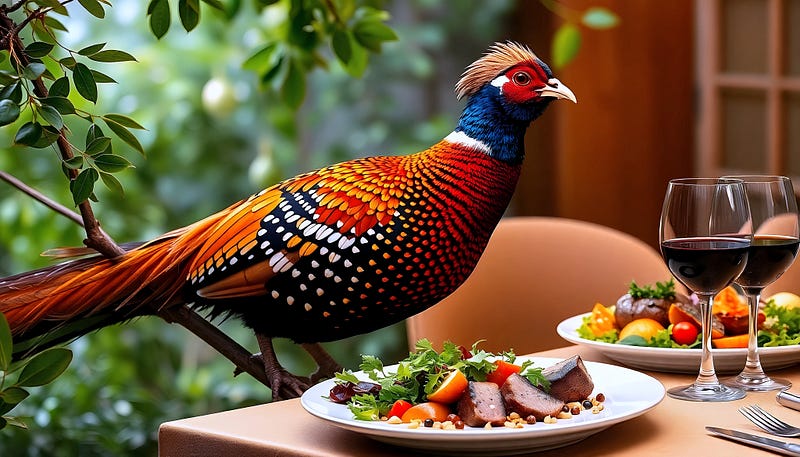
In the flickering golden light of autumn, few sights rival the iridescent shimmer of a male pheasant strutting through a field of fading wheat. The Phasianus colchicus, or Common Pheasant, has long enchanted poets, fed kings, and now commands a place at the modern table for those who savor wild, sustainable fare. But beneath the bird’s vibrant plumage lies a tale of ancient trade, ecological complexity, culinary tradition, and modern conservation. As we examine this storied species, we discover how biology, culture, and cuisine intersect in feathers and flesh.
Taxonomy
The Common Pheasant belongs to the family Phasianidae, under the order Galliformes — a lineage that also includes partridges, quail, and junglefowl. Originally native to Asia, Phasianus colchicus is now globally distributed, with more than thirty recognized subspecies. These range from the Mongolian pheasant to the green-backed Japanese variant, though most North American and European birds descend from crossbreeds introduced for hunting. Names vary across regions — “ring-necked pheasant” for its white collar in the U.S., “cock pheasant” in the British Isles, or simply “game bird” on a restaurant menu. Among gourmets, the Chinese Ringneck and the Kansas Blueback are often praised for their delicate meat and reliable size, prized for both flavor and presentation.
Biology
A rooster pheasant is a living jewel — its burnished copper flanks, bottle-green head, and long, barred tail make it one of the most visually striking birds in the temperate world. Hens are smaller and more cryptic in color, an evolutionary adaptation to protect themselves and their nests from predators. Pheasants exhibit strong sexual dimorphism and polygynous behavior, with males establishing territories during spring and vying for harems through spectacular visual displays and guttural calls. The birds are ground-nesters, laying clutches of up to a dozen eggs that hatch within three to four weeks. Their chicks are precocial, leaving the nest within hours of hatching and learning to forage immediately. Adaptability is a hallmark of the species — they thrive in agricultural mosaics, woodland edges, and managed grasslands, aided by high reproductive rates and opportunistic diets of seeds, berries, and insects.
Ecology
Although not native to the West, the pheasant has woven itself into the ecological fabric of its adopted lands. It plays a dual role as both prey and predator — feeding on invertebrates while serving as a critical food source for foxes, raptors, and other carnivores. Its presence can be a barometer of habitat health, thriving where edge habitats and managed landscapes provide cover and forage. However, the pheasant’s story is not without controversy. In places like the UK, the mass release of captive-bred birds for sport has sparked debates around biodiversity, disease spread, and habitat disturbance. Sustainable game management is essential. Practices like rotating release sites, maintaining hedgerows, and controlling predator pressure can help ensure that the pheasant’s contribution to rural economies does not come at the cost of ecological integrity.
Uses
Beyond the gun and the kitchen, the pheasant has symbolic and economic value. In Eastern traditions, the pheasant represents nobility and harvest; in Europe, it has long been a staple of country estates and aristocratic hunts. In the United States, state wildlife agencies generate significant revenue through pheasant stamps, hunting licenses, and seasonal tourism. The bird has become a linchpin of rural economies where hunting is tightly interwoven with conservation funding. Ethical hunting, regulated harvests, and habitat conservation programs offer a rare synergy between human utility and ecological stewardship. The rise of small-scale game farms and farm-to-table culinary interest in wild game has also elevated the pheasant’s profile among chefs and restaurateurs.
Culinary Aspects
Lean, subtly gamey, and surprisingly versatile, pheasant is a chef’s delight. The breast meat is pale and tender, reminiscent of chicken but with a deeper, earthy resonance. The legs, tougher and darker, reward slow braising. Across cultures, pheasant has been prepared in myriad ways: roasted with juniper berries in Scandinavia, simmered in creamy mushroom sauce in France, or wrapped in bacon and grilled over open flame in America’s heartland. Pheasant pot pie, confit leg, and pheasant pâté — each tells a story of region, tradition, and ingenuity. Nutritionally, it’s a powerhouse: low in fat, high in protein, and rich in micronutrients like B6 and niacin. Unlike industrial poultry, it offers a cleaner, wilder flavor that speaks of fields and forests, not feedlots.
Wine Pairings
Pairing wine with pheasant is a study in subtlety. A young Burgundy with soft tannins and bright cherry notes can uplift the bird’s gentle gaminess. In colder months, an aged Barolo with its truffle undertones complements a slow-roasted pheasant dressed in wild mushrooms. If the dish leans sweet — say, glazed with plum or orange — a Gewürztraminer or Alsatian Riesling adds lift and aromatic balance. Those who smoke or grill their pheasant might look to a Tempranillo or Syrah, whose smoky, leathery complexity mirrors the preparation. In all cases, the guiding principle is respect: the wine must honor, not overwhelm, the pheasant’s delicate character.
Conclusion
From ancient Persia to modern plates, the Common Pheasant endures — not just as a bird to be hunted or admired, but as a living thread in the fabric of culture, ecology, and cuisine. Its survival now hinges not just on its adaptability, but on ours. Whether we are hunters, farmers, chefs, or conservationists, the choices we make — from land use to dining habits — shape the pheasant’s fate. And perhaps that is the real lesson of Phasianus colchicus: beauty and utility need not be at odds. When managed wisely, a single bird can connect us to the land, our history, and each other.