From Nothingness to Everything: The Quantum Puzzle Behind the Birth of Our Universe
Introduction Can something truly come from nothing? This ancient philosophical question has found a curious echo in modern physics. With…
Introduction
Can something truly come from nothing? This ancient philosophical question has found a curious echo in modern physics. With quantum mechanics rewriting our understanding of “emptiness,” some physicists suggest the universe itself may have emerged from a bizarre quantum fluctuation — from an origin point that defies time, space, and matter as we know them. But what does that mean? Is the cosmos a spontaneous accident from a void, or is there something deeper, stranger, and more elusive behind its emergence? Let us dive into this cosmic riddle where quantum theory, speculative cosmology, and metaphysical mystery converge.
The Quantum Roots of Reality
At the heart of this discussion lies quantum mechanics — a theory so successful in predicting experimental outcomes, yet so alien to our everyday intuition that even its notion of “nothing” isn’t truly nothing.
Virtual Particles: Fleeting Phantoms of the Void
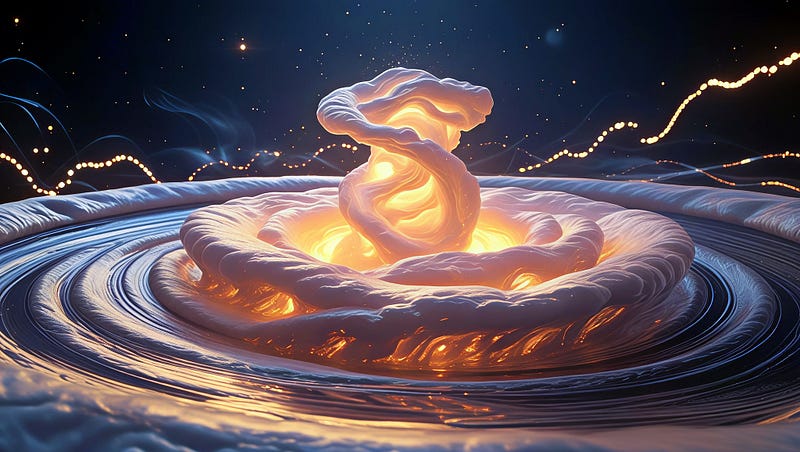
In quantum field theory, the vacuum is alive. Thanks to the Heisenberg Uncertainty Principle, particle-antiparticle pairs continuously flicker into and out of existence, borrowing energy from “nothing” and returning it just as quickly. These ephemeral entities, called virtual particles, are indirectly observable — leaving their fingerprints on phenomena like the Casimir effect and atomic energy levels. But these effects require the preexistence of quantum fields and spacetime. The vacuum, in this sense, is not a blank slate; it is a sea boiling with possibility.
Quantum Foam: Where Spacetime Itself Breaks
As we zoom down to the Planck scale — about 10⁻³⁵ meters — the smooth fabric of spacetime begins to resemble a stormy sea. This so-called quantum foam may be riddled with wild, spontaneous fluctuations in geometry: mini black holes, wormholes, or even baby universes. But even this chaotic froth presupposes the existence of a quantum gravitational framework. We’re still not at “absolute nothing.”
Leaping from Fluctuation to Creation
How do we get from borrowed energy or spacetime ripples to an entire universe? Here, science ventures beyond observation and into bold theorizing.
Tunneling from Nothing: A Quantum Birth?
Physicist Alexander Vilenkin proposed a radical idea: the universe might have tunneled into existence from a true void — a quantum tunneling event from a state with no space, no time, no laws, no fields. This “nothing” is not empty space; it’s an absence of everything. Quantum mechanics, however, allows systems to bypass classical impossibilities through tunneling. Could our universe be the result of one such quantum cheat? In theory, yes — but we still lack a full understanding of the quantum laws that would permit it.
The Hartle-Hawking No-Boundary Proposal
Stephen Hawking and James Hartle offered another perspective: what if time itself has no initial edge? Just as the Earth’s North Pole is not the edge of the planet, the beginning of time might not be a singular point. Their model replaces real time with imaginary time near the origin, smoothing the universe’s birth into a quantum wavefunction without a singularity. Yet again, this isn’t “nothing” — it’s a specific, describable state within a quantum cosmological framework.
Inflation from a Quantum Spark
Some theories suggest our universe was born when a quantum fluctuation triggered inflation — a rapid, exponential expansion. This event may have involved a scalar field stuck in a “false vacuum” state, suddenly decaying and unleashing a burst of energy that shaped everything we see today. But this implies a pre-existing quantum environment — a meta-universe — from which our own emerged.
What Does “Nothing” Really Mean?
The closer we look, the clearer it becomes: physics does not, and perhaps cannot, deal with the absolute void that philosophers ponder.
Physics Presupposes Something
Quantum fluctuations and foam need spacetime. Even the “quantum vacuum” is a structured entity, rich with potential. The models we’ve explored work from some foundation — whether it’s a timeless quantum state or an unstable vacuum.
The Metaphysical Mismatch
True philosophical nothing — the total absence of anything — is an alien concept in physics. A wavefunction, even in its most minimal form, is still something. Our best cosmological models describe transitions from one quantum state to another, not from sheer nonexistence.
Roadblocks and Riddles
Despite decades of theorizing, many obstacles remain in our path toward understanding the universe’s beginning.
Quantum Gravity: Still Missing
To truly model the universe’s origin, we need a unified theory that merges general relativity and quantum mechanics. String theory, loop quantum gravity, and other contenders offer hints but no definitive answers.
The Singularity and Conservation Laws
The Big Bang suggests an initial singularity — an infinite density point. Quantum gravity may eliminate this, but if so, how? And how do conservation laws operate when there’s nothing to conserve against?
Why These Laws?
Perhaps the most haunting question is: Why do the laws of physics exist in the first place? Why not a different set of constants — or none at all? The anthropic principle suggests we’re here because conditions allowed for us, but that doesn’t explain the root cause.
Conclusion: A Universe of Questions
The idea that the universe emerged from “nothing” via quantum mechanics is both breathtaking and bewildering. It offers a tantalizing glimpse at what might lie beyond the veil of time and space, but it doesn’t quite deliver the final answer. Instead, we’re left with models of emergence — from mathematical wavefunctions, from quantum vacuums, from a timeless state — but always from something.
Physics can describe how a universe like ours could blossom from a quantum garden, but the seed of that garden — the “why” of it all — remains untouched.
Maybe the real insight lies not in finding finality, but in embracing the mystery. For in that mystery, our greatest questions endure — and so too does our endless pursuit of the cosmos.