How Guns Get Into the Wrong Hands: Inside America’s Shadow Firearms Pipeline
Introduction In the United States, the line between legal gun ownership and criminal possession is far thinner than many realize. Despite…
Introduction
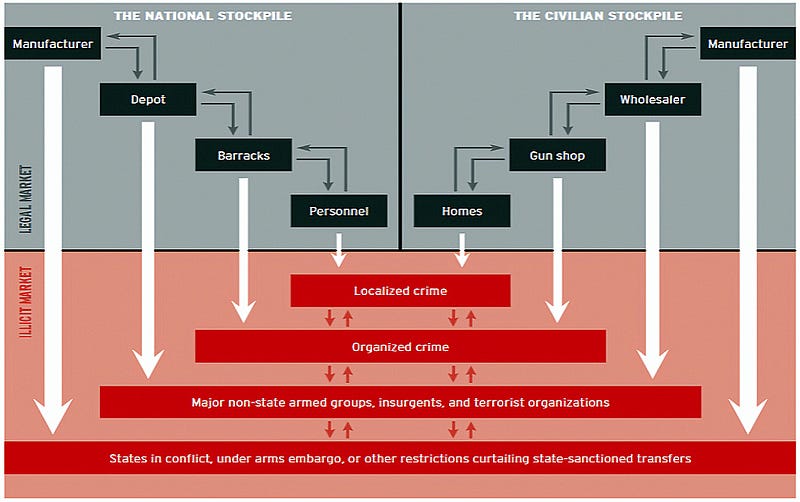
In the United States, the line between legal gun ownership and criminal possession is far thinner than many realize. Despite decades of debate, school shootings, and surging urban violence, America’s firearms continue to flow not just through gun shops and shows — but into the hands of convicted felons, gang members, and traffickers. This isn’t simply a matter of bad luck or isolated lapses. It’s a systemic failure — one with loopholes, corruption, and blind spots that create a thriving black market.
This article peels back the layers of that shadow economy, tracing how criminals obtain guns and why the current system keeps enabling it.
Straw Purchases and the Dirty Dealer Pipeline
Imagine walking into a gun shop and watching a teenager pick out a handgun while their older friend — clean record, nervous smile — fills out the paperwork. That’s a straw purchase: a legal buyer acting as a proxy for someone who can’t legally own a gun.
Straw purchasing is not rare. It’s a dominant route for firearms entering the criminal underworld. Corrupt gun dealers, though a minority, play an outsized role. Just 8% of licensed dealers account for the majority of crime gun recoveries. These dealers exploit weak enforcement and minimal ATF oversight, allowing shady transactions to go unchecked. Guns sold through these channels are often recovered at crime scenes within two years — a damning sign of deliberate diversion.
From Georgia to the Bronx: Interstate Gun Running
The iron pipeline — a term law enforcement uses to describe the steady flow of guns from southern states to northern cities — exposes the wild inconsistencies in America’s state-level gun laws. Georgia, Texas, and Virginia don’t require background checks for private sales. New York and New Jersey do. So, criminals use the former to arm themselves in the latter.
The numbers are staggering: More than 70% of traced guns used in crimes in strict-law states originated elsewhere. From 2017 to 2021, over 230,000 firearms were trafficked across state lines. That’s not a loophole — it’s a superhighway.
The Private Sale Loophole: No Questions Asked
Gun shows, online marketplaces, or even a handshake in a Walmart parking lot — 28 states still allow firearm sales without background checks. For traffickers and convicted felons, this creates a legal gray zone. They don’t need to lie on federal forms. They don’t need forged IDs. They just need cash and a willing seller.
Though only 3% of traced crime guns were linked directly to gun shows, experts agree this number grossly underrepresents the true scale due to incomplete data on private transfers. Small-scale smuggling — “ant trafficking” — where individuals move a few guns at a time across state lines or into urban markets, is difficult to track and nearly impossible to intercept.
Stolen Guns: From Nightstands to Crime Scenes
Every year, hundreds of thousands of guns are stolen — 300,000 from homes, vehicles, and dealers. Criminals often prefer stolen guns not just for availability, but because they’re harder to trace.
According to ATF data, stolen pistols show up at crime scenes nearly nine months faster than guns acquired legally. Between 2019 and 2023, over a million firearms were reported stolen nationwide. These weapons become community hazards, slipping into local networks with virtually no oversight.
Ghost Guns and the Rise of DIY Firearms
No serial number. No background check. No paper trail. That’s the allure of ghost guns — homemade firearms built from kits or 3D printers. From 2017 to 2023, recoveries of ghost guns surged 1,600%. In 2023 alone, over 27,000 such weapons were seized.
Kits from companies like Polymer80 allow users to finish a firearm at home using basic tools. Law enforcement also reports skyrocketing use of machine gun conversion devices — like Glock switches — which transform semi-automatic pistols into illegal automatic weapons. These conversions rose nearly 800% in just four years.
Though recent federal rules attempt to rein in ghost guns, enforcement is slow and uneven. Meanwhile, these untraceable weapons continue fueling violent crimes from coast to coast.
International Smuggling: Exporting Chaos
America’s gun crisis isn’t confined to its borders. The U.S. is the number one source of crime guns in Mexico and the Caribbean. In Mexico, an estimated 70–90% of traced firearms come from the U.S., with Texas, Arizona, and California as top exporters. In the Caribbean, the numbers are even worse — 90% of crime guns originate from the U.S.
These smuggled weapons drive cartel wars, fuel homicides, and destabilize entire regions. Yet international gun trafficking remains poorly prosecuted, in part because there’s no dedicated federal statute criminalizing gun trafficking in the U.S.
Systemic Roadblocks to Reform
Efforts to curtail criminal access to guns are routinely stymied by structural barriers:
- No federal trafficking law: Prosecutors must rely on lesser offenses like “unlicensed dealing,” which often carry weak penalties.
- Restricted trace data: The Tiahrt Amendments prevent the public and even some law enforcement from accessing full gun trace databases, hobbling investigations.
- Patchwork laws: State-level inconsistencies allow traffickers to exploit lenient jurisdictions and undermine nationwide enforcement.
Conclusion: The Fix Isn’t Technical — It’s Political
The pipeline of firearms into criminal hands is not a mystery. It’s a mosaic of avoidable failures. We know how guns move. We know which states are the sources. We know which dealers are dirty. We know how ghost guns are made.
What we lack is the political will to shut these channels down.
Universal background checks, tougher oversight on dealers, better data transparency, and a real federal trafficking statute would strike at the roots of America’s gun problem. Until then, criminals will keep buying, stealing, and building weapons faster than we can take them off the streets.