
Inside America’s Sex Offender Registries: A Demographic Deep Dive
Introduction The United States maintains one of the largest and most scrutinized sex offender registry systems in the world. With nearly…
Introduction
The United States maintains one of the largest and most scrutinized sex offender registry systems in the world. With nearly one million individuals listed, this ever-expanding database not only reflects America’s ongoing battle against sexual crime but also exposes stark realities about race, age, gender, geography, and justice. Who exactly are the people behind the registry? Where do they live, and how did they end up there? More importantly, what can this complex demographic mosaic tell us about the laws and policies shaping public safety?
This article peels back the layers of the U.S. sex offender registry, revealing a population that’s overwhelmingly male, disproportionately Black, aging, and scattered unevenly across states — often for decades or even life. It is a story not just about crime and punishment, but about policy, fear, and the unintended consequences of an ever-widening net.
Age Distribution: The Young and the Lasting
Contrary to public assumptions, a significant portion of registered sex offenders were minors at the time of their offense. One of the most commonly charged ages for sex-related offenses is just 14 years old — a startling statistic that blurs the line between youthful indiscretion and criminality.
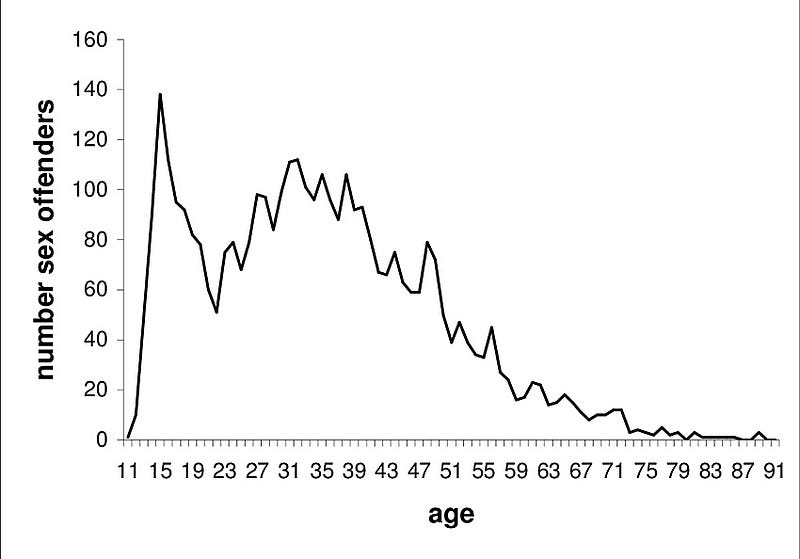
Roughly 25% of all registered sex offenders committed their offenses as juveniles, often in contexts involving consensual peer sexual contact that nonetheless triggered legal consequences. Some were preteens when charged; others entered the registry quietly, with names withheld until age 18.
But the typical face of the registry is older: most offenders were adults at the time of their conviction, often in their 30s or 40s. As lifetime registration becomes the norm, many remain listed into their 60s, 70s, or even 80s. The result is a steadily aging population, with new additions each year outpacing the few who manage to come off.
Gender Breakdown: A Striking Imbalance
Sex offender registries are overwhelmingly male. More than 90% — and in many jurisdictions, closer to 95% — of registered individuals are men. This mirrors broader trends in criminal justice, where sexual offenses are overwhelmingly perpetrated by males.
Women do appear on registries, but they represent a slim minority — often less than 5%. When women are registered, it’s typically for crimes involving minors or statutory violations. Cultural biases, legal discretion, and social taboos may contribute to the relatively low prosecution rate of female offenders.
Over time, this gender disparity has remained consistent. The sex offender registry is perhaps one of the most lopsided in terms of gender distribution in all of criminal justice data.
Racial and Ethnic Composition: Disproportionate Realities
Race plays a complicated and often uncomfortable role in the demographics of the registry. While White offenders constitute the largest group — roughly 72% — Black Americans are strikingly overrepresented. Despite comprising about 13% of the U.S. population, Black individuals account for roughly 26% of all registered sex offenders.
This racial disparity isn’t uniform across the country. In Northern states like Minnesota and Connecticut, Black offenders are up to 10 times more likely than White offenders to be listed. In Southern states like Alabama and Florida, the disparity narrows but remains significant.
Hispanic offenders appear underrepresented, though inconsistencies in how ethnicity is reported muddy the waters. Asian and Native American offenders together represent only a small percentage, though in areas of tribal jurisdiction, Native Americans may be disproportionately convicted under federal law.
These racial discrepancies raise questions not only about crime patterns but also about systemic bias, law enforcement practices, and prosecutorial discretion.
Geographic Distribution: Where Registrants Reside
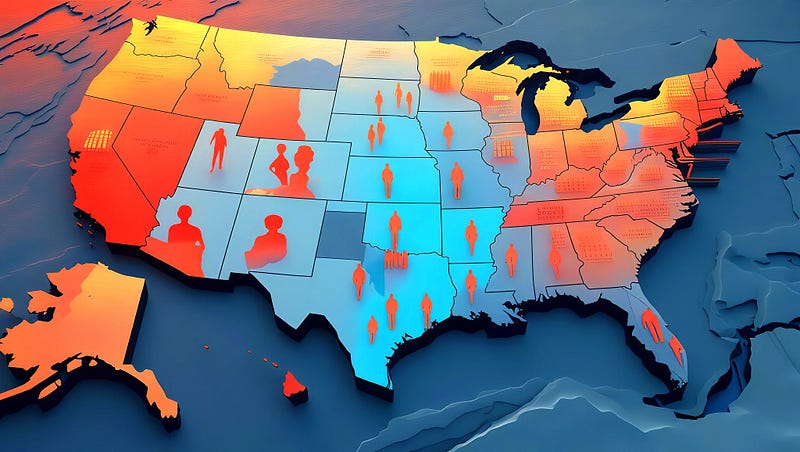
Every U.S. state and territory maintains a sex offender registry, but the size and concentration of these registries vary dramatically.
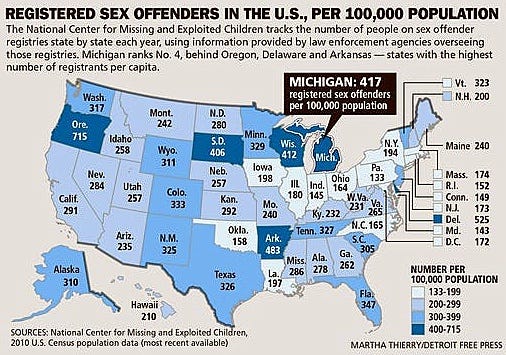
By raw numbers, Texas leads the nation with over 75,000 registered offenders — about one in ten nationally. California follows with more than 60,000. But per capita, it’s Oregon that stands out: nearly 0.8% of its population is on the registry, triple the national average.
Other high-rate states include Arkansas, Alaska, South Dakota, and Wisconsin — many of which have broad registration requirements and lifetime terms. In contrast, states like Massachusetts, Maryland, and Connecticut maintain much lower per capita rates. Policy, not crime rates, explains much of this variance.
Some states count all offenders regardless of tier or risk level; others limit their public registries to high-risk individuals. For example, New Jersey lists fewer than 5,000 names publicly but has many more in the system. This patchwork of practices creates wide disparity in public perception and statistical outcomes.
Trends Over Time: The Growing Registry
Since the 1990s, sex offender registries have grown relentlessly. In 2013, the total stood at around 750,000. A decade later, it’s approaching one million — 972,000 as of 2024, to be precise.
The growth is largely cumulative. New offenders are added each year, while few exit the registry. Lifetime registration for many offenses and limited removal mechanisms mean names accumulate faster than they’re removed. Between 2019 and 2024 alone, nearly 43,000 new names were added — a 6% increase.
Interestingly, while the registry grows, sexual crime rates in the U.S. have remained stable or declined. The increase in registrants reflects policy decisions rather than rising criminality. Expansions of qualifying offenses, the inclusion of juvenile offenders, and longer registration terms drive the numbers.
Despite calls for reform, especially regarding juvenile registration and removal pathways for low-risk individuals, the national trend remains one of steady expansion. Without significant legal change, the registry is poised to surpass the one-million mark within a few years.
Conclusion: Rethinking the Registry
The sex offender registry in the United States has evolved from a targeted law enforcement tool into a sprawling, often controversial database. It reflects not just the country’s concern with public safety, but its deep entanglement with punitive policies, racial disparity, and political inertia.
The typical registrant is a middle-aged, White or Black male, often on the list for life. But beneath that average lie thousands of juveniles, elderly men, women, and individuals caught in a system with little room for nuance.
As the registry grows, so does the conversation around its purpose, scope, and fairness. Is it protecting the public, or merely creating a parallel justice system without exit? The data alone can’t answer that — but understanding the demographics is a crucial first step toward an honest national reckoning.