Mirror Symmetry Simplifies Open Gromov-Witten Invariants
Introduction Imagine trying to count every possible path an ant could take while tethered by an elastic band to a single point on a…
Introduction
Imagine trying to count every possible path an ant could take while tethered by an elastic band to a single point on a sprawling jungle gym. The task seems impossibly intricate, each turn and twist adding layers of complexity. This is precisely the challenge mathematicians face when studying open Gromov‑Witten invariants — a tongue‑twisting name for a deep mathematical problem at the heart of geometry and physics.
But then comes a revelation from an unexpected place: mirror symmetry. It whispers a bold promise — that by stepping into a “mirror universe,” this impossible counting problem transforms into something far simpler, something elegant and computationally manageable. What once felt like counting grains of sand by hand suddenly becomes like reading a clean blueprint of the universe.
The Original Puzzle: Counting Surfaces in Fano Manifolds
Fano Manifolds: The Jungle Gym
A Fano manifold is a geometric shape with positive curvature, rich with curves and surfaces. Think of it as a perfectly smooth balloon on which you can draw infinite loops. Inside this balloon sits a special sub‑shape — a Lagrangian submanifold — where open strings in string theory might anchor.
Open Gromov‑Witten Invariants: Counting the Ant’s Paths
Mathematicians want to count special surfaces — holomorphic disks — whose boundaries are stuck to that sub‑shape. This count, encoded in open Gromov‑Witten invariants, is more than a number: it captures deep structural truths about the geometry itself. But the process is daunting. Each disk’s path bends through a maze of constraints, like an ant weaving endlessly through the jungle gym’s lattice of bars and loops.
The Mirror Swap: Turning Open Problems into Closed Ones
Stepping Into the Mirror
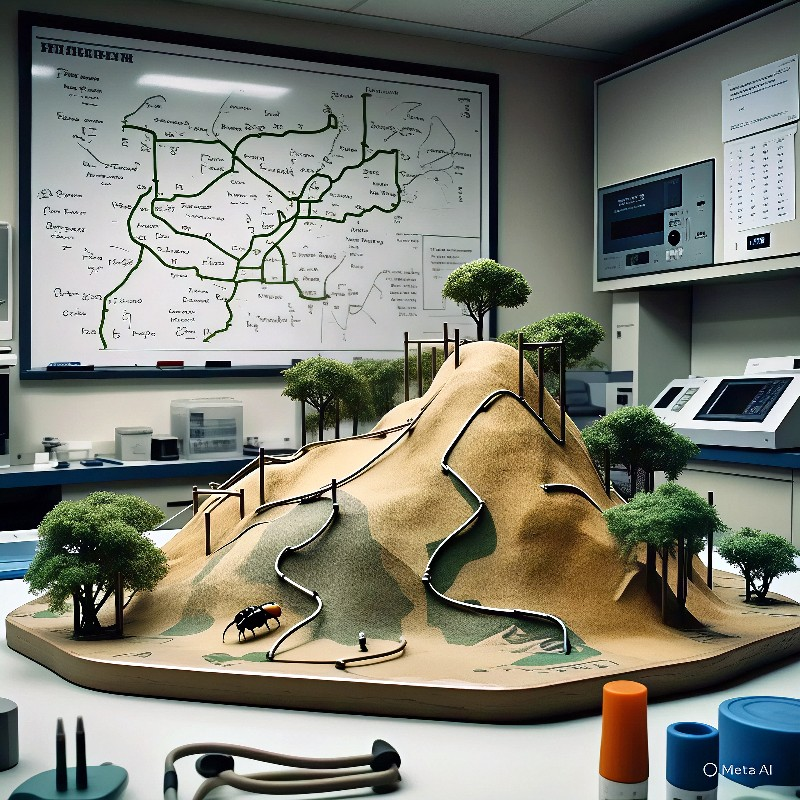
Mirror symmetry says: don’t wrestle with the jungle gym directly. Instead, find its mirror partner — a “smooth hill” shaped by a holomorphic function called the superpotential. On this hill, the messy open‑surface problem morphs into counting closed surfaces — like tiny spheres — without boundaries.
Why Closed Counts Are Easier
Closed Gromov‑Witten invariants are far better understood. Mathematicians have powerful tools, like quantum cohomology and Frobenius manifolds, to calculate them. Instead of wrestling with elastic tethers and boundaries, you’re counting simpler, well‑studied objects.
The Superpotential: A Map to the Hidden Landscape
Critical Points as Clues
On the mirror side, everything you need is encoded in the superpotential’s critical points — the valleys and saddle points in that smooth hill. Each critical point corresponds to a unique “disk count” back in the original Fano manifold. By analyzing these points, mathematicians can unlock otherwise impossible invariants.
An Example: The Sphere
Consider the simplest case: the complex projective line, a sphere with a Lagrangian equator. Its mirror superpotential is a simple function whose critical points perfectly match the basic disks one would struggle to count directly. This is mirror symmetry in action — an elegant detour that turns complexity into clarity.
Why This Matters Beyond Mathematics
Revealing Hidden Structures
This framework doesn’t just solve a puzzle; it reveals deep connections between geometry and physics. Open Gromov‑Witten invariants originated in string theory, where open strings interact with branes — structures akin to those Lagrangian submanifolds. Mirror symmetry bridges these abstract concepts, giving physicists a new lens to test their theories.
A Foundation for New Discoveries
The techniques developed to explore these invariants now fuel research across algebraic and symplectic geometry. What began as a counting problem is now a cornerstone for new mathematics, shaping the future of geometry itself.
Conclusion: Reflections in the Mirror
Mirror symmetry reminds us that the most daunting problems often yield when we shift perspective. By stepping into a mirror universe, mathematicians turn tangled jungle gyms into smooth hills, turning chaos into comprehension.
As you reflect on this, consider the broader lesson: when facing an overwhelming challenge, maybe the solution isn’t to brute‑force your way through — it’s to find the right mirror and look again.