Pathways to Peace: An Analysis of RAND Corporation Recommendations for the Israel-Gaza Conflict
RAND proposes a phased, decades‑long plan for Gaza built on dismantling Hamas, installing a multinational authority, and guiding reconstruction toward a future Palestinian state. It’s detailed and pragmatic, but its success hinges on political will and public trust that do not yet exist.

Executive Summary
The RAND Corporation’s recommendations for resolving the Israel-Gaza conflict are articulated in a comprehensive, multi-decade “road map” for a durable peace, predicated on the long-term vision of a “second state” for Palestinians.1 The framework moves beyond a short-term ceasefire to propose a phased approach across several domains: security, governance, economic development, and physical and social reconstruction. This blueprint is an attempt to address the profound and historically intractable nature of the conflict, which has been exacerbated by the immense costs of the recent war.1
Central to the plan is the prerequisite of dismantling Hamas as a governing and security force, a step that would be followed by the establishment of an interim multinational coalition authority.1 This external body would oversee a phased transition to legitimate Palestinian self-governance and spearhead a massive, multi-billion-dollar reconstruction effort.2 The recommendations are underpinned by a specific framework for international engagement, positioning the United States as a strategic orchestrator of the process, rather than a traditional mediator.1
However, the report also acknowledges significant political and practical hurdles. Prior RAND research indicates that deep-seated mistrust pervades both Israeli and Palestinian populations, with the status quo paradoxically remaining the only option acceptable to a majority of Israeli Jews, despite its long-term unsustainability.4 Furthermore, the proposed governance and security structures have drawn substantive critique, with some analysts arguing they could suppress Palestinian political agency and facilitate a form of “disaster capitalism”.5 This report concludes that while the RAND framework is a pragmatic and exhaustively detailed blueprint, its success is contingent upon political and social shifts — particularly the emergence of courageous leadership and a reduction in public distrust — that have historically been absent. The plan, therefore, serves as a vital strategic document, outlining a possible path forward even as the political will to take it remains uncertain.
Part I: The Strategic Context of the RAND Framework
1.1. The Crisis and the Imperative for Peace
The October 7, 2023, Hamas assault on Israel constituted a profound strategic shock, dismantling Israel’s pre-existing security conception and revealing a significant failure of its deterrence posture.6 RAND analysis characterizes Hamas’s evolution into a “hybrid adversary” — possessing capabilities once reserved for state actors — as a critical factor in this strategic reversal.7 The subsequent Israeli response, an extensive air and ground campaign, resulted in urban warfare of unprecedented scale in the Gaza Strip. The conflict displaced 90% of Gaza’s 2.2 million inhabitants and damaged or destroyed 70% of its housing stock, generating an estimated 42 million tons of rubble.2
The immense human and physical costs of this conflict underscore the urgent need for a new approach, as identified by RAND researchers.1 The sheer scale of destruction and displacement has created a critical inflection point where the extraordinary costs of continued conflict are seen as outweighing the risks of pursuing a new, transformative path to peace.1 This strategic imperative is also heightened by the fact that diplomatic efforts have thus far failed to produce a clear path to lasting peace, with the conflict acting as a “proxy for a host of other competing geopolitical forces” in the Middle East.8 The absence of an effective diplomatic off-ramp necessitated the development of a framework that does not rely on traditional mediation but rather creates a new set of political and security conditions.
1.2. Foundational Principles of the RAND Road Map
The RAND Corporation’s “Pathways to a Durable Israeli-Palestinian Peace” is a comprehensive road map built upon the long-term destination of a “second state” for Palestinians.1 The plan is informed by a deep historical analysis of other conflicts and identifies three fundamental characteristics that have historically made the Israeli-Palestinian conflict so difficult to resolve: a scarcity of credible leadership on both sides, incompatible territorial claims, and international involvement that has not always been constructive.1 The framework is designed to address these very weaknesses by creating an environment where a durable peace can be built.
The most crucial prerequisite for the entire framework is the “elimination of Hamas as a governing entity and a security threat”.1 This starting point fundamentally diverges from other proposals that assume foreign forces would not combat Hamas after a ceasefire.10 The RAND approach is thus not a plan for a negotiated truce with the current belligerents; rather, it is a strategic blueprint for creating the conditions for a new political reality to emerge. This is a pragmatic effort to revive the two-state solution, which prior RAND research had identified as the most politically viable alternative, despite widespread public skepticism and profound distrust among both Israelis and Palestinians.4 The current recommendations seek to create the specific security, governance, and economic conditions that might finally overcome that deep-seated skepticism and political paralysis.
Part II: The Pillars of a Durable Peace
2.1. The Security Pathway
The establishment of an effective and legitimate security environment is posited as the fundamental prerequisite for a durable peace.1 The RAND framework details a multi-staged security model designed to fill the power vacuum left by the disestablishment of Hamas. Initially, an “interim security force” would be deployed, composed of Western and Arab military personnel.1 This multinational presence would be supported by a vetted and trained Palestinian security force, with the long-term objective of building a completely legitimate and effective Palestinian security entity.1
This strategic approach is informed by a detailed analysis of the military lessons of the conflict itself. The war demonstrated the significant challenges of operating in urban environments against a “hybrid adversary” like Hamas, which blends irregular and state-like capabilities.7 These operational realities — including the limits of precision targeting and the ubiquity of rocket attacks — provide the tactical rationale for a robust ground presence and a new security force.7 Furthermore, the conflict underscored the importance of technological defenses like Israel’s Iron Dome and Active Protection Systems (APS) for armored vehicles.7 By proposing a multinational force, the plan attempts to address the historical “security first” critique, which has argued that a focus on Israeli security has come at the expense of Palestinian self-determination.5 The proposed external security presence aims to depoliticize the issue and provide a neutral foundation of trust that has been historically absent.4
2.2. The Governance Pathway
The RAND plan advocates for a phased transition from an externally imposed authority to a legitimate, self-governing Palestinian entity.1 This process would begin with governance at the local level, overseen by a multinational coalition authority.1 Over time, this external authority would cede responsibility to an interim technocratic government, which would be tasked with re-establishing the local Palestinian institutions now in disarray.10 This bottom-up approach is intended to build legitimacy and administrative capacity from the ground up, in contrast to past attempts at imposing a centralized authority without local support.
The long-term vision involves a national reconciliation process, culminating in the drafting of an interim constitution and the holding of national elections.1 The ultimate goal is to create a “new, legitimate Palestinian entity” with the capacity to confidently conduct final status negotiations with Israel.1 While this governance model is designed to prevent a power vacuum, it has also become a central point of critique. Critics, particularly from the Carnegie Endowment, argue that the “multinational coalition authority” denies Palestinians political agency and facilitates external control.5 This critique suggests that the plan’s emphasis on external, non-accountable authorities could lead to the exploitation of reconstruction funds and resources, undermining the very self-determination the plan claims to support.5
2.3. The Economic Pathway
A key component of the RAND road map is the establishment of a viable and prosperous Palestinian economy.1 The framework outlines several key strategies, including the creation of commercial corridors to connect Gaza and the West Bank, the capitalization of a robust Palestinian banking system, and the rebuilding of critical infrastructure for power, water, and transport.1 This vision extends beyond mere humanitarian aid to a long-term strategy for economic growth and revitalization.1
This economic strategy is not a standalone element; its success is intrinsically linked to the security and governance pillars. The vision of a prosperous Palestinian state, as detailed in a prior RAND plan known as “The Arc” 11, is contingent upon a stable security environment that can protect infrastructure and a legitimate governance structure that can manage funds and prevent corruption. The recommendation to build a strong Palestinian banking system is a crucial step for ensuring that reconstruction funds are used effectively and are not diverted. The economic incentives, therefore, serve as a powerful “carrot” to complement the security “stick,” creating a vested interest for all parties in maintaining the peace.
2.4. The Physical and Social Reconstruction Pathway
The scale of destruction in Gaza necessitates a comprehensive and innovative approach to physical and social reconstruction.2 With 90% of the population displaced and 70% of housing destroyed, the challenge is immense, with a projected cost exceeding $50 billion and a timeline spanning decades.2 Prior experience has shown that, at the pace of previous rebuilding efforts in Gaza, it would take 80 years to reconstruct the completely destroyed homes.3
To avoid a protracted humanitarian crisis, the RAND plan proposes a multifaceted approach to shelter and rebuilding. This includes the development of “future-oriented camps” designed to lay the groundwork for permanent neighborhoods, the use of “incremental urbanism” to rebuild partially damaged areas while residents remain on-site, and the razing and rebuilding of destroyed neighborhoods.2 A crucial lesson drawn from history is the risk of temporary displacement camps becoming permanent settlements, which can lead to a poor quality of life and create environments conducive to radicalization, as seen with the camps built in Gaza in 1948.2 The plan’s focus on avoiding this outcome demonstrates a profound understanding of the long-term social and security implications of the reconstruction process.
2.5. The International Pathway
The success of the RAND road map is heavily dependent on a coordinated and clearly defined role for the international community. The United States is not cast in the traditional role of a mediator but as a “process orchestrator,” with its short-term assistance focused on supporting the international security force and the governing multinational authority.1 This strategic shift acknowledges the failure of past mediation efforts and recognizes that the deep mistrust between the parties requires an external actor to create the necessary institutional environment for peace to take root.4
Financial support is a critical component of the international pathway, with the United Kingdom, the European Union, and Arab states expected to provide substantial funding for both humanitarian assistance and long-term development.1 The plan also assigns a specific role for other global powers, encouraging China to play a constructive part in negotiations while deterring Russia and Iran from acting as spoilers.1 This approach frames the conflict as a theater for great power competition, with a stable outcome serving the interests of a broader geopolitical alliance.
Part III: Comparative Analysis and Critical Perspectives
3.1. Comparison with Other Post-Conflict Plans
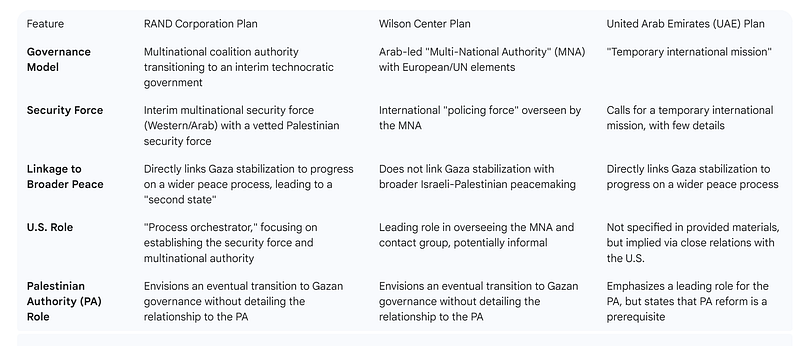
The RAND plan is not the only blueprint for post-conflict Gaza. Proposals from the Wilson Center and the United Arab Emirates share several key features, suggesting an emerging consensus among Western and Arab policy circles.10 All three plans propose an interim international security force and a phased transition to Palestinian self-governance.10
However, significant differences exist. The Wilson Center’s plan calls for an Arab-led “Multi-National Authority” (MNA) and does not explicitly link Gaza stabilization to broader Israeli-Palestinian peacemaking.10 In contrast, the RAND and UAE plans explicitly link the “day after” in Gaza to progress toward a wider peace settlement, signaling a more holistic approach to the conflict.10 This divergence highlights a fundamental strategic disagreement: whether the Gaza crisis should be addressed as a compartmentalized issue or as a crucial first step toward a two-state solution.
The following table provides a detailed comparison of the key elements of these three plans:
3.2. Critiques of the RAND Model
The RAND model, along with others that propose similar external governance structures, has been subject to a trenchant critique. Analysts from the Carnegie Endowment for International Peace argue that the plan facilitates “disaster capitalism”.5 The critique asserts that the model’s reliance on a “multinational coalition authority” and a “security-first” approach is a classic playbook for suppressing local political mobilization and denying Palestinians agency over their future.5
The argument follows a logical, step-by-step progression: by first establishing an external security force, the plan creates a stable environment in which a non-accountable, technocratic government can be installed. The lack of local political oversight then enables the capture of reconstruction funds and facilitates external profiteering from reconstruction and resource extraction, such as the natural gas reserves in the Levant Basin.5 This process, critics argue, ultimately leads not to Palestinian self-determination but to “dispossession,” where public assets are privatized and the local population is denied control of their own future.5 This critique highlights a recurring and fundamental tension in post-conflict reconstruction: the conflict between the need for external, apolitical stability and the principle of local self-determination.
Part IV: Implementation Challenges and Viability
4.1. Domestic Political Obstacles
The most formidable challenges to the RAND framework are not strategic or logistical but political and psychological. Prior RAND research conducted in 2021 found profound animosity and deep distrust between Israelis and Palestinians.4 The analysis revealed that none of the alternatives to the status quo — including a two-state solution, a confederation, or annexation — were acceptable to a majority of both populations.4 The status quo was the only option rated “acceptable” by a majority of Israeli Jews, while it was strongly disliked by Palestinians.4
This finding points to a core political challenge: the “status quo trap.” While the current situation is demonstrably unsustainable in the long run, it is paradoxically the only arrangement that garners majority support from the dominant power. This explains the political paralysis and immense difficulty in generating domestic support for any transformative plan.4 The report concludes that a peaceful resolution requires a fundamental shift in domestic politics and the emergence of “strong and courageous leadership” willing to articulate and pursue a vision for a better future, a factor that has been historically lacking.4
4.2. Long-Term Reconstruction and Financial Hurdles
The physical reconstruction of Gaza presents a logistical and financial challenge of staggering proportions. The costs are estimated to exceed $50 billion over a multi-decade period.2 To illustrate the scale of the task, the report notes that at the pace of rebuilding after the 2014 and 2021 conflicts, it would take 80 years to reconstruct the 79,000 destroyed homes.3 This reality underscores a critical paradox: the urgency of the reconstruction effort is at odds with the typical slow pace of post-conflict recovery.2 The RAND plan’s innovative proposals, such as “future-oriented camps” and “incremental urbanism,” are a direct response to this paradox, intended to accelerate the process while avoiding the failures of past temporary settlements.
The financial component of the plan is also a critical implementation hurdle. The call for substantial financial support from the UK, EU, and Arab states 1 is more than a funding request; it is an attempt to create a powerful economic incentive for all parties to maintain the peace. The reconstruction funds serve as a form of leverage, a “carrot” that complements the security-focused approach. However, securing and managing this multi-billion-dollar effort will require unprecedented levels of international cooperation and oversight to ensure the funds are not diverted or used for purposes that undermine the goals of the plan.
Conclusion: A Hinge Point for Peace
The RAND Corporation’s recommendations for ending the Israel-Gaza conflict represent a comprehensive, holistic, and pragmatic blueprint for a durable peace. The framework is unique in its integration of military insights from the conflict, its phased approach to governance, its historically-informed reconstruction strategies, and its clear delineation of roles for international actors. It is a plan that is deeply rooted in empirical analysis and that acknowledges the profound, multifaceted difficulties of the conflict.
The report’s analysis indicates that while the RAND framework is arguably one of the most detailed and viable options for a two-state solution, its success is fundamentally contingent on political preconditions that remain profoundly absent in the current environment. Prior RAND research has shown that the deep-seated mistrust and skepticism between Israelis and Palestinians, combined with a political preference for the unsustainable status quo, create a powerful obstacle to any transformative change.4 Furthermore, the plan faces a fundamental philosophical critique that its security-first, external-control model risks disempowering Palestinians and enabling a process of “disaster capitalism”.5
In its totality, the RAND report serves less as a ready-to-implement solution and more as a crucial strategic document. It is a detailed map of a road to peace, a road that RAND’s own research indicates remains politically and psychologically difficult to take. Its ultimate value lies in its ability to inform policy, provide a common framework for discussion among international actors, and, perhaps, inspire the “courageous leadership” that has, for so long, been absent.
Works cited
- Pathways to a Durable Israeli-Palestinian Peace | RAND, accessed August 23, 2025, https://www.rand.org/pubs/research_reports/RRA3486-1.html
- From Camps to Communities: Post-Conflict Shelter in Gaza | RAND, accessed August 23, 2025, https://www.rand.org/pubs/research_reports/RRA3486-2.html
- RAND report: Gaza’s reconstruction could take decades with $50 billion price tag, accessed August 23, 2025, https://www.ynetnews.com/article/h1vgwcmpyl
- Alternatives in the Israeli-Palestinian Conflict | RAND, accessed August 23, 2025, https://www.rand.org/pubs/research_reports/RRA725-1.html
- Destruction, Disempowerment, and Dispossession: Disaster …, accessed August 23, 2025, https://carnegieendowment.org/research/2025/07/destruction-disempowerment-and-dispossession-disaster-capitalism-and-the-postwar-plans-for-gaza?lang=en
- Israeli Security After October 7 | Carnegie Endowment for International Peace, accessed August 23, 2025, https://carnegieendowment.org/research/2024/02/israeli-security-after-october-7?lang=en
- Lessons from Israel’s Wars in Gaza — RAND, accessed August 23, 2025, https://www.rand.org/pubs/research_briefs/RB9975.html
- Israel-Hamas War: Insights from RAND, accessed August 23, 2025, https://www.rand.org/topics/featured/israel-hamas-war.html
- The Israel-Gaza Crisis: Three Things to Know | Council on Foreign Relations, accessed August 23, 2025, https://www.cfr.org/video/israel-gaza-crisis-three-things-know
- How “Day After” Governance of Gaza Can Draw from Existing Plans …, accessed August 23, 2025, https://www.washingtoninstitute.org/policy-analysis/how-day-after-governance-gaza-can-draw-existing-plans
- Rand studies make recommendations for a successful Palestinian State — Rand Corporation news release/Non-UN document — Question of Palestine — the United Nations, accessed August 23, 2025, https://www.un.org/unispal/document/auto-insert-196811/