Quantum Leap: Crafting the Ultimate Quantum Computer Engineering Curriculum
Introduction: A New Frontier in Engineering
Introduction: A New Frontier in Engineering
There are rare moments in history when technology doesn’t just advance — it leaps. The steam engine, the transistor, the internet — each opened doors humanity didn’t even know existed. Now, poised at the edge of another revolution, quantum computing stands ready to upend how we solve problems, secure information, and even understand the universe itself. But such revolutionary tools demand new craftsmen. Who will design, build, and refine these strange machines that thrive in the icy stillness near absolute zero, manipulating particles that dance between reality and probability?
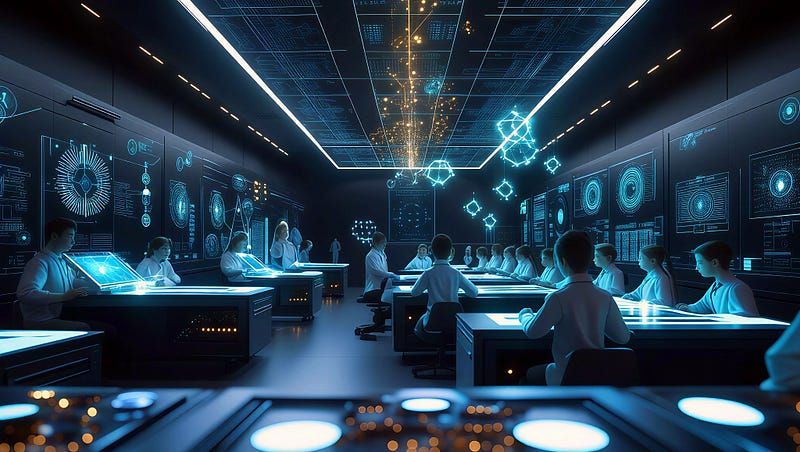
The answer lies in education. To prepare for a world where quantum devices power breakthroughs in medicine, logistics, climate modeling, and artificial intelligence, we need a curriculum that does more than recite equations. We need one that builds engineers fluent in the bizarre language of quantum mechanics while grounding them in the practical realities of building tomorrow’s quantum devices. Here is an ambitious blueprint for a semester-long course — an odyssey into the art and science of quantum computer engineering.
The Curriculum Vision: Forging Quantum Engineers
Setting the Stage: Classical vs. Quantum
Every journey begins with context. Students first encounter a metaphor that captures the heart of quantum computing: the flashlight versus the crystal. A flashlight — steady, binary, reliable — represents the classical computer, churning through problems step by step. But a crystal, glowing and refracting light in many directions at once, embodies the quantum computer — capable of exploring countless possibilities simultaneously.
This section teaches that quantum computers are not replacements for laptops or smartphones; they are specialized instruments. Just as scalpels and sledgehammers both have their place in a toolbox, classical and quantum computers each excel in different arenas. That foundational understanding allows students to appreciate why quantum computing matters and where its limitations lie.
Foundations in Quantum Mechanics: The Strange Rules of the Microcosm
To engineer quantum systems, students must first embrace the weirdness of the quantum world. This portion of the course explores qubits — quantum bits that, unlike their classical counterparts, can exist in superposition, representing both 0 and 1 simultaneously. It introduces entanglement, the eerie phenomenon where two qubits remain linked across vast distances, changing in tandem faster than any signal could travel.
Imagine teaching students to design circuits that use these rules rather than fight them. They learn about wavefunction collapse — the strange act of measurement itself that transforms potential into certainty. The curriculum anchors these ideas with mathematical formalisms, but always circles back to practical applications: How does this help us build better quantum processors? How does it affect hardware choices and error correction strategies?
Quantum Gates and Circuits: Sculpting Quantum Logic
After theory comes architecture. Students design and analyze quantum circuits, learning how single-qubit gates such as Hadamard or Pauli-X transform quantum states, and how multi-qubit gates like CNOT create entanglement on demand. They discover universal gate sets — the “alphabets” of quantum logic — and practice constructing circuits that perform nontrivial computations.
Hands-on labs using platforms like IBM’s Qiskit or Google’s Cirq cement these ideas. Students watch as simulated qubits respond to their code, giving them an engineer’s intimacy with the quantum toolkit.
Algorithms Beyond Classical Limits
Here, the course takes flight, showing how quantum algorithms surpass classical methods. Deutsch-Jozsa and Bernstein-Vazirani introduce the notion of quantum parallelism, solving problems with a single pass through the data. Grover’s Search reduces exhaustive searches from years to mere moments, while Shor’s Algorithm reveals the unsettling power of quantum machines to crack encryption once thought unbreakable.
Students not only learn these algorithms but also implement them, exploring why some are ripe for near-term applications while others remain theoretical beacons.
Hardware in the Real World: From Superconductors to Photons
A good engineer knows their materials. This module delves into hardware platforms driving quantum research today. Superconducting qubits, used by IBM and Google, rely on loops of super-cooled metal, while IonQ’s trapped-ion approach uses lasers to suspend atoms in midair. Topological qubits, still experimental, promise stability by encoding information in exotic particles called Majorana fermions.
Students compare these platforms, exploring scalability challenges and the engineering trade-offs that come with each. They learn why maintaining qubits at temperatures colder than deep space is necessary and why even stray magnetic fields can sabotage computations.
Quantum Error Correction: Guarding Against Fragility
Here, the course confronts a hard truth: Qubits are fragile. Decoherence — loss of quantum information — happens in an instant. Students study error-correcting codes like Shor’s and Steane’s, learning how to encode a single logical qubit into many physical qubits to protect it from errors. They implement these codes in lab exercises, watching firsthand as noisy data is restored to clarity.
Quantum Networking: Communication in the Quantum Age
In an age obsessed with cybersecurity, quantum communication stands out like a beacon. Students explore quantum key distribution, protocols such as BB84 and E91, and the dream of a quantum internet where eavesdropping is not just difficult but fundamentally impossible. They simulate teleportation experiments, grasping how entanglement can transmit information without moving particles.
Hybrid Quantum-Classical Computing: A Bridge Between Worlds
Quantum computing won’t replace classical computing; it will augment it. This module teaches hybrid algorithms like Variational Quantum Eigensolvers (VQE) and Quantum Approximate Optimization Algorithms (QAOA), which leverage classical processors to guide quantum systems through complex landscapes. Case studies from chemistry, finance, and machine learning highlight the practical power of these methods.
Quantum AI: The New Horizon
Students peek into the future, where quantum-enhanced machine learning transforms how we analyze data. Quantum neural networks and quantum Boltzmann machines hint at AI models that learn patterns far beyond today’s reach, revolutionizing industries from healthcare to logistics.
Ethics and Societal Implications: A Call to Responsibility
Technology is never neutral. A truly transformative curriculum doesn’t stop at equations; it challenges students to ask hard questions. What happens when quantum computers break encryption that protects global banking systems? How should societies prepare for the disruptive effects on industries and employment? This module invites deep reflection, ensuring graduates leave not just as engineers but as thoughtful stewards of quantum technology.
Labs and Hands-On Learning: Where Theory Meets Reality
Each week integrates labs that push students to implement what they’ve learned. From designing simple quantum circuits in Qiskit to running experiments on real IBM Quantum hardware, these sessions provide tactile understanding. Students might simulate quantum key distribution protocols or run error correction demonstrations, gaining the confidence that comes only from hands-on practice.
Capstone Projects: Engineering Tomorrow’s Quantum Tools
The semester culminates in final projects — open-ended challenges that encourage creativity and innovation. Students might design a quantum optimization algorithm, implement a cryptographic protocol, or explore new error mitigation techniques. They present their work, not as mere assignments, but as contributions to the growing frontier of quantum engineering.
Conclusion: Building the Architects of a Quantum World
This curriculum is more than a course outline — it is a vision for cultivating the engineers who will shape the quantum era. By weaving together theoretical rigor, practical engineering, and ethical reflection, it prepares students not just to use quantum computers but to design and improve them.
The quantum revolution is coming. The only question is who will be ready to lead it. With courses like this, the answer could be you.