Salt of the Marsh: The Wild Elegance of Samphire (Salicornia europaea)
Introduction Samphire, also known as sea asparagus or glasswort, is one of the ocean’s most quietly luxurious gifts. Growing along tidal…
Introduction
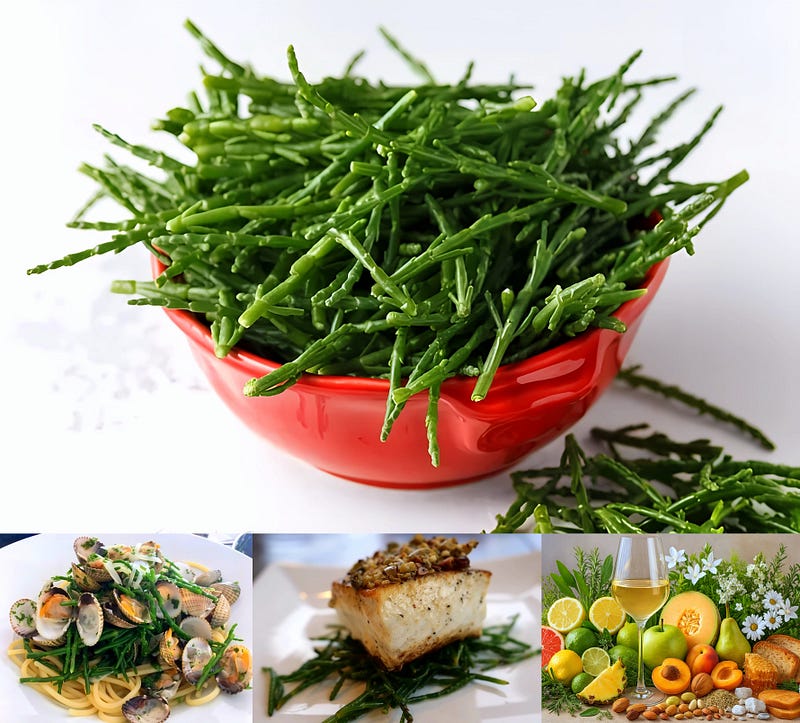
Samphire, also known as sea asparagus or glasswort, is one of the ocean’s most quietly luxurious gifts. Growing along tidal flats and salt marshes, this briny green succulent captures the taste of the sea without a drop of salt added. Its crisp texture and mineral tang have made it a prized delicacy in fine dining, while its ecological importance has positioned it as a cornerstone of coastal sustainability. Samphire represents a rare intersection of gastronomy, botany, and environmental stewardship — a plant both ancient and newly relevant in the era of climate resilience and regenerative food systems.
Taxonomy
Salicornia europaea belongs to the family Amaranthaceae and the subfamily Salicornioideae. Its genus, Salicornia, comprises several salt-tolerant annual succulents known collectively as glassworts due to their historic use in soda ash production for glassmaking. Common names include samphire (English, UK), sea asparagus (English, USA and Canada), passe-pierre (French, France), salicornia (Italian, Spain), and saltwort (English, coastal Europe). In Korea, it is known as “hamcho” (함초), and in Japan as “ashibamodoki.” The species is native to the coasts of Europe, North Africa, and parts of Asia, but has naturalized along saline soils in North America.
Biology
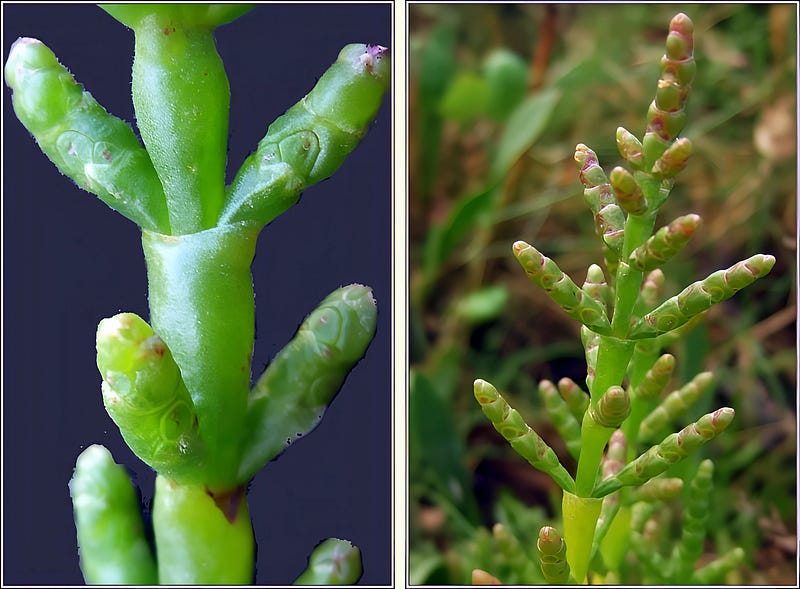
Samphire’s structure is a study in adaptation. It lacks true leaves, instead forming jointed, fleshy stems that retain water and resist desiccation in saline environments. The plant rarely exceeds 12 in (30 cm) in height. Flowers are minute and embedded within the joints, producing tiny seeds adapted for dispersal by water. It is an annual halophyte, germinating in spring and flowering through summer, with a full life cycle completed by early autumn. Its salt tolerance arises from specialized vacuoles that compartmentalize sodium ions, preventing cellular toxicity. This mechanism has drawn agronomic interest for future saline agriculture models.
Ecology
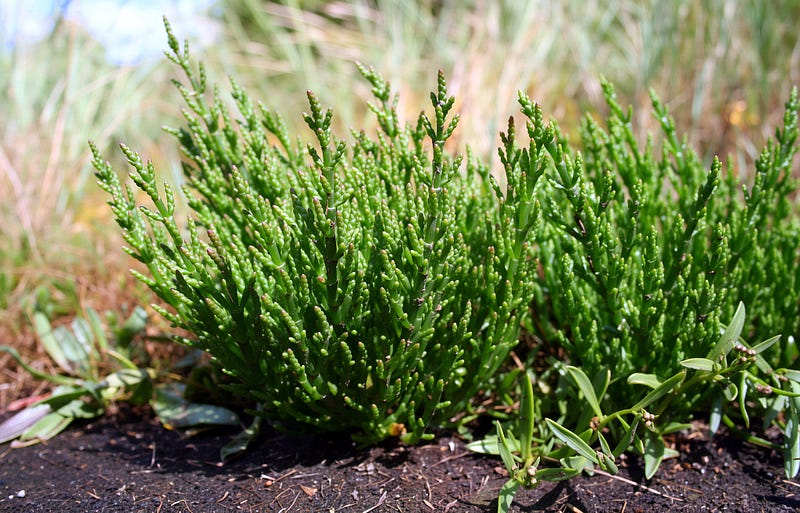
Salicornia europaea thrives in intertidal zones, coastal mudflats, and salt marshes. It plays a critical role in stabilizing sediment, filtering runoff, and providing habitat for microfauna and juvenile fish. The plant’s carbon sequestration potential, while modest compared to forests, is notable for its niche — approximately 1.8 metric tons of CO₂ per hectare per year (1.6 short tons per acre). Samphire cultivation requires minimal freshwater, fertilizer, or arable land, making it ideal for sustainable coastal farming. Its resilience positions it as a candidate for biosaline agriculture and marshland restoration projects worldwide.
Uses
Edible parts include the tender green shoots harvested before lignification in midsummer. They are eaten raw, blanched, sautéed, or pickled. In culinary form, samphire appears in seafood dishes, risottos, salads, and tempura. Yield averages 5–8 metric tons per hectare (4,460–7,140 lb per acre) under managed cultivation. Energy content stands at 22 kcal per 100 g (0.22 kcal per g), with key nutrients including sodium, potassium, magnesium, vitamin C, and beta-carotene.
The plant contains no major antinutrients but requires blanching to reduce salinity. Commercial samphire is processed into pickles, sea salt blends, and gourmet condiments. Taste is saline and herbaceous, with an aroma reminiscent of sea breeze and a crisp, juicy texture. When cooked, it retains a satisfying crunch. Optimal cooking methods include brief blanching in boiling water for 30 seconds, followed by immediate chilling in ice water to preserve color and texture.
Medicinally, extracts of Salicornia europaea have demonstrated antioxidant and hepatoprotective effects in preliminary studies, attributed to betaine and ferulic acid content. Dosage forms include powders and tinctures, but regulatory approval remains limited. Traditional Korean medicine uses hamcho for liver support and blood pressure regulation.
As livestock feed, the plant’s high mineral content limits its use to small inclusion ratios, typically below 10% of the feed mix. However, its silage potential in saline regions offers niche benefits. Industrial applications include bioethanol production and use as a halophytic biomass source for renewable energy. The ash content — rich in sodium carbonate — was once vital for glass and soap manufacture, hence its English name “glasswort.”

In soil reclamation, samphire aids desalination and prevents erosion. Its invasiveness risk is low due to habitat specialization. It supports pollinators in limited ways but provides nesting substrate for waders and marsh birds. Restoration programs in Europe and the Middle East use samphire to rehabilitate saline coastal plains, integrating it into carbon capture and aquaculture co-production systems.
Market demand has expanded sharply, driven by the farm-to-table movement and high-end restaurants. Wholesale prices range from USD 8 to 15 per pound (USD 17.6–33.1 per kg) depending on season and origin. Major producers include the Netherlands, the UK, and South Korea, with certification often linked to organic or sustainable aquaponics operations. Harvesting is regulated in many regions to prevent wild population depletion.
Culinary Aspects
Samphire’s taste profile is bright, salty, and mineral-rich, with grassy undertones and a crisp bite. The flavor complexity recalls fresh spinach mingled with ocean spray. Its aftertaste carries a slight umami note derived from natural glutamates. When sautéed in butter or olive oil, the vegetal sharpness mellows into a nutty sweetness.
The texture — succulent yet firm — delivers excellent contrast in seafood preparations. In British cuisine, it often accompanies steamed mussels or poached cod. In French gastronomy, samphire appears alongside scallops in beurre blanc. Korean cooks pickle it in vinegar for a tangy side dish called hamcho jangajji. Nutritionally, it provides hydration and micronutrients with minimal calories, fitting both gourmet and health-conscious diets.
Wine Pairings
For raw or lightly blanched samphire salads, a Muscadet Sèvre-et-Maine from the Loire Valley aligns perfectly. Its brisk acidity and saline minerality echo the plant’s oceanic profile. When paired with butter-poached fish and samphire, a Vermentino di Gallura from Sardinia complements the dish with citrus notes and a faint herbal finish, enhancing mouthfeel balance. For pickled samphire served as a garnish with cured mackerel, a dry Fino sherry from Jerez provides the oxidative depth and briny resonance that mirror coastal intensity. In East Asian preparations — such as tempura samphire — a Junmai Ginjo sake offers umami continuity while cutting through residual salt with polished rice sweetness. For rich shellfish bisques incorporating sautéed samphire, a Santorini Assyrtiko delivers high-tension acidity and volcanic minerality, uniting land and sea flavors in perfect equilibrium.
Conclusion
Salicornia europaea embodies a model of sustainable gastronomy — ancient in use, modern in relevance. Its ability to grow where little else can makes it a symbol of adaptation in a warming world. As chefs rediscover its culinary versatility and conservationists harness its ecological functions, samphire stands as proof that the future of food may lie not on the plowland but in the tide.