Sanctified and Vilified: The Divergent American Narratives of the Boston and Kent State Massacres
The American narrative of protest is not a consistent chronicle of principle but a selective tradition shaped by the volatile alchemy of…
The American narrative of protest is not a consistent chronicle of principle but a selective tradition shaped by the volatile alchemy of narrative control, victim identity, and political expediency. The starkly different national responses to the Boston Massacre of 1770 and the Kent State shootings of 1970 reveal a fundamental hypocrisy in how the nation sanctifies and vilifies dissent. This analysis examines the historical contexts, divergent public perceptions, media portrayals, and political repercussions of these two events, arguing that the designation of martyr is a political construct rather than an inherent quality, a pattern that continues to inform the reception of modern social movements.
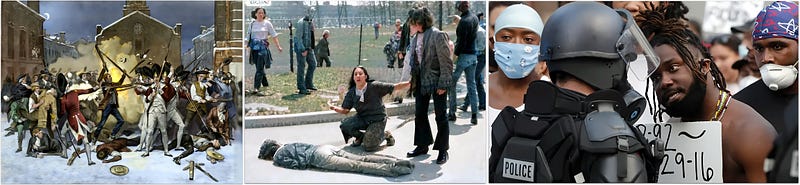
The Boston Massacre occurred within a tinderbox of colonial resentment over British taxation and the presence of occupying troops. The shooting itself, a chaotic confrontation on King Street, was rapidly distilled into a potent symbol of tyranny through a deliberate and sophisticated propaganda campaign. Patriots like Paul Revere engineered what could be termed an eighteenth-century version of fake news, creating an engraving that wildly misrepresented the event. His print depicted a coordinated volley by brutish soldiers upon a peaceful, well-dressed crowd, erasing the reality of a hostile mob and a panicked, disjointed response. This narrative fabrication was designed for emotional impact and rapid dissemination, transforming the fallen colonists, including Crispus Attucks, into sainted martyrs for a unifying cause. Their funeral became a massive political demonstration, and their story was woven into the very fabric of the national founding myth.
In contrast, the Kent State shootings a century later elicited a profoundly different national reaction. The students protesting the Vietnam War’s expansion into Cambodia were challenging their own government during a period of deep internal division. When the Ohio National Guard fired into the crowd, killing four students, the power of the narrative was wielded not to sanctify them, but to vilify them. Political leaders set the tone, with figures like Governor James Rhodes labeling the protesters the worst type of people and President Nixon characterizing them as bums. This framing influenced media coverage, which often emphasized the preceding unrest and allowed for justifications of the Guardsmen’s actions. Consequently, a significant portion of the public perceived the students not as victims of state violence but as responsible for their own deaths. Their identities as privileged youths protesting a war further alienated a silent majority that saw their dissent as unpatriotic rather than legitimate.
The political repercussions of each event further underscore this divide. The Boston Massacre had severe consequences for British authority, leading to the withdrawal of troops and becoming a direct precursor to the organized resistance of the American Revolution. The victims were instrumentalized to rally opposition and justify rebellion. At Kent State, however, the political consequences demonstrated the limits of accountability. While the shootings galvanized the anti-war movement and led to a national student strike, there were no criminal convictions of the Guardsmen. The lack of legal repercussions signaled a failure to hold state power accountable for the use of lethal force against citizens, reinforcing the narrative that the victims were not worthy of full justice.
This hypocrisy in attitude reveals that historical memory is dictated less by the objective facts than by the power to control the story. The enduring lesson is that America’s venerated tradition of dissent is a highly selective myth. The nation sanctifies only those challengers, like the Boston rioters, whose stories can be co-opted into a triumphant national saga. It systematically vilifies those, like the Kent State students, whose dissent poses a fundamental threat to the prevailing structures of power. This framework directly informs the reception of modern protest movements. Groups such as antifa, anti-ICE, and Trans-rights activists, who challenge foundational state authority and social hierarchies, are consistently met with the Kent State paradigm. Their legitimate dissent is framed as illegitimate violence, their identities are weaponized against them, and any state violence they suffer is rationalized as a necessary cost of maintaining order. The hierarchy of grief remains a potent tool of political control, determining which lives are mourned as national tragedies and which are dismissed as collateral damage.