The Architect of a Constrained Vision: The Intellectual Contributions and Personal Ethos of Thomas…
Sowell’s life shaped his shift from Marxism to empirical free‑market thought. He argues policies often backfire, disparities stem from culture and history, and intellectuals trust theory over results. His legacy blends influence, controversy, and a “tragic vision” of limits.
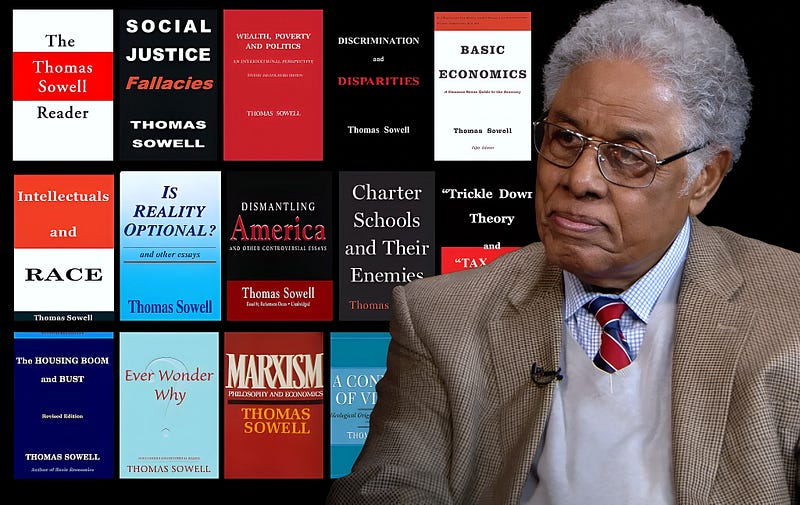
The Architect of a Constrained Vision: The Intellectual Contributions and Personal Ethos of Thomas Sowell
The Crucible of Experience: Formative Influences and Ideological Evolution
Thomas Sowell’s intellectual contributions are inextricably linked to his personal history, which provides the empirical foundation for his most enduring ideas. His life is not merely a biographical timeline; it is the living embodiment of the principles he champions. This is a journey that began in the segregated South of the 1930s, where he was born into poverty in Gastonia, North Carolina, and was raised by a great-aunt after his father’s death.1 As a child, he became part of the Great Migration, moving with his family to Harlem, a neighborhood he would later describe as “grim and sometimes dangerous”.1 Despite these difficult circumstances, his intellectual aptitude was evident early on, and he excelled in integrated public schools, even winning admission to the prestigious Stuyvesant High School. However, his life took a different turn when, at the age of 16, he was forced to drop out of school to find work, leaving home a couple of years later.2
His path back to academia began after a period of service in the U.S. Marine Corps during the Korean War.1 The G.I. Bill enabled him to enroll in Howard University, a historically black institution, from which he later transferred to Harvard University.1 His academic ascent continued with degrees from Columbia University and the University of Chicago, where he earned a PhD in economics.3 His teaching career at various institutions, including Cornell and UCLA, was often marked by friction, as he insisted on maintaining high academic standards and refused to lower them in response to student complaints or institutional pressure.3 This uncompromising stance on intellectual rigor ultimately led him to a non-teaching role as a senior fellow at the Hoover Institution, where he found the freedom to dedicate his time to writing.2 This biographical narrative establishes a direct connection between his early struggles and his later intellectual positions. His advancement was not the result of special privileges or legislative measures but a consequence of his personal discipline, hard work, and intellectual capacity. This lived experience serves as the initial, and perhaps most powerful, piece of evidence for his worldview, shaping his later beliefs about self-reliance and the limitations of social engineering.
Sowell’s ideological transformation from a young Marxist to a prominent free-market economist is a crucial element of his intellectual story.1 In his twenties, he was a staunch follower of Karl Marx, and one of his earliest publications was a sympathetic exploration of Marxist thought.5 However, this theoretical commitment was shaken by a single, powerful empirical finding. While conducting research for the U.S. Department of Labor on the sugar industry in Puerto Rico, he observed a pattern that contradicted his ideological assumptions: federal minimum wage laws appeared to be causing increased unemployment among sugar workers.1 This data-driven revelation began to “erode his faith in government programs” and the theoretical probabilities that had previously guided his thinking.2 This intellectual shift was solidified during his time at the University of Chicago, where he studied under the Nobel laureate Milton Friedman.2 Sowell has noted that despite their differing backgrounds, their shared devotion to “intellectual standards and intellectual argumentation” forged a bond that further cemented his reliance on empirical evidence over abstract ideology.2 His journey from a theoretical Marxist to a pragmatic, data-driven economist illustrates the central theme of his work: that the real-world consequences of policies are far more important than the intentions behind them. This intellectual causality establishes his authority, demonstrating that his arguments are not born of political dogma but are the hard-won conclusions of a mind that has followed evidence wherever it leads, even if it contradicts a deeply held personal belief.
The Intellectual Contributions: Core Arguments and Major Works
Sowell’s prolific body of work, spanning more than fifty books, essays, and columns, is organized around a handful of deeply intertwined arguments that challenge conventional wisdom across a range of subjects.1 A core principle found throughout his writings is the “perversity thesis,” which asserts that well-intentioned government policies and social programs often lead to unintended, and even counterproductive, consequences.2 This theme, first crystallized by his research in Puerto Rico, is applied to a variety of topics.
In works like The Housing Boom and Bust and Basic Economics, he argues that policies such as rent control and minimum wage laws, while designed to help the poor, consistently result in housing shortages and unemployment.5 He also posits that the 2008 housing crisis was largely a result of government interventions.1 This perspective forms the bedrock of his critique of centralized planning and his defense of free markets, emphasizing a focus on what policies actually achieve rather than what they are promised to do.9
A significant portion of Sowell’s intellectual career has been dedicated to a rigorous, data-driven analysis of race and ethnicity, a field where he argues public discourse is often dominated by emotional rhetoric rather than empirical facts.6 In seminal works like Race and Culture: A World View, Wealth, Poverty, and Politics, and Ethnic America, he contends that vast disparities in income and wealth are the historical norm across different groups and nations, and are not solely, or even primarily, the result of a single cause like discrimination.10 He attributes these differences to a complex interplay of geography, demography, and culture.10 He cites examples such as the economic isolation created by geographic barriers like deserts and mountains, and the unequal economic outcomes that arise from differing median ages among ethnic groups.10
His most controversial argument on the topic, detailed in Black Rednecks and White Liberals, posits that the “dysfunctional ghetto culture” often associated with African Americans originated in the culture of a specific group of Scotch-Irish immigrants who settled the antebellum South.13 He argues that this “cracker culture,” marked by a disdain for education, violence, and promiscuity, was adopted by black communities and, unlike with white communities, was not effectively eroded over time.14 Sowell’s analysis of racial disparities is an attempt to shift the public debate from a moralistic condemnation of racism to a more nuanced, empirical inquiry into the multi-causal factors that actually produce progress. His core argument is that real income is a product of cultural “inputs,” and that a failure to recognize this complexity leads to simplistic and ultimately destructive social policies.12
A key application of this framework is his prominent and outspoken opposition to affirmative action.4 In his book Affirmative Action Around the World, he argues that such policies not only discriminate against whites and Asians but also harm their intended black beneficiaries.10 His “mismatch” theory suggests that affirmative action places black students in schools for which they are not academically prepared, leading to higher dropout rates than they would have experienced at a less prestigious institution.10 He also claims that the benefits of these programs disproportionately flow to individuals who are already better off.4 Sowell’s work on race has, however, drawn significant criticism. Reviewers and scholars have argued that he downplays or ignores the lingering historical and structural forces that have shaped black communities, such as the destructive effects of slavery and systemic racism.2 Critics point to specific examples of the destruction of black wealth by the U.S. government, such as the closing of the Freedman’s Bank and the destruction of Black Wall Street, as counter-arguments to his focus on cultural pathology.15 A scholarly review of Discrimination and Disparities notes that while it agrees with Sowell’s definitions, it takes issue with his dismissal of the possibility of government intervention improving outcomes and his downplaying of the role of unequal opportunity in creating disparities.16
The Philosophical Framework: Visions, Knowledge, and the Limits of Reason
Sowell’s philosophical contributions provide the intellectual foundation for his arguments on economics and social policy. His most important work, A Conflict of Visions, presents a framework for understanding political and ideological struggles as fundamentally rooted in two competing “visions” of human nature rather than merely conflicts of interest.5
The Constrained Vision is described as a “tragic vision of the human condition”.17 It is based on the premise that human nature is fundamentally flawed, unchanging, and limited by inherent “passions and limitations”.17 Proponents of this view believe that a perfect society is an unattainable ideal and that the best one can hope for is a series of “trade-offs, rather than solutions”.20 This vision places a profound reliance on the accumulated wisdom of tradition and time-tested institutions to manage these limitations, favoring spontaneous order and the equal application of rules over central planning.17 The concept of “constraint” here is not about self-discipline but a statement about the inherent limitations of human capabilities for knowledge and goodness.18 This perspective underpins Sowell’s entire classical liberal philosophy, seeing society as an intricate web of interactions that cannot be fully controlled or understood by a single authority.
In contrast, the Unconstrained Vision is utopian in its outlook, holding that human nature is perfectible and that societal problems such as poverty and injustice are the result of “changeable institutions”.17 This vision places its faith in individual human reason, or what Sowell calls “articulated rationality,” and believes that a select group of “superior intellects” can create an “earthly paradise” through “bold experiments”.20 It is a view concerned with achieving equal results, even if it requires a powerful, centralized state and judicial activism to override existing rules and traditions.17 This is the vision Sowell systematically critiques throughout his career, seeing it as fundamentally unrealistic and dangerous.
The philosophical underpinnings of the constrained vision are detailed in Knowledge and Decisions.5 Here, Sowell argues that knowledge in a complex society is not centralized in the hands of a few experts, but is “radically dispersed” among millions of individuals.6 He famously states that “Ideas are everywhere, but knowledge is rare,” emphasizing that the vast, fragmented, and often unspoken knowledge required to make a society function cannot be aggregated or managed by a central planner.6 Any attempt to do so is inherently flawed and destined for failure.8 This argument extends beyond economic planning, applying to a broad range of human activities where centralized decision-making is proposed.6 The two central philosophical concepts — the conflict of visions and the theory of dispersed knowledge — are not separate ideas but are inseparably linked. The profound difference between the two visions stems directly from a core epistemological distinction: the belief that knowledge is centralized and accessible to experts (the unconstrained vision) versus the belief that knowledge is decentralized and dispersed (the constrained vision). The hubris of the unconstrained vision, in this framework, is its failure to grasp this fundamental reality, which in turn explains why its attempts at social engineering lead to unintended and negative consequences.
The Psychology of the “Anointed”: A Critique of the Intellectual Class
In his works, particularly Intellectuals and Society and The Vision of the Anointed, Sowell turns his analytical focus on the intellectual class, providing a psychological and sociological perspective on his core philosophical ideas. Sowell defines an intellectual not as someone who applies knowledge, like an engineer or a doctor, but as a “dealer in ideas” whose primary function is to generate and disseminate concepts.21 He argues that this group is often driven by an “anointed” vision, a belief in their own moral and intellectual superiority that enables them to propose and implement what they see as “solutions” to societal problems.20 Sowell interprets this as a form of intellectual hubris, the “imagining that one can judge merit” based on abstract notions rather than on concrete, verifiable performance and results.22 He cites historical figures such as Woodrow Wilson and John Maynard Keynes as examples of intellectuals whose academic arrogance and faith in centralized planning led to disastrous real-world outcomes.20
A central element of Sowell’s critique is that the intellectual class has developed a system of validation that is largely insulated from empirical reality.21 Unlike professions like engineering or medicine, where a failure is often undeniable and immediate, the negative consequences of an intellectual’s idea can be easily “explained away” by blaming other factors.7 The validation of their ideas, Sowell argues, is based on a consensus within the intellectual community rather than on real-world outcomes.10 He contends that this system allows intellectuals to promote ideas that do not properly reflect how a society actually works.21 He also identifies several rhetorical tactics used by the “anointed” to maintain their position, such as dismissing their opponents’ arguments as “simplistic” or preemptively claiming the moral high ground to avoid a factual debate.20 He suggests that this modern intellectual class functions as a secular equivalent of a priestly class, whose power is derived from faith in their theories rather than from verifiable results.23 This critique is a psychological extension of Sowell’s core philosophical and epistemological arguments. The progression is clear: the belief in the unconstrained vision leads to an intellectual hubris, which in turn allows intellectuals to promote abstract ideas and avoid accountability for the negative consequences that follow. It explains why destructive ideas, however well-intentioned, can persist and gain traction within society.
A Legacy of Consequence: A Concluding Assessment of Impact and Influence
Thomas Sowell’s intellectual legacy is complex, marked by both widespread admiration and sharp criticism, placing him as a major figure in American public life. As a leading intellectual in Black conservatism, he has provided a powerful counter-narrative to the idea that racial identity must determine political ideology.9 His views have influenced prominent figures such as U.S. Supreme Court Justice Clarence Thomas.2 His political identity is best described as a fusion of libertarian and conservative principles, with a core belief in the primacy of personal responsibility, self-effort, and free markets.9 He has self-identified as a libertarian but maintains a distance from the movement on certain issues, such as national defense.5
The reception of Sowell’s work is sharply divided, often along ideological lines, with conservative and right-leaning critics offering praise, while politically central and left-leaning publications provide criticism.11 His admirers commend his directness, intellectual honesty, and his willingness to use empirical evidence to challenge popular superstitions.3 He has been formally recognized for his contributions, receiving the National Humanities Medal in 2002.3 However, his academic reception is more mixed. He is criticized from within the economics and sociology fields for his methodology, with critics noting that his work, while rich in data and anecdotes, is often normative rather than positive and that many of his major publications are not peer-reviewed.25 Furthermore, he is accused of intellectual hubris, of commenting with authority on subjects outside his primary field of economics — a practice he critiques in others.7
The central tension of Sowell’s legacy lies in the paradox of his own intellectual stance. He built his reputation by operating largely outside the traditional academic system, publishing books for a general audience rather than peer-reviewed papers.5 He is seen as a “maverick” who critiques intellectual hyperspecialization while himself delving into a wide array of disciplines, including psychometrics, criminology, and law.3 The core of his public credibility lies in this paradox; he is perceived as a credible voice because he is seen to be outside the very intellectual establishment he critiques, even though he is a product of its highest echelons. This makes his legacy not just a collection of powerful ideas, but a living case study of the complex relationship between academic rigor and public intellectualism. His consistent focus on the tragic gap between good intentions and real-world results leaves a profound and enduring mark on contemporary social and political thought.
Works cited
- The triumph of Thomas Sowell | The New Criterion, accessed August 24, 2025, https://newcriterion.com/article/the-triumph-of-thomas-sowell/
- Thomas Sowell | Biography, Books, Economics, Conservatism …, accessed August 24, 2025, https://www.britannica.com/biography/Thomas-Sowell
- Thomas Sowell | EBSCO Research Starters, accessed August 24, 2025, https://www.ebsco.com/research-starters/literature-and-writing/thomas-sowell
- Thomas Sowell — National Endowment for the Humanities, accessed August 24, 2025, https://www.neh.gov/about/awards/national-humanities-medals/thomas-sowell
- Thomas Sowell — Wikipedia, accessed August 24, 2025, https://en.wikipedia.org/wiki/Thomas_Sowell
- The immortal Sowell | American Enterprise Institute — AEI, accessed August 24, 2025, https://www.aei.org/articles/the-immortal-sowell/
- Thomas Sowell Is a Cynical Man — Jacobin, accessed August 24, 2025, https://jacobin.com/2024/03/sowell-cynical-social-domination-conservatism
- Tom Sowell in Practice and Theory — Claremont Review of Books, accessed August 24, 2025, https://claremontreviewofbooks.com/tom-sowell-in-practice-and-theory/
- Sowell, Thomas (1930-): A Libertarianism.org Guide, accessed August 24, 2025, https://www.libertarianism.org/topics/sowell-thomas-1930
- Thomas Sowell, An Intellectual Giant | Hoover Institution Thomas …, accessed August 24, 2025, https://www.hoover.org/research/thomas-sowell-intellectual-giant
- Wealth, Poverty and Politics — Wikipedia, accessed August 24, 2025, https://en.wikipedia.org/wiki/Wealth,_Poverty_and_Politics
- Race, Culture, and Equality | Hoover Institution Race, Culture, and …, accessed August 24, 2025, https://www.hoover.org/research/race-culture-and-equality
- Black Rednecks and White Liberals — Wikipedia, accessed August 24, 2025, https://en.wikipedia.org/wiki/Black_Rednecks_and_White_Liberals
- Thomas Sowell on Redneck Culture — White and Black — Curtis Bowman, accessed August 24, 2025, https://bowman.typepad.com/cubowman/2005/05/thomas_sowell_o.html
- Dr. Thomas Sowell’s Myths of Economic Inequality — Mississippi Free Press, accessed August 24, 2025, https://www.mississippifreepress.org/white-supremacy-vs-negro-ineptitude-sowells-myths-of-economic-inequality/
- A Review of Thomas Sowell’s Discrimination and Disparities — Jennifer Doleac, accessed August 24, 2025, https://jenniferdoleac.com/wp-content/uploads/2022/12/Doleac_bookreview_JEL.pdf
- econfaculty.gmu.edu, accessed August 24, 2025, https://econfaculty.gmu.edu/bcaplan/sowell
- Thomas Sowell argues political disagreements are not conflicts of interests but “conflicts of visions”. The “Unconstrained” Utopians believe human nature is perfectible while the “Constrained” believe that humans are inherently (though not necessarily essentially) selfish and greedy : r/philosophy — Reddit, accessed August 24, 2025, https://www.reddit.com/r/philosophy/comments/y4s2la/thomas_sowell_argues_political_disagreements_are/
- A Conflict of Visions: Ideological Origins of Political Struggles — Goodreads, accessed August 24, 2025, https://www.goodreads.com/book/show/3047.A_Conflict_of_Visions
- Thomas Sowell’s Field Guide to Intellectuals — Mackinac Center, accessed August 24, 2025, https://www.mackinac.org/12152
- Intellectuals and Society — Academy of Ideas, accessed August 24, 2025, https://academyofideas.com/2016/09/intellectuals-and-society-sowell/
- Quote by Thomas Sowell: “The hubris of imagining that one can judge meri…” — Goodreads, accessed August 24, 2025, https://www.goodreads.com/quotes/10230176-the-hubris-of-imagining-that-one-can-judge-merit-as
- Intellectuals and Libertarianism: Thomas Sowell and Robert Nisbet, accessed August 24, 2025, https://www.libertarianism.org/columns/intellectuals-libertarianism-thomas-sowell-robert-nisbet
- A Blueprint for Freedom: The Classical Liberal Path to Prosperity — Econlib, accessed August 24, 2025, https://www.econlib.org/a-blueprint-for-freedom-the-classical-liberal-path-to-prosperity/
- Why do people dislike Thomas Sowell? : r/AskEconomics — Reddit, accessed August 24, 2025, https://www.reddit.com/r/AskEconomics/comments/sqazbv/why_do_people_dislike_thomas_sowell/