The Bitter Heart of the Cherry Tree: Exploring the Legacy and Flavor of Mahaleb (Prunus mahaleb)
Introduction Tucked away in the forgotten corners of Mediterranean woodlands and Central Asian slopes grows a tree whose name few know, but…
Introduction
Tucked away in the forgotten corners of Mediterranean woodlands and Central Asian slopes grows a tree whose name few know, but whose seeds have seasoned bread and lore for centuries. Prunus mahaleb, or mahaleb cherry, is not your ordinary cherry tree. It is a relic of culinary antiquity, a botanical mystery, and a living bridge between old-world tradition and modern sustainability. As the culinary world rediscovers ancient flavors, the bitter almond-scented kernel of this wild cherry has found its way from village ovens to artisan bakeries, luring curious palates and conservationists alike.
Taxonomy
Belonging to the Rosaceae family, Prunus mahaleb is closely related to cherries, plums, and almonds. Its scientific name honors the Arabic mahlab, the spice made from its seeds. Known also as the St. Lucie cherry, this species does not produce the juicy drupes familiar to lovers of sweet cherries like Prunus avium. Instead, its fruit is small, dark, and intensely bitter — nature’s decoy, guarding a treasure within. While there are no formally recognized subspecies, regional varieties exist across the Balkans, Middle East, and North Africa, each adapted to its microclimate and soil type. In Turkey and Greece, where the kernel is prized as mahlep, its use in festive breads and dairy desserts is as old as folklore itself.

Biology
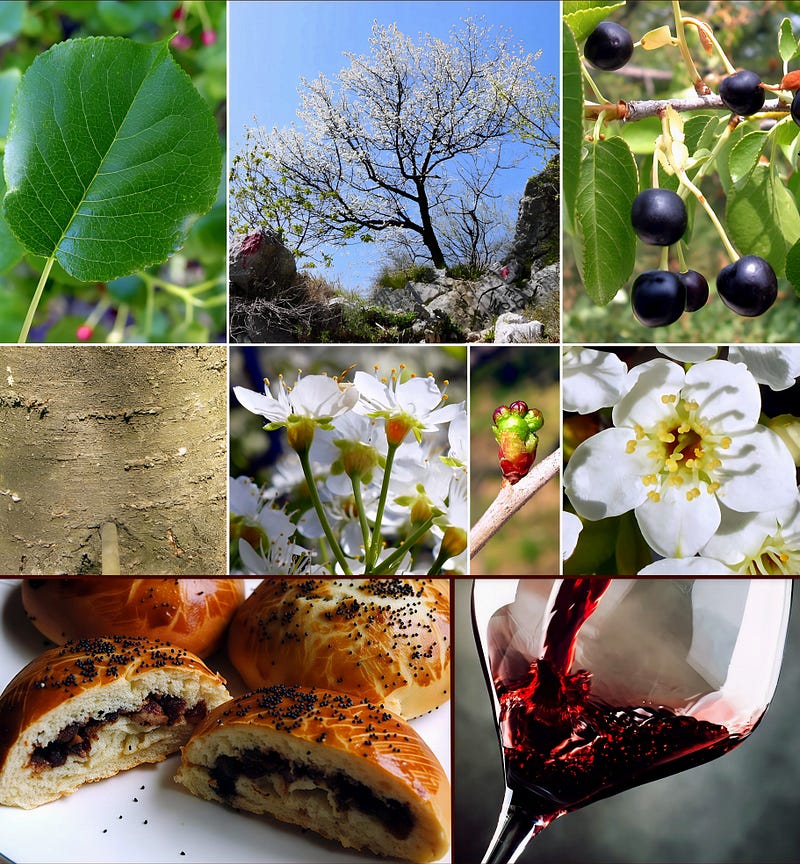
A small deciduous tree, Prunus mahaleb rarely exceeds 33 ft, or 10 m in height. Its bark peels in papery layers and releases an aroma reminiscent of almond and vanilla when scraped. It flowers in early spring, producing cascades of fragrant white blossoms that feed bees before fruiting begins. By early summer, the tiny cherries ripen — typically no larger than 0.4 in, or 1 cm in diameter — shiny black and almost inedible due to their astringency. Yet within each pit lies the kernel, the culinary prize: oval, beige, and redolent of coumarin, a compound also found in tonka beans and cinnamon. The tree thrives in dry, rocky soils, tolerates extreme cold down to 5°F or -15°C, and needs little irrigation — making it a poster child for climate-adapted agriculture.
Ecology
Native to southeastern Europe and western Asia, Prunus mahaleb plays an important role in dryland ecosystems. Its deep roots stabilize poor soils, while its early blossoms offer nectar to native pollinators, and its fruits feed birds and small mammals. It grows wild on limestone outcrops, hillsides, and forest margins, where it serves as pioneer vegetation in disturbed or marginal habitats. Though not endangered, its range has shrunk in parts of the Middle East due to overgrazing and land conversion. Conservation-minded growers are now encouraging its reintroduction in agroforestry systems, where it doubles as a pollinator ally and a source of wild spice. When used as a rootstock for sweet cherry cultivars, it imparts disease resistance and drought tolerance, reducing the need for pesticides and irrigation — two pillars of sustainable fruit production.
Uses
Beyond its culinary fame, Prunus mahaleb has carved out a quiet but significant niche in sustainable agriculture. Its wood, fine-grained and honey-hued, is favored by carvers for musical instruments and pipe-making. In traditional medicine, extracts from the bark and seeds were once prescribed for stomach ailments and respiratory issues. Commercially, the kernel is harvested, dried, and ground into a powder used in specialty baked goods, particularly in Turkish çörek, Greek tsoureki, and Armenian cheoreg. Harvesting requires manual labor and precise processing, as the coumarin content must be kept below toxic thresholds. Typically, 1 oz or 28 g of ground mahaleb sells for several times the price of cinnamon or nutmeg, making it an economically viable specialty crop in small-scale spice markets.
Culinary Aspects
Mahaleb tastes like no other spice — bitter and sweet, floral and nutty, with echoes of cherry pits, marzipan, and ancient perfumes. A pinch, about 0.25 tsp or 1.25 mL, transforms ordinary dough into something evocative and haunting. In Middle Eastern and Balkan baking, it is most commonly paired with milk, butter, and yeast in enriched breads, where it melds beautifully with sesame, mastic, and cardamom. In North America, adventurous chefs are incorporating it into ice creams, custards, and savory rubs for lamb and game. Because it is potent, too much can render a dish acrid or overpowering, but used judiciously, it lifts flavor in ways vanilla cannot. Nutritionally, the kernel is rich in calcium, magnesium, and essential fatty acids, though it should be consumed in small amounts due to its coumarin content, which in large doses may cause liver stress.
Wine Pairings
The aromatic complexity of mahaleb calls for equally nuanced wines. A young Beaujolais, with its bright cherry notes and hint of spice, offers a natural harmony with mahaleb-laced breads or desserts. For savory applications, such as a spice-crusted duck or lamb dish, a bold Syrah or earthy Grenache brings balance to the kernel’s almond-like bitterness. In Mediterranean desserts, where mahaleb meets rosewater and orange blossom, a chilled Muscat or late-harvest Riesling enhances the floral dimensions while tempering any residual bitterness. In all cases, the pairing must honor the spice’s mystique without overwhelming its delicate floral undertone.
Conclusion
In the overlooked seeds of a wild cherry tree lies a story of persistence, elegance, and cultural memory. Prunus mahaleb is not merely a spice or a tree — it is a botanical heirloom that invites us to taste the past while cultivating a more resilient, biodiverse future. As more chefs, bakers, and growers rediscover its virtues, the ancient tree of mahaleb might just find its rightful place in modern kitchens and climate-smart orchards around the world. Let its subtle, mysterious flavor remind us that sometimes the smallest, bitterest things leave the deepest, sweetest imprint.