The Black Grouse: Wild Flavor and Fragile Balance on Europe’s Heathlands
Introduction
Introduction
The black grouse (Lyrurus tetrix) is a bird that unites the disciplines of ecology, gastronomy, and conservation. Once abundant across northern Europe, its haunting lek displays and rich game flavor have earned it reverence among hunters, chefs, and field naturalists alike. Today, its presence is both a privilege and a warning — a reminder that culinary heritage depends on ecological stewardship. This article traces the black grouse through its taxonomy, biology, and ecology, then examines its multifaceted human uses, from table to trade, before closing with the sensory depth and wine harmonies that define it as one of Europe’s most distinctive wild species.
Taxonomy
Lyrurus tetrix belongs to the kingdom Animalia, phylum Chordata, class Aves, order Galliformes, and family Phasianidae. The genus Lyrurus, meaning “lyre tail,” distinguishes it from the larger capercaillies (Tetrao spp.) through its unmistakable tail curvature and lekking behavior. Two main subspecies are recognized: L. t. tetrix, the Eurasian black grouse, ranging from the British Isles to western Siberia, and L. t. viridanus, extending farther east across Siberia.
Common English names include black grouse, blackcock (male), and greyhen (female). Vernacular equivalents vary: tétras lyre in French, Birkhuhn in German, orre in Swedish, teeri in Finnish, orrfugl in Norwegian, and тетерев чёрный (teterev chyorny) in Russian. The species features prominently in regional folklore and seasonal hunting traditions. No distinct edible varieties exist beyond wild population variability, though regional differences in diet and fat composition subtly affect flavor.
Biology
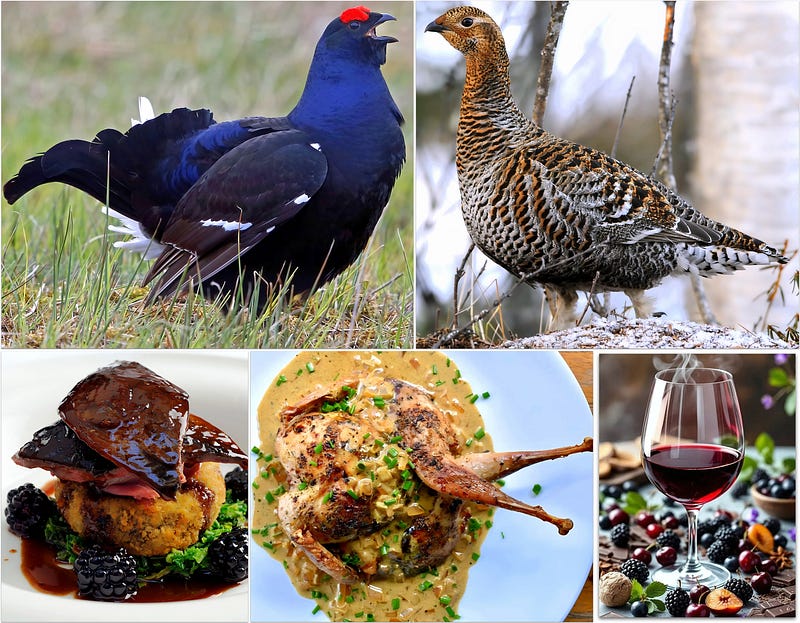
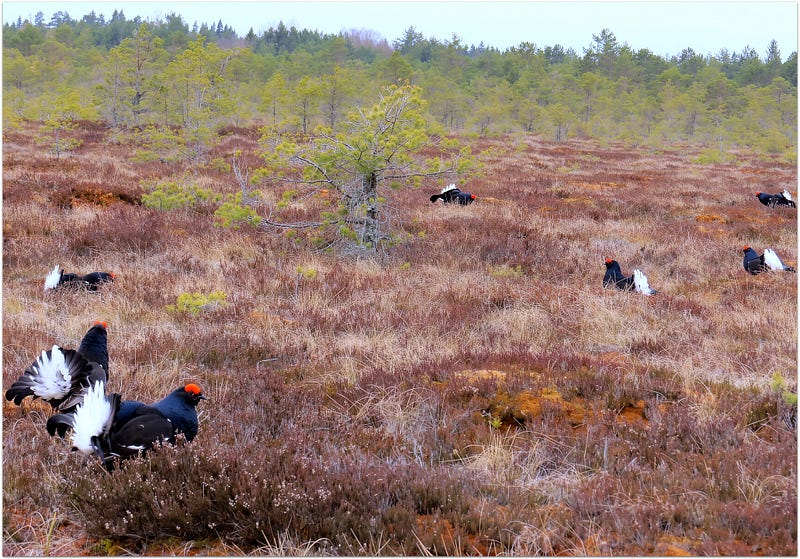
Adult males measure 55 cm (≈ 21.6 in) and weigh around 1.1 kg (≈ 2.4 lb). Females average 40 cm (≈ 15.7 in) and 0.9 kg (≈ 2 lb). Males possess iridescent blue-black plumage with white wing bars and lyre-shaped tails; females are cryptically mottled brown. Courtship occurs at dawn in spring on leks — traditional display arenas — where males fan their tails, inflate crimson wattles, and issue bubbling calls audible up to 500 m (≈ 1,640 ft). Females select mates based on display vigor and territory.
Nests are ground scrapes lined with grass and heather. Clutches of 6–10 eggs incubate for roughly 25 days. Chicks are precocial, feeding initially on insects before shifting to buds and berries. The diet broadens seasonally to include birch buds, willow catkins, heather shoots, and berries. The digestive tract enlarges in winter to process woody material, demonstrating physiological adaptation to cold climates. Average lifespan is four to five years, though few survive beyond three in the wild.
Ecology
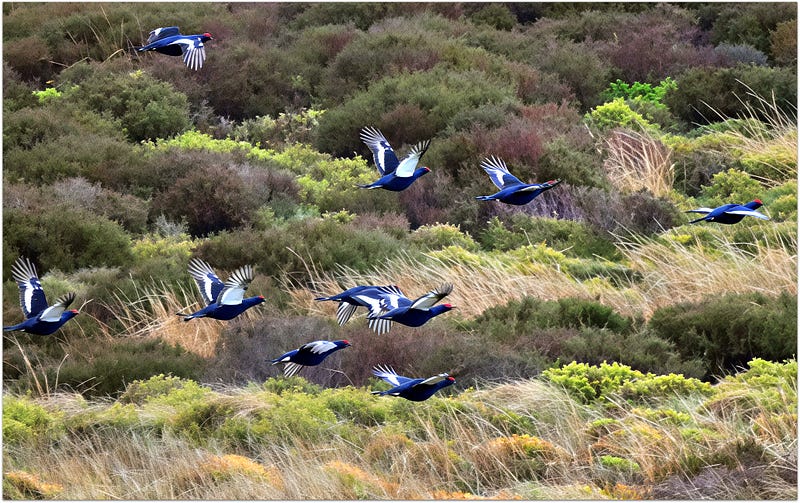
The black grouse thrives in transitional landscapes — forest edges, open moors, and heathlands interspersed with young woodland. Its distribution extends from Britain and Scandinavia through the Baltic and central Russia to Siberia. The species depends on mosaics of heather (Calluna vulgaris), bilberry (Vaccinium myrtillus), and birch regeneration.

Population decline mirrors habitat degradation: overgrazing, drainage, conifer plantations, and land abandonment have fragmented territories. Climate change alters vegetation composition and lek timing, compounding stress. Predation by foxes and corvids increases where human disturbance weakens habitat cover.
As a seed disperser and insect predator, the black grouse contributes to upland ecosystem function. Its presence signals healthy shrub structure and balanced grazing. Moorland capable of supporting sustainable populations sequesters about 4.5 t C ha⁻¹ yr⁻¹ (≈ 1.8 short tons C acre⁻¹ yr⁻¹), linking conservation with climate goals. Sustainable management relies on rotational burning, low-intensity grazing, and winter refuge corridors to maintain lek activity.
Uses
The black grouse is primarily valued as game meat but also provides ecological, cultural, and artisanal benefits. Its utilization reflects a blend of culinary tradition and conservation ethics.
Edible parts include breast, thighs, heart, and liver, with feather and bone by-products used for stocks and decorative crafts. Typical preparation forms are whole-roast, breast fillets, pâté, terrine, and smoked cuts. Traditional dishes feature roast grouse with lingonberry reduction or juniper glaze. In northern Europe, the hunting and consumption season spans August through December, coinciding with post-breeding abundance.
Average yield under sustainable harvest is roughly 0.7 kg (≈ 1.54 lb) edible meat per bird, at densities near 1 bird per 100 ha in managed moorland. Energy value is 160 kcal per 100 g (≈ 454 kcal per lb). Nutrient content per 100 g: 22 g protein, 1.8 g fat, 4.5 mg iron, 8 mg niacin, and 2.5 µg vitamin B₁₂.
No inherent anti-nutrients or toxicity are known. Main safety concerns stem from lead residues or microbial spoilage if aged improperly. Proper evisceration and cooking to 74 °C (≈ 165 °F) ensure safety.
Processing involves dry-aging for 2 to 3 days at 2 °C (≈ 36 °F), plucking, gutting, and packaging under refrigeration. Commercial products include smoked fillets, cured breast, and game terrine. Taste is rich, iron-forward, and faintly resinous; aroma carries woodland and heather notes; texture is firm but tender when basted in fat.
Cooking behavior favors roasting at 175 °C (≈ 347 °F) for 20 minutes, pan-searing, or sous vide at 60 °C (≈ 140 °F) for 90 minutes. Flavor remains stable under moderate heat but deteriorates under charring. Best methods integrate slow roasting or confit to preserve juiciness.
Ideal pairings include juniper, blackcurrant, wild mushrooms, and smoked pork. Flavor stability improves when served with acidic or fruit-based sauces. Medicinally, grouse broth was once used as a restorative in Scandinavian folk medicine, though scientific evidence is anecdotal.
Farming the species is impractical due to behavioral stress and low reproductive yield. Feed applications and silage conversion are nonviable. Feather waste enriches compost with 1.3 % N and 0.9 % P, while habitat management for grouse increases pollinator density by up to 40 %.
Market price averages USD 30–40 per bird (≈ EUR 28–37), depending on region and season. Legal trade requires game-dealer licensing; European sales fall under the Birds Directive 79/409/EEC. No commercial imports are registered in the U.S. Conservation status is Least Concern globally, but Red-Listed in the U.K. and Western Europe. Sustainable estates may hold local certification verifying habitat management and population monitoring.
Permits restrict annual harvests to < 10 % of autumn stock. Monitoring indicators include lek counts, chick-to-hen ratios, and habitat cover indices.
The black grouse thus bridges multiple value chains: ecological services through landscape maintenance, cultural value through hunting heritage, and gastronomic prestige through fine dining.
Culinary Aspects
The taste profile of black grouse is intensely earthy and slightly metallic, reflecting a diet rich in berries and buds. Flavor complexity develops with aging, revealing resinous, juniper-like tones and hints of forest floor. Aroma evokes peat, moss, and faint sweetness from muscle glycogen. Mouthfeel is dense and coating; texture remains firm but not fibrous when cooked below 180 °C (≈ 356 °F). The balance is savory-acidic, particularly when paired with berry or wine reductions. Complexity builds through layered spice: black pepper, thyme, and rosemary heighten its forest character.
Aftertaste is clean and mineral, finishing dry rather than fatty. Visually, the meat presents deep red-brown hues with crisp golden skin. Chemesthesis registers warmth from spice rather than heat. Cultural importance persists across Scandinavia and Britain, where serving black grouse symbolizes culinary craftsmanship and connection to the land. Nutritionally, it's low-fat and high-protein ratio supports endurance diets typical of cold-climate populations.
Wine Pairings
The key to pairing lies in balancing iron-rich savor with acidity and aromatic lift. A Lagrein from Alto Adige harmonizes through blackberry and violet notes that match berry glazes while tannins complement the meat’s structure. Cabernet Franc from the Loire provides green spice and graphite minerality, offsetting the game’s richness. A Trousseau from the Jura suits lightly smoked preparations, mirroring forest aromas with restrained fruit. For fruit-sauced dishes, a Cinsault rosé from Bandol balances tartness and body. With mushroom cream or truffle jus, an oxidative Savagnin or aged Vin Jaune achieves resonance between nutty oxidation and roasted umami. Each pairing aligns acidity, tannin, and aromatic structure to the bird’s intrinsic wildness.
Conclusion
The black grouse encapsulates the intertwined fates of cuisine and conservation. Its survival depends not on abstention but on disciplined, habitat-driven harvest. Properly managed moorlands sustain both biodiversity and culinary tradition. Each meal that honors its flavor while respecting ecological thresholds reinforces the idea that gastronomy can be a tool of stewardship. In the lingering smoke of a roasted bird lies the scent of heather, the sound of the lek, and the lesson that true sustainability begins with restraint.