The Captagon Kingdom: How Illicit Drugs Corrode State Sovereignty and Forge Global Criminal…
The term “narco-state” describes a nation where the institutions of government have been systematically co-opted by the power and profits…
The Captagon Kingdom: How Illicit Drugs Corrode State Sovereignty and Forge Global Criminal Networks
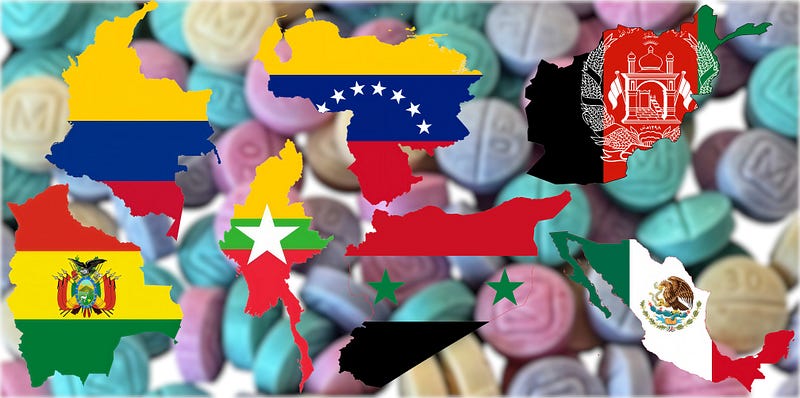
The term “narco-state” describes a nation where the institutions of government have been systematically co-opted by the power and profits of the illegal drug trade, creating a hybrid entity that operates outside international norms. This report provides a comprehensive academic analysis of this global security threat, examining the political, economic, and social mechanics that allow states to become servants to criminal enterprise. The analysis delves into specific case studies, including the cocaine-funded regimes of Bolivia, the cartel-dominated landscapes of Colombia and Mexico, the state-sponsored captagon production in Syria, and the opium-rich territories of Afghanistan and Myanmar. It will explore the historical evolution of these states, the precise mechanisms of their capture, and the profound consequences for global stability, democratic governance, and human security. What follows is a detailed investigation into how sovereign nations transform into criminal franchises and the uncomfortable reality of global complicity that enables their survival.
The term “narco-state” evokes images of countries overrun by drug lords, where state institutions have been thoroughly compromised by the power and wealth of the illegal drug trade. This phenomenon represents a fundamental blurring of lines between criminal organizations and governmental structures, creating hybrid entities that operate outside international norms. The global narcotics economy has demonstrated a staggering capacity to infiltrate, subvert, and sometimes even replace legitimate state functions, giving rise to unique forms of governance where criminal profit rather than public welfare becomes the organizing principle. From the cocaine-funded coups in Latin America to the state-sponsored production of captagon in the Middle East, narco-states present a complex challenge to global security, democratic governance, and international law. Understanding the mechanisms through which illicit drugs corrode state sovereignty reveals uncomfortable truths about the vulnerabilities of political systems and the adaptive nature of transnational criminal networks in the twenty-first century.
The Conceptual Framework of Narco-States
At its core, a narco-state emerges when legitimate institutions become penetrated by the power and wealth of the illegal drug trade. This penetration typically manifests through systematic corruption, where government officials, law enforcement agencies, and judicial systems are co-opted through bribery, intimidation, or a combination of both. The traditional understanding of narco-states often associates them with state failure, assuming that criminal elements fill power vacuities left by weakening governments. However, contemporary analysis reveals a more complex reality where narco-states can also arise through deliberate state sponsorship of drug production and trafficking. In such cases, it is not institutional weakness but rather the state’s strength and organizational capacity that enables the industrial-scale production and distribution of illicit substances.
Scholars have attempted to categorize narco-states based on their level of dependence on the narcotics trade and the threat this trade poses to domestic and international stability. These categories range from incipient and developing to serious, critical, and advanced narco-states. What remains consistent across these classifications is the fundamental compromise of state sovereignty, where the primary allegiance of key institutions shifts from public service to the facilitation of criminal enterprise. This compromise often begins with individual acts of corruption but evolves into sophisticated systems where the state itself becomes a stakeholder in the very illicit economy it is nominally tasked with combating.
The terminology surrounding narco-states has evolved to capture these nuances, with concepts like “narco-capitalism” describing the economic dimensions and “narco-kleptocracy” highlighting how ruling elites systematically loot state resources through drug trafficking. What makes this phenomenon particularly resilient is its ability to adapt to different political systems, from military dictatorships to nominal democracies, demonstrating that no governance structure is inherently immune to the corrupting influence of drug wealth. The conceptual challenge lies in distinguishing between countries with significant drug problems and true narco-states where the state apparatus itself has become a vehicle for narcotics trafficking.
Historical Evolution and Global Manifestations
The modern concept of the narco-state first emerged in relation to Bolivia following the 1980 coup of Luis García Meza, which was largely financed with the help of narcotics traffickers. This coup marked a pivotal moment where drug wealth directly enabled the seizure of state power, setting a precedent that would repeat itself across different continents. The Bolivian cocaine economy grew exponentially throughout the 1970s and 1980s, with the drug trade estimated to be worth nearly thirteen percent of the country’s GDP by 1988. The power of Bolivia’s organized crime sector became so formidable that drug kingpin Roberto Suárez, dubbed the King of Cocaine, famously offered to pay off the country’s entire national debt in 1983.
During the same period, Colombia emerged as the epitome of the narco-state, with cartels from Medellín and Cali establishing sophisticated operations that challenged state authority. Pablo Escobar’s Medellín Cartel not only produced and trafficked cocaine but also systematically infiltrated law enforcement and political institutions through a combination of bribery and extreme violence. The cartel’s reign of terror included kidnappings, assassinations, and bombings designed to ensure business continuity. The Cali Cartel later adopted a more subtle approach, focusing on political influence that reached the highest levels of government, including the presidency of Ernesto Samper, who was accused of being funded by drug money.
The late twentieth century saw the globalization of drug routes, with cocaine markets expanding to Europe through new transit pathways from Colombia through Brazil or Venezuela and Western Africa. This expansion transformed African states such as Nigeria, Ghana, and Guinea-Bissau into significant narco-states, with the latter being famously labeled “the world’s first narco-state” in 2008. In Afghanistan, the Taliban leveraged opium production to fund their guerrilla war, with subsequent governments shielding the opium trade from foreign intervention. The early twenty-first century has witnessed the emergence of Syria as what some analysts consider the world’s largest narco-state, with the Assad regime allegedly generating the majority of its revenue from the global export of Captagon, an amphetamine-type stimulant.
Mechanisms of State Capture and Control
The transformation of a state into a narco-state typically follows identifiable patterns of capture and control, though the specific mechanisms vary based on local political and economic conditions. The most direct path involves the outright seizure of government institutions through drug-funded political movements or coups, as seen in Bolivia’s 1980 military takeover. A more gradual approach involves the systematic corruption of existing state structures through what scholars term “state-narco networks” — relationships of financial and political patronage between government officials and organized crime. These networks often originate during authoritarian periods, as witnessed in Bolivia’s military regime, where leaders used drug wealth to build political bases by granting lands to military officers in drug-producing regions and providing soft loans to agribusiness elites diversifying into cocaine ventures.
Institutional compromise follows predictable patterns, beginning with law enforcement and judicial systems before expanding to legislative and executive branches. Police forces are often the first point of penetration, with officers offered bribes to ignore trafficking activities or actively participate in them. In Nicaragua, researchers documented instances of police recruiting captured traffickers to “work together,” with officers explicitly seeking to establish business relationships with drug suppliers. This institutional corruption becomes self-perpetuating, as the compromised institutions develop a vested interest in maintaining the drug economy that enriches them.
The judicial system represents the next frontier, with prosecutors and judges accepting bribes to drop charges or deliver lenient sentences. In extreme cases, entire electoral processes become compromised, with drug traffickers financing political campaigns in exchange for protection and influence. Mexico’s recent trial of Genaro García Luna, the former Secretary of Public Security, revealed that officials at the highest levels of government received millions of dollars from the Sinaloa Cartel in exchange for protection and information. What begins as individual corruption evolves into a parallel system of governance where state institutions serve criminal interests while maintaining the facade of legitimate government.
Case Studies in Narco-State Governance
Syria under Bashar al-Assad presents a compelling case study of state-sponsored narcotics production as official policy. Unlike traditional narco-states where criminal groups infiltrate government, Syria exemplifies a reverse model where the state itself initiated and industrialized drug production. Researchers have identified that approximately eighty percent of captagon production facilities were located in regime-held areas, directly operated by or under the protection of the 4th Armored Division commanded by Assad’s brother Maher, along with the Military Intelligence and Air Force Intelligence directorates. The captagon trade became the most valuable sector of Syria’s economy, with estimates valuing it between two and six billion dollars annually — nearly equivalent to the country’s entire formal GDP. This case demonstrates how narcotics production can evolve from criminal enterprise to state policy, particularly when regimes face international isolation and economic sanctions.
Bolivia offers another instructive model, highlighting how state-narco networks can persist through political transitions from dictatorship to democracy. During Bolivia’s military-authoritarian period, regimes systematically used drug wealth to build political bases, granting military officers lands in drug-producing regions and facilitating the diversification of agribusiness elites into cocaine when legitimate commodity prices collapsed. Following democratization in 1982, these networks adapted rather than disintegrated, with drug traffickers forming linkages across the military, police, and political parties. Civilian leaders, fearing a return to military rule, largely turned a blind eye to narco-corruption within security institutions. This case illustrates the resilience of state-narco networks and their ability to reconfigure themselves to survive political transitions.
Nicaragua represents a third pattern, where the state exercises strict control over drug trafficking through institutionalized corruption. Research indicates that Nicaragua’s relative peace compared to neighboring countries stems not from the absence of drug trafficking but from state control over the trade. The government established a political agreement with criminal actors around drug trafficking, creating what scholars describe as a “mafia state” that regulates and profits from narcotics transit. This model mirrors the system that existed in Mexico under the Institutional Revolutionary Party’s seven-decade rule, where the state strictly controlled criminal activities through arrangements that maintained superficial order while facilitating illicit profit. The Nicaraguan case demonstrates how narco-states can maintain lower levels of violence through monopolistic control over criminal markets.
The International Dimension and Global Complicity
Narco-states do not emerge in isolation but are products of a global system characterized by asymmetrical relationships between drug-producing and drug-consuming nations. The United States, as the world’s largest consumer of illegal drugs, plays a particularly significant role in this dynamic. American demand for cocaine, heroin, methamphetamine, and fentanyl creates the economic incentive that makes drug trafficking phenomenally profitable. Well over twenty percent of Americans over age twelve report using illegal drugs within the past year, with nearly a million becoming first-time cocaine users annually. This consumption pattern makes the U.S. an unwitting enabler of the narco-state phenomenon, creating a codependent relationship where Mexican trafficking organizations supply American consumption habits.
The international drug trade has also provoked extraterritorial responses that raise complex questions of sovereignty and international law. Recent years have seen the United States conducting military strikes on alleged drug-smuggling vessels in the Caribbean and Pacific, actions that neighboring countries like Colombia have denounced as disproportionate and outside international law. These operations, justified as targeting “narco-terrorists,” represent an expansion of counter-drug efforts into direct military action, sometimes resulting in fatalities and diplomatic friction. The global dimensions of the drug trade ensure that narco-states cannot be understood as purely domestic problems but must be analyzed as interconnected nodes in a transnational network of production, transit, and consumption.
Western financial systems also play an often-overlooked role in sustaining narco-states through money laundering. The phenomenal profits generated by drug trafficking — estimated at over thirty billion dollars annually for Syrian captagon alone — require integration into the global financial system. Banks in Europe and North America, whether wittingly or through inadequate safeguards, facilitate the movement and legitimization of drug proceeds. This financial dimension means that narco-states are embedded in legal global economic structures, not existing outside them. The international community thus faces the uncomfortable reality that the economic benefits of drug consumption and money laundering in wealthy nations directly contribute to the conditions that create and sustain narco-states elsewhere.
Consequences for Democracy, Development, and Human Security
The emergence of a narco-state has devastating consequences for democratic governance, as the fundamental contract between state and citizen becomes corrupted. When government institutions serve criminal interests rather than public welfare, democracy becomes a hollow shell. This erosion manifests most visibly in electoral processes, where drug money finances political campaigns, and candidates who refuse cooperation face assassination. Mexico’s recent election cycle saw more than three dozen candidates for state and local office killed, presumably by cartels seeking to influence outcomes. Beyond elections, the very notion of public service becomes meaningless when government positions are valued primarily for their access to criminal revenue streams rather than their capacity to serve citizens.
Human security deteriorates dramatically in narco-states, though the patterns of violence vary. Some narco-states, like Bolivia in the 1980s, maintained relative peace because state-narco networks managed criminal competition and reduced incentives for violence. Others, like contemporary Mexico, experience extraordinary levels of bloodshed, with over thirty thousand homicides annually — a rate approximately four times higher than the United States at its worst period. This violence extends beyond direct participants in the drug trade to encompass journalists, activists, and ordinary citizens caught in the crossfire. The psychological impact on populations is profound, with surveys indicating that over three-quarters of adults in Mexico feel unsafe in their own communities.
Paradoxically, the dismantling of narco-state structures can sometimes increase violence in the short term, as established arrangements that managed criminal competition collapse. This creates a painful dilemma for reformers: tolerate the systemic corruption that characterizes a narco-state but maintains a semblance of order, or confront corrupt institutions and risk an explosion of violence as criminal groups battle for supremacy. Mexico’s experience following the erosion of the PRI’s monopolistic control over criminal activity illustrates this pattern, as the relative stability of the prior era gave way to extreme violence. Similarly, researchers warn that a democratic transition in Nicaragua could disrupt the state’s control over drug trafficking and “unleash new forms of violence” as different criminal groups vie for dominance.
Conclusion: The Future of Narco-States in a Globalized World
The phenomenon of narco-states represents one of the most significant challenges to state sovereignty in the twenty-first century. As global drug demand persists and trafficking networks become increasingly sophisticated, the conditions that enable state capture by criminal interests will likely proliferate. The future may see not just traditional producer and transit countries affected but also consumer nations in Europe and North America developing their own hybrid criminal-state structures, as evidenced by concerns about the Netherlands potentially evolving into a “narco-state.” This geographical expansion suggests that the problem is not confined to weak or failing states but can emerge anywhere that the profit potential of illegal drugs intersects with corruptible institutions.
Addressing the narco-state phenomenon requires moving beyond simplistic law enforcement approaches to recognize the complex political economies that sustain these systems. Effective responses must acknowledge the international dimensions, including the role of consumption patterns in wealthy nations and the flow of weapons from industrialized countries that fuel violence in narco-states. Ultimately, understanding narco-states means recognizing them not as anomalies in the international system but as logical, if pathological, adaptations to global inequalities and prohibitions. The future of governance in vulnerable regions may depend on the international community’s willingness to address not just the symptoms of narco-states but their root causes in both global demand and local political arrangements.