The Cosmic Web: Unraveling the Universe’s Large-Scale Structure
Introduction
Introduction
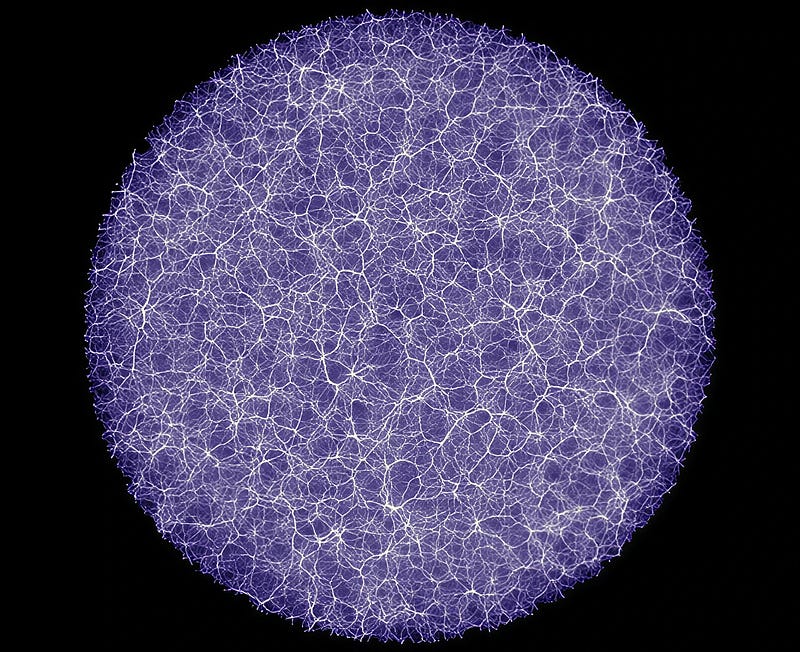
Stargazing on a clear night, one might imagine galaxies scattered randomly across an infinite sky. In reality, however, the cosmos is anything but random. Galaxies are woven into a vast cosmic web — an immense network of clusters, filaments, and voids that stretches across the universe. Our own Milky Way, along with countless other galaxies, resides on one strand of this colossal web. Scientists call this the large-scale structure of the universe, and understanding it has been one of modern astronomy’s most exciting achievements. In this article, we’ll explore how this cosmic web was discovered, how it formed, and why it matters for our understanding of the universe.
Galaxies on a Cosmic Web
At first glance, the universe appears homogeneous — the same in all directions — but zoom in a bit (on scales of tens to hundreds of millions of light-years) and a remarkable tapestry emerges. Galaxies rarely exist in isolation. They tend to gather together due to gravity, forming groups and clusters — cities of galaxies bound in mutual orbit. These groups and clusters often arrange into even larger associations known as superclusters, sprawling collections of galaxy clusters.
But the hierarchy doesn’t end there. Superclusters can link into gigantic chains and sheets called galactic walls, creating some of the largest continuous structures ever observed. All of these components tie into a grand pattern: the cosmic web. Imagine a three-dimensional spiderweb or foam-like structure on cosmological scales. Threadlike filaments of galaxies stretch across space, intersecting at dense nodes where clusters reside, with vast dark voids in between.
In other words, galaxies and galaxy clusters line up along invisible cosmic highways, congregating where the “roads” meet, and leaving enormous empty regions (voids) where very few galaxies exist. This weblike arrangement is the natural outcome of gravity shaping matter on cosmic scales. Over billions of years, gravity has drawn galaxies into these filaments and nodes, like dust settling into the threads of an intricate cosmic cobweb.
This cosmic web is not only made of galaxies and gas, but is also anchored by an invisible component: dark matter. Dark matter makes up about 85% of all matter in the universe, and its gravity serves as the scaffold for the cosmic web. Under gravity’s influence, dark matter clumped into filaments after the Big Bang, and ordinary matter followed these gravitational wells. The filaments of dark matter act as the backbone of the universe, guiding the formation of galaxies and directing the flow of gas. At the intersections of these filaments — the nodes — massive galaxy clusters and superclusters have formed. Bright galaxies trace this hidden architecture, revealing a map of the unseen.
From a Smooth Beginning to a Cosmic Web
It’s astonishing to realize that the cosmic web grew from a nearly featureless early universe. In the moments after the Big Bang, matter was almost uniformly distributed. Had it remained perfectly homogeneous, no stars, galaxies, or cosmic web would exist.
Fortunately, tiny imperfections — minute density fluctuations — were present in that primordial soup. These were likely seeded during a period known as cosmic inflation, when quantum-scale variations were stretched to macroscopic scales. Where density was slightly higher, gravity exerted a stronger pull, gradually drawing in more matter. Over millions and then billions of years, those tiny ripples grew into the large-scale structures we see today.
Dark matter played a crucial role. Being unaffected by radiation, it clumped together first, forming an invisible scaffolding. Ordinary matter followed, cooling and collapsing into these gravitational wells. Galaxies and galaxy clusters formed at the densest knots, while areas with below-average density became vast cosmic voids.
In essence, the large-scale structure we observe today is a fingerprint of the early universe. The arrangement of filaments and voids reflects primordial fluctuations, amplified by gravity. Mapping the cosmic web allows scientists to peer back into the universe’s youth. The spacing of galaxy clusters even preserves the imprint of ancient sound waves known as baryon acoustic oscillations — providing clues about cosmic expansion and the mysterious force of dark energy.
Charting the Cosmic Web: From Great Walls to Laniakea
Until the late 20th century, the universe’s grand structure remained hidden. Astronomers catalogued galaxies and clusters, but their large-scale distribution was a mystery. That changed with the advent of redshift surveys — three-dimensional maps of galaxy positions.
In 1989, astronomers revealed a colossal structure stretching hundreds of millions of light-years: the Great Wall. This was one of the first direct glimpses of the cosmic web. Later surveys, like the Sloan Digital Sky Survey, mapped over a million galaxies and revealed even vaster formations, including the Sloan Great Wall, more than a billion light-years across.
In 2014, astronomers identified our galaxy’s home supercluster: Laniakea, meaning “immeasurable heaven.” Encompassing the Milky Way, Virgo Cluster, and others, Laniakea spans about 500 million light-years. It defines the region of space where galaxies, including ours, are moving inward as if into a shared gravitational basin.
Recent research suggests that Laniakea may itself be part of an even grander structure, centered on the massive Shapley Concentration. If confirmed, our cosmic neighborhood could be ten times larger than previously thought — a reminder that we’re still charting the edges of the cosmic web.
Even more astonishing is the proposed Hercules–Corona Borealis Great Wall, a structure that may span 10 billion light-years. If real, it would be so vast that it challenges the foundational idea that the universe becomes uniform at large enough scales. While its existence remains debated, the mere possibility testifies to the awe-inspiring scale of the cosmos.
Why Understanding the Cosmic Web Matters
Understanding the cosmic web has deep implications:
- It validates cosmological theories. The distribution of galaxies supports the standard model of cosmology, which includes dark matter and dark energy. The patterns match predictions from simulations that begin with the Big Bang and evolve through gravity’s influence.
- It shapes galaxy evolution. A galaxy’s position in the web influences its growth. Filaments funnel gas into galaxies, fueling star formation. Dense nodes — like clusters — may strip galaxies of gas, halting star formation. The web isn’t just a backdrop; it’s an active player in galactic life cycles.
- It reveals the hidden matter of the universe. Recent observations have directly captured faint filaments of intergalactic gas, confirming long-standing theories. These filaments act as bridges between galaxies, transporting the raw materials for stars.
- It expands our cosmic perspective. Earth is part of a solar system, in a galaxy, within a group, inside a cluster, embedded in a supercluster — all tied to a cosmic web. This hierarchy of scale is more than poetic. It’s a scientific reality.
Conclusion
The large-scale structure of the universe — the cosmic web — is the grandest pattern we’ve ever discovered. It reveals how matter evolved from uniformity to complexity, from the Big Bang to sprawling filaments of galaxies. This structure is not just beautiful; it’s deeply informative. It confirms our cosmological models, helps explain galaxy evolution, and hints at deeper truths about dark matter and dark energy.
New telescopes and surveys are poised to map the cosmos in ever greater detail. With each discovery, we weave a clearer picture of our universe — not just as a place of stars and planets, but as a living, interconnected web of cosmic history.
We live in the strands of a cosmic web, and as we continue to explore it, we inch closer to answering the biggest questions of all: Where did we come from? Where are we going? And what is the true nature of the universe we call home?