The Criminal Profile and Crimes of Edward Theodore Gein
Early Life and Formative Influences
Early Life and Formative Influences
Edward Theodore Gein was born on August 27, 1906, in La Crosse, Wisconsin, to George Philip Gein (an alcoholic and frequently unemployed carpenter) and Augusta Wilhelmine Gein (née Lehrke), a devout Lutheran who dominated the household with religious extremism.¹ Augusta preached that all women except herself were “harlots” and “instruments of the devil,” reserving daily Bible readings focused on divine retribution and death.² The family relocated to a 155-acre farm near Plainfield, Wisconsin, around 1914–1915, where Augusta intensified their isolation, prohibiting social interactions and punishing Ed for attempting friendships.³ Gein developed an obsessive attachment to his mother, later describing her as his “only friend and one true love.”⁴
The Gein family experienced several traumatic deaths:
- George Gein (1940): Died of heart failure exacerbated by alcoholism, leaving Ed and his brother Henry as sole providers.⁵
- Henry Gein (1944): Died under suspicious circumstances during a marsh fire. Though officially ruled asphyxiation, investigators later noted head injuries suggesting foul play, with biographer Harold Schechter speculating Ed murdered him to protect Augusta’s dominance.⁶
- Augusta Gein (1945): Suffered fatal strokes after witnessing a neighbor’s extramarital affair, which she condemned as immoral. Her death triggered Gein’s psychological collapse; he preserved her bedroom as a shrine while the farm deteriorated into squalor.⁷
Criminal Activities: Grave Robbing and Homicides
Necrophilic Experimentation (1947–1957)
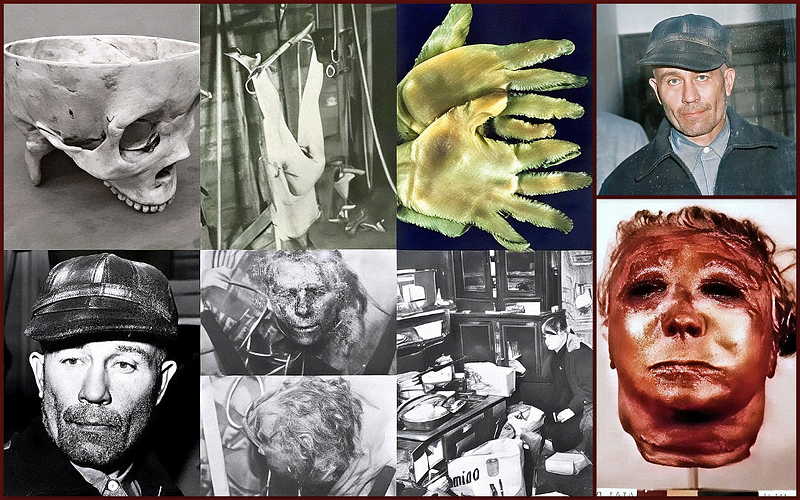
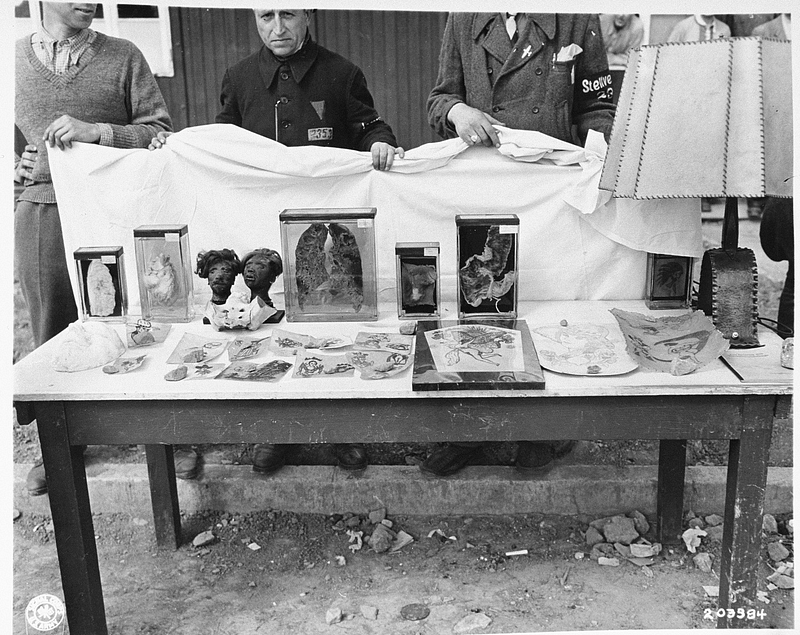
Between 1947 and 1952, Gein conducted approximately 40 nocturnal grave robberies in three local cemeteries, targeting recently buried middle-aged women who resembled Augusta.⁸ Using anatomical knowledge from self-study and pulp magazines about Nazi atrocities (particularly Ilse Koch’s human-skin artifacts), he fashioned macabre artifacts:⁹
- Bodily Adornments: Masks from facial skin, a “woman suit” from stitched torsos, leggings from leg skin, a nipple belt, and a corset from a female torso.¹⁰
- Domestic Objects: Skulls used as soup bowls, chairs upholstered with skin, wastebaskets from human skin, and a lampshade from a face.¹¹
- Trophies: A shoebox containing nine vulvas, preserved hearts, noses, and lips on window shade strings.¹²
Confirmed Murders
- Mary Hogan (December 8, 1954): Shot in the forehead at her Pine Grove tavern; her face skinned for a mask and skull preserved.¹³
- Bernice Worden (November 16, 1957): Shot with a .22-caliber rifle in her Plainfield hardware store, decapitated, disemboweled, and hung “dressed like a deer” in Gein’s shed; her heart discovered in a plastic bag.¹⁴
Gein’s modus operandi involved targeting women resembling Augusta, using firearms for killings, and employing surgical precision in dismemberment. He later claimed to be in a “daze-like state” during crimes and denied cannibalism or sexual intercourse with corpses due to their odor.¹⁵
Evidence Recovered from Gein’s Farmhouse (November 1957)
Human Remains
Bernice Worden’s decapitated body; Mary Hogan’s skull
Evidence of homicide
Preserved Organs
9 vulvas in shoebox; human hearts; noses; lips on drawstring
Sexual trophies; potential ritualistic use
Artifacts
Skin masks; wastebasket of skin; chairs upholstered with skin; nipple belt; “woman suit”
Necrophilic craftsmanship; transvestic fetishism
Grave-Robbing
Bones from ≥9 exhumed corpses
Source of non-murder victim materials
Psychological Pathology and Legal Proceedings
Diagnostic Profile
Psychiatrists diagnosed Gein with schizophrenia and sexual psychopathy, noting delusions of “communing” with exhumed corpses.¹⁶ His pathology stemmed from:
- Mother-Induced Paraphilias: Augusta’s prohibition against relationships with living women fostered necrophilia, transvestism, and a desire to create a “woman suit” to “become” his mother.¹⁷
- Psychotic Triggers: The 1945 death of Augusta dissolved his reality-testing capabilities, leading to grave-robbing as a coping mechanism.¹⁸
Legal Proceedings
- Initial Commitment (1958): Deemed unfit for trial due to schizophrenia; confined to Central State Hospital.¹⁹
- Trial (1968): Found guilty of Worden’s murder but legally insane at the time of the crime. Recommitted to Mendota Mental Health Institute, where he remained until his death.²⁰ Prosecutors tried only one murder due to budgetary constraints, ignoring Hogan’s case.²¹
Cultural Legacy and Media Impact
Cinematic Inspirations
Gein’s crimes directly influenced iconic horror characters:
- Norman Bates (Psycho, 1960): Mother fixation and taxidermy, based on Robert Bloch’s novel.²²
- Leatherface (The Texas Chain Saw Massacre, 1974): Isolated farm setting and skin masks.²³
- Buffalo Bill (The Silence of the Lambs, 1991): Construction of a “woman suit” and transvestic motivations.²⁴
Contemporary Media Representations
- Documentaries: Psycho: The Lost Tapes of Ed Gein (2023) featured unreleased interrogation audio, revealing Gein’s “meek, mild” persona as a “monster in plain sight.”²⁵
- Dramatizations: Netflix’s Monster Season 3 (2025) will star Charlie Hunnam as Gein, continuing public fascination.²⁶
- Academic Impact: FBI profiler John Douglas analyzed Gein in Obsession (1998) as a case study in maternal fixation leading to predatory violence.²⁷
Conclusion: The Paradox of the “Ordinary Monster”
Ed Gein’s case remains pivotal in forensic psychology and criminal profiling, illustrating how extreme childhood trauma intersecting with psychiatric disturbance can manifest in unprecedented violence.²⁸ His crimes revolutionized insanity defense protocols and underscored the “ordinariness” masking profound deviance. As investigator Joe Wilimovsky noted, Gein was considered a “harmless” handyman and babysitter by neighbors, embodying the terrifying banality of evil.²⁹ The 1957 farmhouse discoveries remain a benchmark for understanding how isolation and religious fanaticism can catalyze unimaginable horror, ensuring Gein’s legacy endures in both academic discourse and popular culture.³⁰
Footnotes
¹. Harold Schechter, Deviant: The Shocking True Story of the Original Psycho (New York: Pocket Books, 1989), 45, cited in “Ed Gein,” Wikipedia, last modified July 6, 2025, https://en.wikipedia.org/wiki/Ed_Gein.
². “Ed Gein,” EBSCO Research Starters, 2022, https://www.ebsco.com/research-starters/history/ed-gein.
³. “Ed Gein,” Britannica, accessed July 7, 2025, https://www.britannica.com/biography/Ed-Gein.
⁴. Schechter, Deviant, 102.
⁵. “Ed Gein,” Biography, last updated July 7, 2025, https://www.biography.com/crime/ed-gein.
⁶. “Ed Gein,” Criminal Minds Wiki, accessed July 7, 2025, https://criminalminds.fandom.com/wiki/Ed_Gein.
⁷. “Ed Gein,” Wikipedia.
⁸. “Ed Gein,” Britannica.
⁹. “Ed Gein,” Criminal Minds Wiki.
¹⁰. “Ed Gein,” Wikipedia.
¹¹. “Ed Gein,” EBSCO Research Starters.
¹². “Ed Gein,” Wikipedia.
¹³. “Ed Gein,” Biography.
¹⁴. “Ed Gein,” Wikipedia.
¹⁵. “Ed Gein,” Criminal Minds Wiki.
¹⁶. “Ed Gein,” EBSCO Research Starters.
¹⁷. K.E. Sullivan, “Ed Gein and the Figure of the Transgendered Serial Killer,” Jump Cut, no. 43 (July 2000): 42, https://www.ejumpcut.org/archive/onlinessays/JC43folder/EdGein.html.
¹⁸. “Ed Gein,” Biography.
¹⁹. “Ed Gein,” Britannica.
²⁰. “Ed Gein,” Wikipedia.
²¹. “Ed Gein,” Criminal Minds Wiki.
²². Sullivan, “Ed Gein and the Figure,” 45.
²³. “Ed Gein,” Biography.
²⁴. Sullivan, “Ed Gein and the Figure,” 38.
²⁵. “Ed Gein,” Biography.
²⁶. Ibid.
²⁷. John Douglas, Obsession: The FBI’s Legendary Profiler Probes the Psyches of Killers, Rapists, and Stalkers (New York: Scribner, 1998), cited in “The FBI’s Legendary Profiler,” NCJRS Virtual Library, accessed July 7, 2025, https://www.ojp.gov/ncjrs/virtual-library/abstracts/obsession-fbis-legendary-profiler-probes-psyches-killers-rapists.
²⁸. “Ed Gein,” EBSCO Research Starters.
²⁹. “Ed Gein,” Wikipedia.
³⁰. “Ed Gein,” Britannica.
Bibliography
“Ed Gein.” Biography. Last updated July 7, 2025. https://www.biography.com/crime/ed-gein.
“Ed Gein.” Britannica. Accessed July 7, 2025. https://www.britannica.com/biography/Ed-Gein.
“Ed Gein.” Criminal Minds Wiki. Accessed July 7, 2025. https://criminalminds.fandom.com/wiki/Ed_Gein.
“Ed Gein.” EBSCO Research Starters. 2022. https://www.ebsco.com/research-starters/history/ed-gein.
“Ed Gein.” Wikipedia. Last modified July 6, 2025. https://en.wikipedia.org/wiki/Ed_Gein.
“Ed Gein: The Butcher of Plainfield.” Wikipedia. Accessed July 7, 2025. https://en.wikipedia.org/wiki/Ed_Gein:_The_Butcher_of_Plainfield.
Schechter, Harold. Deviant: The Shocking True Story of the Original Psycho. New York: Pocket Books, 1989.
Sullivan, K.E. “Ed Gein and the Figure of the Transgendered Serial Killer.” Jump Cut, no. 43 (July 2000): 38–47. https://www.ejumpcut.org/archive/onlinessays/JC43folder/EdGein.html.
The FBI’s Legendary Profiler Probes the Psyches of Killers, Rapists, and Stalkers. NCJRS Virtual Library. Accessed July 7, 2025. https://www.ojp.gov/ncjrs/virtual-library/abstracts/obsession-fbis-legendary-profiler-probes-psyches-killers-rapists.