The Finelined Surgeonfish: A Living Jewel of the Sea
The finelined surgeonfish is a graceful reef grazer whose beauty and utility sustain coral life and human culture. To admire or eat it is to acknowledge our duty to protect the reefs that ensure its future.
Introduction
In the turquoise sweep of the Indo-Pacific, where reefs glow like underwater cathedrals, lives the finelined surgeonfish, Acanthurus grammoptilus. Its sleek body, lined with delicate striations, is both a work of art and a testament to evolution’s precision. Known among divers for its elegance and among fishers for its market value, this species occupies a unique intersection of beauty, biology, and human use. Beyond its shimmering presence, the finelined surgeonfish prompts questions about sustainability, cuisine, and our relationship with marine ecosystems.
Taxonomy
The finelined surgeonfish belongs to the family Acanthuridae, a group famed for its scalpel-like spines on either side of the tail. Its classification places it firmly within the genus Acanthurus, alongside iconic reef dwellers like the blue tang. While “finelined surgeonfish” is its most common name, local fisheries across the Indo-Pacific often label it more generically as a tang or surgeonfish. Unlike some species, Acanthurus grammoptilus has no recognized subspecies, though regional variations in size and coloration exist depending on environmental pressures.
Biology
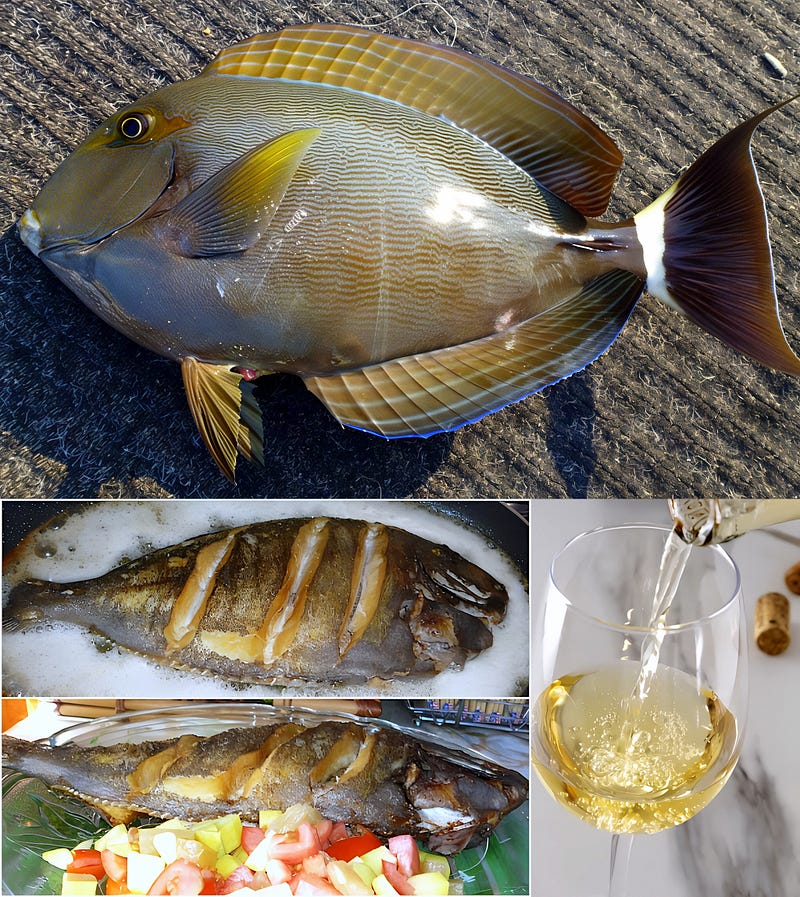
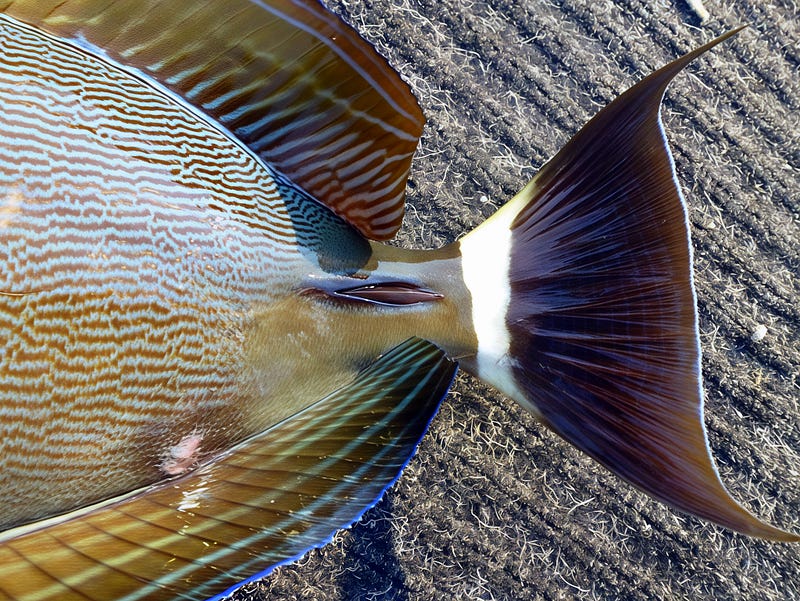
Sleek and laterally compressed, the finelined surgeonfish reaches lengths of about 40 cm (15.7 in), its body etched with fine, parallel lines that give the fish its name. These markings act as camouflage against the rippling light of shallow reefs. Like its relatives, it carries a sharp defensive spine near the tail, a biological “scalpel” that deters predators. Surgeonfish are herbivorous, grazing primarily on algae, a role that prevents algal overgrowth and supports coral health. Their life cycle mirrors other reef fish: larvae drift in the plankton before settling onto reefs, where they mature into agile swimmers patrolling the coral labyrinths.
Ecology
Native to the warm Indo-Pacific waters, from Indonesia to the Solomon Islands, the finelined surgeonfish thrives in coral reef ecosystems. Here, it functions as a keystone grazer, nibbling constantly on algal films that might otherwise suffocate coral polyps. Its role is vital: without surgeonfish, coral reefs can collapse into algal wastelands. Climate change, overfishing, and coral bleaching have placed many reef species under pressure, and while the finelined surgeonfish is not currently endangered, its habitats are increasingly fragile. Sustainable reef management and marine protected areas will be key to preserving its ecological role.

Uses
Economically, the finelined surgeonfish is valued both in artisanal fisheries and in the ornamental trade. Small-scale fishers in island nations catch it for local markets, where it is sold fresh or dried. Its sturdy build and vibrant patterns also make it a sought-after species for large aquariums, though responsible sourcing is essential to avoid reef depletion. Unlike larger pelagic fish, it is not a global export powerhouse, but in regional economies, it represents both protein and livelihood. Sustainability concerns arise when local demand exceeds natural reproduction rates, highlighting the need for fisheries management and reef conservation policies.
Culinary Aspects
In traditional island cuisines, the finelined surgeonfish holds a modest but notable place. Its flesh is white, lean, and subtly flavored, with a clean, briny taste that reflects its herbivorous diet. Prepared fresh, it is often grilled over coconut husk embers, steamed in banana leaves, or cooked into fish soups. A whole fish of 40 cm (15.7 in) yields fillets averaging about 0.75 lb (340 g), making it a practical catch for small households. Nutritionally, it is rich in protein and low in fat, with essential omega-3 fatty acids. However, like other reef fish, it carries some risk of ciguatera poisoning in certain regions, meaning consumption requires local knowledge of safe fishing grounds.
Wine Pairings
For those fortunate enough to enjoy the finelined surgeonfish at table, pairing it with wine enhances its gentle character. Its delicate flesh harmonizes with a crisp Sauvignon Blanc, especially those from New Zealand, whose citrus and grassy notes mirror the fish’s reef-foraged diet. A dry Riesling, with hints of lime and minerality, also works beautifully, balancing the clean, oceanic flavors. For a more indulgent preparation — grilled with coconut milk or spiced with chili — a lightly oaked Chardonnay provides enough body without overwhelming the dish.
Conclusion
The finelined surgeonfish is more than a reef-dweller with elegant stripes. It is a grazer, a protector of coral balance, a modest food source, and a living reminder of the fragility of marine ecosystems. Its beauty and utility tie it to human culture, yet its survival hinges on our stewardship of the seas. To savor its taste or admire its lines is also to recognize our responsibility: that the reefs, and the creatures within them, remain vibrant for generations to come.