The Golden Bloom of Utility: Unveiling the World of Safflower (Carthamus tinctorius)
Introduction Beneath the sunburnt plains of arid lands, a flower flourishes in defiance — bristling, brilliant, and brimming with promise…
Introduction
Beneath the sunburnt plains of arid lands, a flower flourishes in defiance — bristling, brilliant, and brimming with promise. The safflower, Carthamus tinctorius, is no mere ornament. With roots sunk deep into antiquity and petals once prized more than gold, this thorny survivor bridges the realms of botany, cuisine, commerce, and culture. A flower that stains fabrics, flavors stews, and fortifies economies, safflower tells the story of human ingenuity, sustainability, and the curious evolution of usefulness.
Taxonomy
Safflower belongs to the family Asteraceae, sharing lineage with sunflowers and daisies. Its scientific name, Carthamus tinctorius, speaks to its ancient role in dye-making — tinctorius meaning “used for dye.” Common names include false saffron, dyer’s saffron, and bastard saffron, often referencing its historical role as a cheaper surrogate for Crocus sativus, true saffron. While no subspecies dominate classification, selective breeding has produced distinct varieties optimized for oil production, pigment extraction, and drought tolerance. Among these, edible cultivars rich in linoleic or oleic acid have found their place in modern health-conscious kitchens.
Biology
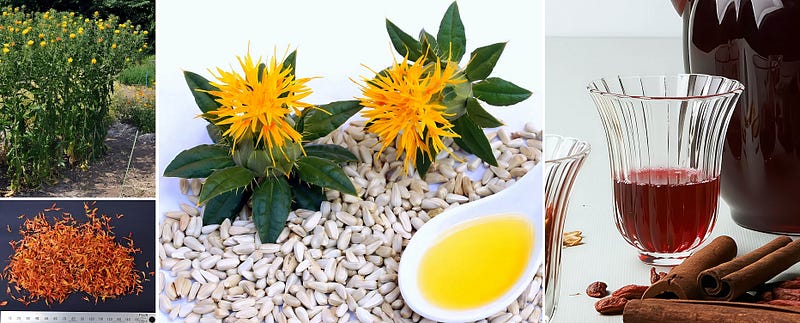
The safflower plant stands like a sentinel, upright and unyielding, growing between 12 to 60 inches tall — that is, 30 to 152 cm. Its deep taproot allows it to access moisture beyond the reach of other crops, a vital adaptation for survival in semi-arid climates. Spiny, lance-shaped leaves and clusters of vivid orange, yellow, or red flower heads bloom atop sturdy stalks, attracting pollinators with their bold display. Each flower head contains up to 150 florets, which eventually dry into seeds packed with oil and nutritional value. Its annual life cycle ensures that safflower can be cultivated rapidly and rotated easily with other crops.
Ecology
Native to the Fertile Crescent but naturalized far beyond, safflower thrives in dry, well-drained soils with full sun exposure. It has become a staple in countries like India, Mexico, Kazakhstan, and the United States, particularly in California and Arizona. Its resilience to heat and drought makes it a model crop for regions confronting water scarcity. Safflower fields provide habitat and forage for pollinators while requiring relatively few chemical inputs, thus appealing to organic and regenerative agricultural models. Though not invasive, its persistence and ruggedness can lead to competitive dominance in fallow or poorly managed fields.

Uses
Historically used to dye textiles, safflower was once a coveted export in ancient Egypt and Rome, fetching prices rivaling those of rare spices. Today, the seeds are pressed to produce safflower oil — one of the most heat-stable, flavor-neutral oils available. High-oleic safflower oil boasts a smoke point of 510°F (265°C), making it ideal for frying, roasting, and sautéing. Its high content of monounsaturated fats positions it as a heart-healthy alternative to more saturated options. Additionally, the petals, once a natural dye source, now find use in cosmetics, herbal teas, and traditional medicine. As a rotational crop, safflower improves soil health and supports biodiversity.
Culinary Aspects
In the kitchen, safflower reveals its quiet versatility. Its dried petals — sometimes misleadingly labeled as “Mexican saffron” — bring a mild, earthy flavor and golden hue to rice dishes, broths, and stews. Unlike saffron, safflower lacks the pungent intensity, but its subtlety makes it suitable for delicate dishes. Safflower oil, with its light taste and high smoke point, is prized for frying vegetables, searing fish, and baking pastries. A teaspoon of safflower petals steeped in hot water yields a delicate tea rich in flavonoids and antioxidants. The seeds can even be roasted and eaten as a snack, not unlike sunflower seeds.
Wine Pairings
Safflower’s culinary contributions — particularly through its oil and dried petals — lend themselves to light, aromatic wines. Dishes cooked in safflower oil, especially vegetable-forward or mildly spiced, pair beautifully with Sauvignon Blanc, whose herbaceous notes enhance the flower’s earthy undertone. When used in Middle Eastern rice dishes or North African tagines, a dry Riesling offers a lively contrast. For safflower-petal broths or teas, a chilled rosé or a crisp Albariño complements the floral nuance without overwhelming it. These pairings reflect safflower’s understated complexity, inviting wine to dance beside it rather than dominate.
Conclusion
The story of Carthamus tinctorius is not one of flamboyance, but of tenacity and transformation. It is a crop of the future rooted in ancient traditions — one that thrives where others falter, offers health where others harm, and adds color to lives long after its petals have faded. As we look toward climate resilience, culinary innovation, and sustainable agriculture, safflower deserves a renewed spotlight — not as a mere substitute, but as a sovereign star in its own right.