
The Hard Problem of Consciousness: Why Your Mind Feels Alive
Introduction Why does a lump of gray matter, thrumming with electrochemical signals, feel like anything at all? This is the question that…
Introduction
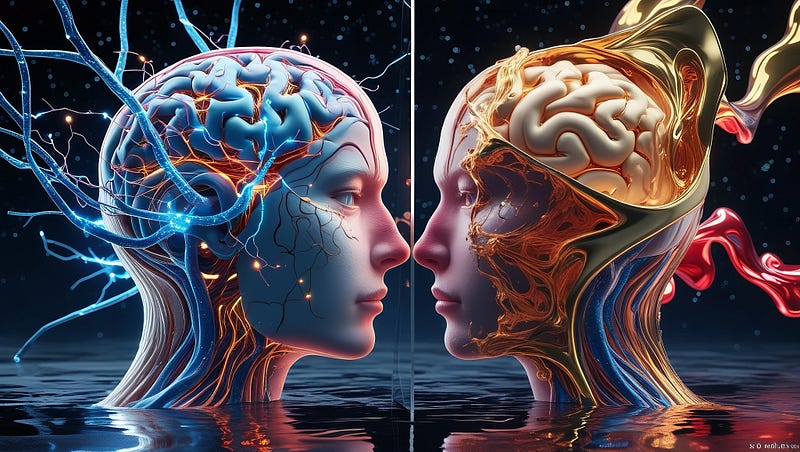
Why does a lump of gray matter, thrumming with electrochemical signals, feel like anything at all? This is the question that has haunted philosophers, neuroscientists, and mystics alike: the hard problem of consciousness. We can trace neural circuits and map brain regions until we’re blue in the face, but no scan explains why you feel the sting of salt on your tongue or the warm glow of sunlight on your skin. These inner sensations — called qualia — refuse to be reduced to mere data processing. And that, dear reader, is where the story begins.
The Puzzle at the Heart of Mind
Australian philosopher David Chalmers crystallized the hard problem in 1995, forcing science to confront a question it often prefers to sidestep: how do physical processes in the brain give rise to subjective experience? Imagine a robot built with perfect sensors and lightning‑fast processors. It could measure temperature, catalog colors, and store sound patterns with astonishing precision. But would it ever feel the chill of winter, or hear a melody and sense joy? The hard problem whispers that there’s something more — an irreducible, private reality that resists dissection.
Competing Theories of Consciousness
Scientists and philosophers have proposed frameworks to pierce this mystery, each offering glimpses but never the whole.
Integrated Information Theory (IIT):
This bold model suggests consciousness is woven into any system with sufficiently complex and unified information flow. By this logic, even a simple circuit might possess a faint spark of awareness. Supporters celebrate IIT’s elegance; critics bristle at its sweeping implications, wary of attributing experience to toasters and thermostats.
Global Neuronal Workspace:
Another popular approach holds that consciousness emerges when information in the brain becomes globally accessible — “broadcast” across regions for decision-making, memory, and verbal report. It explains why certain stimuli pop into awareness while others remain hidden. Yet it leaves unanswered the haunting question: why should broadcasting feel like anything at all?
Predictive Processing:
Here, the brain is a prediction machine, constantly generating models of the world and correcting them with sensory input. Perception becomes a kind of controlled hallucination. But even this elegant framework explains the mechanics of awareness without touching its mystery.
Radical Perspectives and Provocative Critiques
Some thinkers reject the hard problem outright. Illusionists claim our sense of inner experience is itself an elaborate cognitive trick, a byproduct rather than a phenomenon. Mysterians throw up their hands, suggesting the human mind may simply lack the conceptual tools to solve this riddle — just as an ant can’t fathom calculus.
Others go the opposite direction. Panpsychists propose that consciousness is a fundamental property of matter, a faint shimmer present even in particles, intensified by complex brains. Dual‑aspect monists argue that mind and matter are two sides of the same cosmic coin. Newer critiques point out that even our sense of space might itself be a quale, making our traditional explanations circular.
Emerging Research and Expanding Horizons
Recent work has taken an interdisciplinary turn. Studies on how the brain constructs spatial perception hint that qualia may arise from feedback loops between sensory input and cognitive architecture. Computational models explore fractal information structures, suggesting consciousness might persist through self‑replicating patterns that resist entropy. Cultural theorists weigh in, exploring how language and narrative shape our inner lives. The boundaries between neuroscience, philosophy, and art grow porous as the mystery deepens.
Why It Matters
This isn’t just academic musing. As artificial intelligence advances, we must grapple with whether a machine could ever truly feel. If we build a system with perfect neural correlates of human consciousness, will it possess subjective experience — or merely simulate it? The stakes are ethical as much as intellectual, shaping how we treat emerging forms of intelligence and how we understand our own.
Conclusion
The hard problem of consciousness refuses to be tamed. It humbles us, reminding us that even as we chart the brain’s circuitry, there remains a private, shimmering world that defies explanation. Perhaps the answer will come from a synthesis we can’t yet imagine — neuroscience enriched by philosophy, computation entwined with poetry. Until then, let this mystery stir your reflections. Look inward, feel the sunlight on your skin, and marvel that anything at all feels like something.