The Moral Frontlines: Douglas Murray’s Defense of Civilization in the Age of Democratic Erosion
Douglas Murray’s On Democracies and Death Cults: Israel and the Future of Civilization presents a forceful and unflinching polemic that…
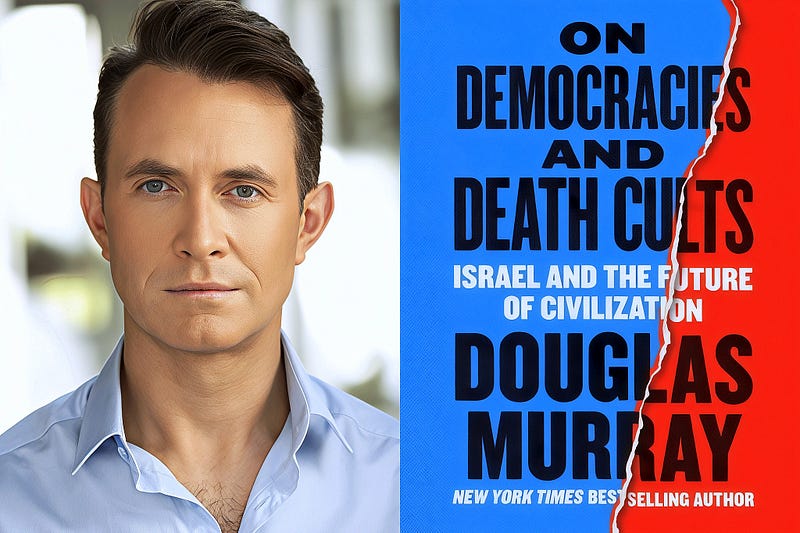
Douglas Murray’s On Democracies and Death Cults: Israel and the Future of Civilization presents a forceful and unflinching polemic that frames the Israel–Hamas conflict not merely as a geopolitical struggle but as a civilizational reckoning. Anchored in a deep belief in the values of liberal democracy — individual liberty, pluralism, reason, and the sanctity of life — Murray draws a stark moral line between Israel, which he casts as a beacon of Western ideals, and Hamas, which he characterizes as a death cult that glorifies martyrdom, violence, and annihilation. The book is both a moral outcry and a political manifesto, seeking to awaken a Western world that Murray believes is increasingly paralyzed by moral relativism and intellectual cowardice.
The centerpiece of the book is a searing reconstruction of the events of October 7, 2023, when Hamas launched a brutal assault on Israel. Murray presents the massacre through eyewitness testimonies and survivor accounts, giving voice to victims whose suffering, he argues, was often ignored or rationalized by global media, academia, and protest movements. For Murray, this event served as a revelatory moment, exposing what he sees as a crisis in Western moral reasoning. The widespread reluctance to unequivocally condemn the attacks, and in some quarters even to celebrate them, revealed to him a deep corruption within elite institutions and cultural discourse.
Murray’s narrative strategy is built on contrast. On one side stands Israel, portrayed as a multi-racial, liberal democracy striving for coexistence, albeit within a security framework forged by decades of existential threats. On the other side is Hamas, which he contends does not merely resist occupation but seeks the obliteration of an entire people and way of life. Murray positions Hamas within a broader ideological lineage that includes radical Islamist theology and, disturbingly, elements of historical antisemitism, including echoes of Nazi ideology. He contends that this ideological force is not merely political but theological and nihilistic, rooted in a celebration of death rather than a desire for life, compromise, or peace.
A recurring concern in the book is the reaction of Western societies to such events. Murray charges that intellectuals, academics, journalists, and political activists often fail to grasp or admit the gravity of the ideological stakes. The moral equivalence often drawn between Hamas and Israel, he argues, reflects a deeper self-loathing and confusion within Western liberalism. In failing to defend Israel robustly, the West, he warns, is failing to defend itself. For Murray, the erosion of moral clarity is symptomatic of a broader decay in the intellectual foundations of Western civilization.
While the book is rich in rhetorical force and persuasive urgency, it does not engage deeply with policy or historical nuance. Murray offers little exploration of the material conditions in Gaza, such as the humanitarian impact of the blockade or the socio-political divisions within Palestinian society. His framing, while compelling to those who share his worldview, leaves little space for moderate or critical engagement with Israeli policy, nor does it explore paths to peace or long-term solutions. The conflict is presented in binary terms: a struggle between civilization and barbarism, life and death, order and chaos.
To place Murray’s work in context, it is instructive to compare it with other recent literature on the Israel–Palestine conflict. Rashid Khalidi’s The Hundred Years’ War on Palestine offers a Palestinian nationalist narrative that frames the conflict as a colonial enterprise backed by Western powers. In contrast to Murray’s moral dichotomy, Khalidi emphasizes historical dispossession, imperial complicity, and the continuity of Palestinian resistance. The War of Return by Adi Schwartz and Einat Wilf argues that the Palestinian insistence on the right of return is a primary obstacle to peace, proposing a realist two-state framework grounded in legal and demographic pragmatism. Norman Finkelstein’s Gaza: An Inquest into Its Martyrdom presents a meticulous, legalist indictment of Israeli military actions in Gaza, accusing Israel of repeated violations of international law and challenging Western complicity.
Each of these works offers a distinct ideological lens, and taken together, they reveal the profound polarization and complexity of the discourse. Murray’s contribution stands out for its civilizational framing and unapologetic defense of Western liberalism, but its rhetorical absolutism risks alienating readers who seek more balanced analyses or humanitarian considerations for both sides. Nonetheless, it remains a significant intervention — forceful, provocative, and unrelenting in its demand for moral clarity in an era of intellectual confusion.
In an age where democratic values are increasingly challenged both from within and without, On Democracies and Death Cults asks whether the West still dares to defend itself — not only militarily, but morally and philosophically. It is a book that demands to be reckoned with, even if it does not offer a roadmap forward.