The Mountain’s Feathered Flame: Chukar Partridge and the Wild Harvest of the High Deserts
Introduction
Introduction
In the parched crags of Central Asia and the sun-bleached plateaus of the American West, there lives a bird as elusive as it is emblematic. The chukar partridge — Alectoris chukar — moves with the defiant grace of something born from stone and storm. It is the wild heart of rugged uplands, both hunted and revered, both beautiful and bitter. For the ecologist, the chukar is a symbol of hardy adaptation; for the chef, a canvas of ancient flavor. And for the conservationist, it is a lesson in the delicate equilibrium between nature and human appetite. Today, we journey into the highlands where the chukar reigns and explore its legacy at the intersection of biology, culture, and cuisine.
Taxonomy
The chukar partridge belongs to the genus Alectoris, nestled within the family Phasianidae. Native to southern Eurasia — from eastern Greece to western China — Alectoris chukar was introduced across western North America in the 1930s, where it now thrives in the basalt-littered deserts of Nevada, Utah, and eastern Oregon. Despite this vast range, it remains a single, cohesive species, though regional subspecies have been described based on subtle plumage differences.
The bird is known simply as “chukar” in English, a name borrowed from its Hindi and Urdu onomatopoeic cry: chakur-chakur. In the Middle East, it is called kaftar, and in Nepal, dhodre. Though not domesticated, the chukar has found its way into game farms and controlled hunting preserves, prized for its spirited flush and table-worthy size.

Biology
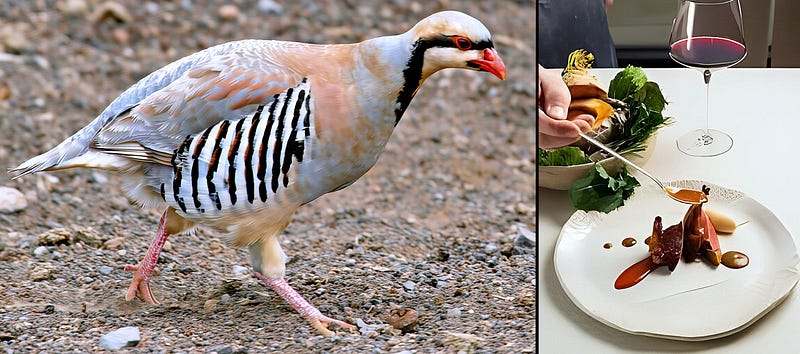
A chukar partridge stands roughly 14 in tall and weighs between 19 to 27 oz (540 to 765 g). Its plumage blends harmoniously with the scree and shale of its habitat — grey-brown back, buff belly, and bold black stripes along the flanks. A thick black band wraps across its forehead, eyes, and neck like a masked warrior. Its legs are coral red, its beak sharp and carmine.
Chukars are ground-dwelling birds that favor rocky, arid slopes between 3,000 to 9,000 ft (914 to 2,743 m) in elevation. Monogamous in breeding, a hen lays between 8 to 20 eggs per clutch in a shallow ground nest. Chicks hatch precocial — eyes open, fully feathered, ready to run. The lifespan in the wild averages three to five years, though predators and climate extremes frequently cut this short.
What makes the chukar exceptional is its endurance. It runs uphill in explosive bursts, and though it can fly, it prefers scrambling among stones with the kinetic elegance of a parkour artist. Its diet consists of seeds, grasses, and insects, but when food is scarce, it adapts with stoic tenacity, foraging thorny scrub and saltbush.
Ecology
The chukar is not simply a bird — it is a litmus test for ecosystem integrity in some of the world’s harshest upland terrains. In its native range, it plays a modest but stable role in dry mountain food webs. In the United States, it occupies an ecological niche vacated by extinct or displaced native ground birds.
Its introduction, while largely successful, has not been without controversy. Invasive potential, competition with native species like sage-grouse, and habitat degradation from overgrazing complicate its ecological standing. However, studies show that in most western states, chukar populations have become relatively stable and self-regulating — sustained without supplemental stocking.
Hunters play a surprising role in chukar ecology. In states like Idaho and Nevada, chukar hunting is a revered tradition, and revenue from licenses funds conservation initiatives. Proper management ensures that harvests remain sustainable, and that their rugged habitat — often shared with bighorn sheep and golden eagles — is preserved for generations.
Uses
Economically, the chukar’s greatest value lies in gamebird hunting. Its flush is challenging, its flight unpredictable, and its terrain merciless. Upland bird hunters speak of “chukar legs” with the same reverence marathoners reserve for “runner’s high.” It is not a sport for the faint-hearted.
Game farms also rear chukar for controlled shoots and culinary markets, where prices can reach as high as $8.50 per bird. Unlike factory-raised chicken, chukar require less water, less feed, and thrive in semi-wild outdoor pens. This lends itself to more humane and sustainable husbandry practices, appealing to chefs and consumers alike who value ecological responsibility.
Because chukars do not lend themselves to intensive industrial farming, they remain largely seasonal, regional, and artisanal in the culinary world — a model of sustainability by limitation.
Culinary Aspects
The flavor of chukar is lean, subtly gamey, and unmistakably wild. Its meat is darker than chicken but milder than pheasant. When roasted whole, its skin crisps to a golden crackle while the flesh within remains earthy and moist. Marinating in olive oil, citrus, and herbs like rosemary or za’atar brings out its best qualities.
In traditional Persian cooking, chukar is sometimes stewed with barberries and saffron. In rural Greece, it’s grilled over hardwood and served with lemon wedges and charred eggplant. A single roasted chukar yields about 6 oz (170 g) of edible meat — making it a perfect small-plate centerpiece or part of a multi-course rustic meal.
Nutritionally, chukar meat is high in protein and B vitamins while remaining low in saturated fat. A 3 oz (85 g) serving provides roughly 25 g of protein and only 3 g of fat — ideal for lean game lovers seeking nutrient density without heaviness.
Wine Pairings
The chukar’s flavor, perched between poultry and venison, calls for thoughtful pairing. A light red wine like Pinot Noir brings out its earthy undertones without overpowering them. Wines from Oregon or Burgundy are ideal — those with forest floor notes and bright acidity to cut the gaminess.
For those preparing it with Mediterranean spices or fruit glazes, a dry Rosé or Grenache offers balance, particularly if the dish includes sumac, cherries, or pomegranate. If you choose a white, go bold — a French Viognier or aged Chardonnay with enough oak and depth to stand its ground.
The wine, like the chukar, should speak of place — arid, stony hillsides, sunburned vineyards, and rugged landscapes.
Conclusion
The chukar partridge is more than a game bird — it is a creature of story, terrain, and endurance. From the Himalayan steppes to the Snake River plains, it embodies the marriage of wild instinct and culinary potential. In a world increasingly divorced from the sources of its food, the chukar stands as a living reminder of how nature provides when we respect its tempo.
Let us hunt with care, cook with reverence, and conserve with foresight. In doing so, the flame-feathered spirit of the mountains will remain with us — not just on the plate, but in the heart of the land.