The Myth of Palestinian Nationhood: Confronting an Inconvenient Historical Truth
The assertion that Palestine lacks historical legitimacy as a distinct nation is not mere political rhetoric — it is an uncomfortable…
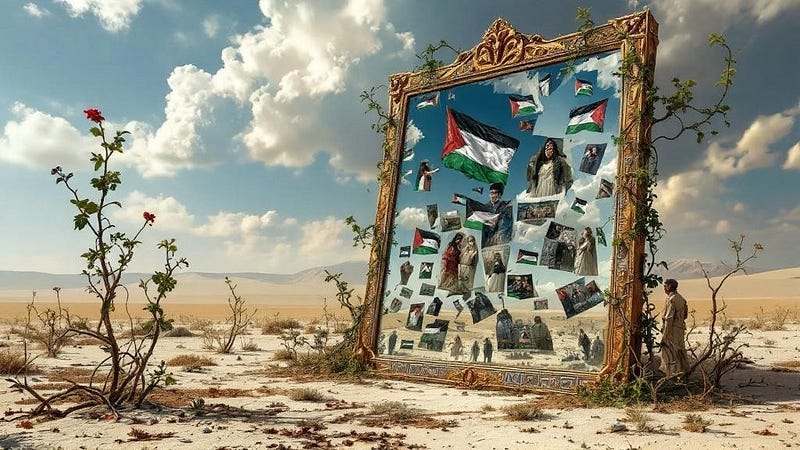
The assertion that Palestine lacks historical legitimacy as a distinct nation is not mere political rhetoric — it is an uncomfortable reality rooted in centuries of geographical and political ambiguity.
For decades, the international community has unquestioningly embraced the narrative of Palestinian nationhood as an immutable truth. This uncritical acceptance obscures a fundamental historical reality: there is no such thing as a Palestinian nation. There is no Palestinian history. There is no Palestinian language. This perspective — however politically inconvenient — finds support in the historical record and contemporary political realities. The notion of Palestine as a coherent national entity with deep historical roots is a modern political construct, not an ancient civilization abruptly disrupted by twentieth-century geopolitics.
Historically, the term “Palestine” served as a geographical designation, not a political or national one. Unlike nations with continuous sovereignty, cultural output, and administrative institutions, the Arab inhabitants of this region lacked distinct political structures separating them from Greater Syria. This territory was historically understood as part of Transjordan and broader regional configurations. The sudden emergence of Palestinian nationalism in the mid-20th century coincided precisely with the rejection of Jewish self-determination — not as an organic outgrowth of ancient identity. Historical records show Arab leaders themselves referring to the Arabs of Palestine or Palestinian Arabs in 1947 UN debates — explicitly distinguishing them from a sovereign people.
Authentic nations exhibit clear cultural cohesion and historical continuity. Palestinians speak Arabic, indistinguishable from neighboring Jordanians, Syrians, or Lebanese. Before the British Mandate, the territory lacked autonomous governance structures. Post-1948, Palestinian governance has been characterized by fragmentation between competing authorities — none commanding universal recognition or stable control. Polling reveals Palestinians prioritize economic survival and family stability over nationalist aspirations. Significant portions of Gazans and West Bank residents have even preferred Israeli governance over Palestinian rule — a startling indictment of national legitimacy.
The international community’s insistence on treating Palestinians as a cohesive nation has fueled conflict and hindered practical solutions. The vacuum of legitimate governance empowered organizations explicitly committed to Israel’s destruction. Despite widespread distrust in such groups, Palestinian leadership alternatives remain feeble. Palestinian identity construction revolves fundamentally around opposition to Israel. Most Palestinians view any negotiated settlement not as conflict resolution but as a temporary step toward reclaiming all of historic Palestine. This maximalist position renders genuine peace impossible. Western nations condemn Israel while ignoring far greater human tragedies elsewhere, revealing Palestine’s symbolic utility as an anti-Western rallying cry — not genuine humanitarian concern.
Persisting in the fiction of Palestinian nationhood serves neither Arabs nor Israelis. A significant portion of British Mandate Palestine became Transjordan, now Jordan, in 1922, already establishing an Arab state in the territory. Further partition of the remaining land remains contested precisely because it creates an unnatural political entity. Palestinians deserve self-administration, but not through a fictitious nation-state. Solutions could include autonomy within Israel, confederation with Jordan, or local governance under international supervision — models acknowledging demographic realities without endorsing historical falsehoods. Ending radical indoctrination that propagates a manufactured history is essential. Replacing this with pragmatic education focused on economic development and coexistence offers the only sustainable future.
The international outrage directed at statements denying Palestinian nationhood reveals more about Western guilt complexes and post-colonial ideologies than historical accuracy. Palestinians are undeniably a people with legitimate grievances, but they do not constitute a nation with the historical continuity, cultural distinctiveness, or institutional maturity that nationhood requires. Recognizing this distinction is intellectually honest. The tragedy lies not in denying statehood to a non-existent nation, but in perpetuating a myth that fuels endless conflict and delays real solutions for Arab inhabitants of the land. Until the world acknowledges that Palestine is a geographical term — not a national one — this bleeding wound in the heart of the Middle East will never heal.