The Necessary Impossibility: A Requiem for Old Paradigms and a Blueprint for Radical Coexistence
For any solution to the Palestinian-Israeli conflict to transcend the graveyard of failed initiatives, it must first undergo a catastrophic…
For any solution to the Palestinian-Israeli conflict to transcend the graveyard of failed initiatives, it must first undergo a catastrophic dismantling of its foundational assumptions. The crisis is not a simple political dispute but a deeply fused amalgam of traumatic memory, competing sovereignties, and fractured identities. Thinking outside the box requires recognizing that the box itself — the nation-state model as traditionally conceived — may be part of the problem. A workable solution demands not a transaction, but a transformation.
The first non-negotiable requirement is the abandonment of the “zero-sum” paradigm. The current logic dictates that a win for one side is inherently a loss for the other: land, security, sovereignty, and even historical narrative are treated as finite commodities to be won or lost. This must be replaced by a “positive-sum” framework where the security and dignity of one nation is understood as inextricably linked to the security and dignity of the other. Israel cannot have true security while Palestinians live in despair under occupation, and Palestinians cannot achieve self-determination while Israelis live in fear of annihilation. This is not a moral platitude but a strategic imperative. An international consortium, with unprecedented authority and backed by major global and regional powers, must be established not merely to mediate, but to guarantee this interconnected reality, acting as a permanent referee with the mandate to enforce violations on either side.
The abandonment of the zero-sum paradigm is the foundational pivot upon which any truly new solution depends. It is not a vague hope for harmony, but a hard-nosed architectural principle that must be engineered into the very structure of a new political reality. To visualize this, we must design the system that makes it inescapable.
This requires the creation of a permanent and powerful international body, which we will call the Joint Sovereignty Guarantor (JSG). This would not be another temporary UN monitoring mission. It would be a consortium led by the US, EU, Arab League (specifically Egypt, Jordan, Saudi Arabia, and the UAE), and perhaps China, granted unprecedented and legally binding authority by the UN Security Council to act as the ultimate referee and guarantor for a fixed period of 25 years, with a phased draw-down clause.
The JSG’s mandate would be to enforce the principle of interconnected security and dignity through concrete mechanisms. Its governance would be a bicameral council with an upper house of international representatives and a lower house with equal representation from Israeli and Palestinian civil society — engineers, doctors, artists, business leaders — who have a vested interest in normalcy, not political posturing.
The JSG would operationalize the positive-sum framework in three critical domains:
First, in Security and Law Enforcement, the JSG would command a dedicated, multinational rapid reaction force. This force would be the only entity legally permitted to operate heavy weaponry between the Jordan River and the Mediterranean. Its purpose is not to occupy, but to neutralize threats to the agreed-upon order. If a militant group launches rockets from Palestinian areas, this JSG force, not the Israeli army, would be responsible for confronting and dismantling that cell. Conversely, if an Israeli settler militia attacks a Palestinian village, the same JSG force would intervene to arrest the perpetrators. This removes the cycle of unilateral retaliation and replaces it with a predictable, impartial enforcement mechanism that protects both communities equally from violence, making security a shared commodity, not a contested one.
Second, in Economics and Infrastructure, the JSG would administer a “Cross-Border Benefit Trust.” All tax revenues, customs duties, and proceeds from shared natural resources like gas and water would be pooled into this trust. Disbursements to Israeli and Palestinian authorities would be contingent on verifiable cooperation. For instance, funds for a new Israeli desalination plant would be released only if it also pipes a guaranteed quota of water to Palestinian communities. Similarly, a grant for a Palestinian industrial park is approved only if it guarantees a percentage of jobs to Israelis and Palestinians. This makes prosperity literally interdependent. Attempting to hoard resources or strangle a neighbor’s economy would immediately trigger a financial penalty for both sides, making cooperation the most financially rational path.
Third, and most profoundly, in Narrative and Education, the JSG would oversee a “Committee for Historical Context.” This is not about creating a single, sanitized history book. It is about mandating that all educational curricula, on both sides, must include the foundational historical narratives of the other as a required part of the syllabus. Israeli students would be required to learn about the Nakba from primary Palestinian sources, and Palestinian students would be required to learn about the Holocaust and the millennia of Jewish connection to the land. The JSG would not dictate what to think, but it would enforce the requirement to know what the other side thinks and feels. This systematically dismantles the ignorance that allows each side to dehumanize the other, making the zero-sum narrative — that the other’s story must be erased for ours to be valid — impossible to sustain.
In this system, a violation by one party is no longer an opportunity for the other to gain a moral or military advantage. It becomes a problem for the JSG to solve, a problem that damages the shared economic and security infrastructure that benefits everyone. This architecture makes the security and dignity of each nation a prerequisite for the other, not its enemy. It transforms a conflict over a divisible pie into a collaborative project to build a bigger, shared oven.
Second, the solution must be holistic, simultaneously addressing the deepest traumas of both nations. This means decoupling the political future from the historical past through a formal, internationally recognized Truth and Reconciliation Commission. Unlike its predecessors, this body would have a dual mandate: to acknowledge the Jewish people’s historical persecution and the existential necessity of a secure homeland, while also fully acknowledging the Palestinian experience of displacement, the Nakba, and the realities of occupation. This would not be about assigning blanket blame but about creating a shared, verified record of events that allows both nations to be heard and their pain validated as a prerequisite for political negotiation. Without this psychological groundwork, any territorial or political agreement will be built on sand.
A Truth and Reconciliation Commission (TRC) for the Israeli-Palestinian conflict would be a formally established, internationally sanctioned body with a mandate to investigate and create a definitive record of the key historical events and grievances from both sides since 1948. Its operation would not be a vague exercise in dialogue but a structured process focused on establishing a shared factual foundation. The TRC would possess subpoena power to collect testimonies from victims, perpetrators, and officials, examining the historical context of Jewish persecution and the founding of Israel, alongside the Palestinian narrative of displacement, the Nakba, and the subsequent decades of occupation and conflict. Its goal would be to forensically document human rights violations, war crimes, and acts of persecution experienced by all communities. The commission’s final report would not assign collective guilt but would individualize responsibility where evidence exists and, most critically, would formally validate the historical suffering and existential fears of both nations. This process would “solve” the problem by dismantling the weaponized denial that fuels the conflict, creating an authoritative historical record for educational systems to replace competing nationalist narratives, and providing a psychological release valve of acknowledgment that is a necessary precondition for any political settlement to endure.
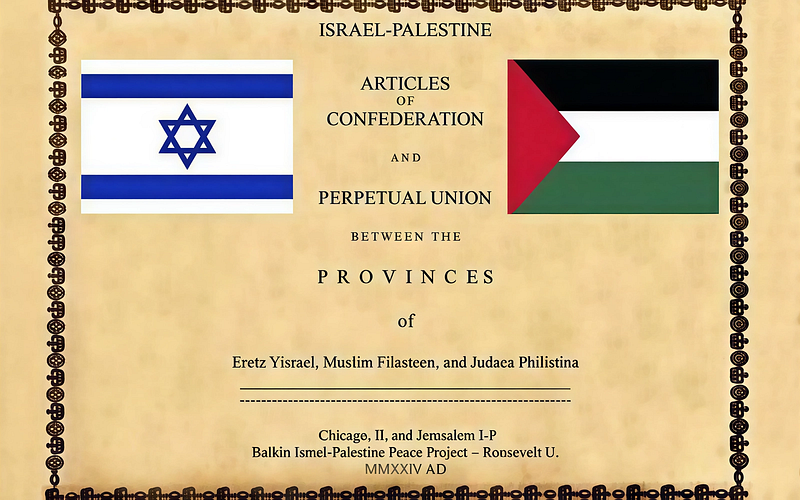
Third, the concept of sovereignty itself must be reimagined. The rigid, Westphalian model of fully independent states with hard borders may be unworkable in the cramped, intertwined geography of Israel-Palestine. A more viable model could be a hybrid confederation or a European Union-like structure. In this scenario, two sovereign entities, Israel and Palestine, would exist with their own flags and passports but would cede certain key authorities to a supranational body. This joint authority would manage cross-border security, water resources, the environment, and economic policy, while ensuring freedom of movement for all citizens. Jerusalem would not be divided but serve as a shared federal capital, its governance administered by a special council with guaranteed representation for all faiths.
Forget two states along the 1967 lines. Forget a single, bi-national state. Instead, imagine a single, sovereign entity — a “Commonwealth” or “Union” — stretching from the Jordan River to the Mediterranean Sea, but one that radically redefines what sovereignty means. This is not a unitary state; it is a platform for multiple, overlapping jurisdictions where identity and citizenship are decoupled from geography and military control.
This Union’s central government would be minimalist, handling only those functions that are indivisible: cross-border infrastructure, international trade, and a central bank. It would have a single, demilitarized international border, permanently monitored by a robust, third-party international force with a mandate to protect the Union’s territorial integrity from any internal or external threat.
The radical innovation lies beneath this tier. Instead of two territorial states, there would be multiple, non-territorial “Cantons” or “Districts” based on community and affiliation. A “Tel Aviv Canton,” a “Gaza Canton,” a “Hebron Canton,” and a “West Bank Settlements Canton” would all exist. These Cantons would not have hard borders. Their jurisdiction would be over people and community life — managing local education, culture, and religious affairs for their members, regardless of where those members live physically within the Union.
Crucially, every individual would hold dual citizenship: one in the overarching Union, and one in their chosen Canton. A person could live in a physically mixed city like Jerusalem, participating in the city’s unified municipal economy, while sending their children to a school run by their Canton and voting in that Canton’s elections. This system allows for deep cultural and communal autonomy without granting any one group exclusive territorial control over land that the other group also claims as its heartland.
Security, the ultimate deal-breaker, would be transformed. The old model of one army policing another is abolished. Instead, a unified internal security service, staffed by both Palestinians and Israelis under international command and focused on policing, not warfare, would be responsible for law and order for all citizens. The existing militant groups would be disbanded, with their members offered integration into this new service or into the civil infrastructure of the new Cantons.
This model accepts the deeply intertwined, post-1967 reality on the ground as a fait accompli that cannot be surgically undone. It does not try to separate the two populations but creates a flexible political structure that allows them to be together, yet apart, in the same space. It replaces the quest for partition with a framework for complex, negotiated coexistence, making the very idea of dominating the other logistically and legally impossible. It is a system designed not for the perfect peace of friends, but for the necessary and productive coexistence of perpetual rivals.
Fourth, the refugee issue — the open wound of the conflict — requires a bold, multi-pronged approach that transcends the simplistic choice between return and resettlement. The solution lies in offering a menu of dignified options, including citizenship in the new State of Palestine, permanent residency with compensation in current host countries facilitated by a massive international fund, and a limited, agreed-upon number of family reunification cases in Israel proper. Crucially, the “right of return” would be recognized as a principle satisfied by this package of choices, not as an unlimited literal right that would dismantle Israel.
The refugee issue is the deepest and most emotionally charged wound of the conflict, and addressing it requires a mechanism that is both just and pragmatic, acknowledging the past without destabilizing the future. Here is a detailed expansion of how such a multi-pronged approach would function.
The entire process would be governed by a single, internationally constituted and funded body, which we will call the Permanent Refugee Resolution Authority (PRRA). This would not be a temporary UN committee but a powerful, permanent institution with a finite mandate to resolve all outstanding claims within a defined period, perhaps 15 years. Its authority would be binding and recognized by all participating states, including Israel, Palestine, and host countries like Jordan, Lebanon, and others.
The “menu of dignified options” would be a formalized, transparent process. Every registered refugee and their descendant would be required to register with the PRRA to receive a comprehensive package of benefits, the core of which is a significant lump-sum compensation paid into a personal account. This compensation, funded by a consortium of the EU, Gulf States, the United States, and other international donors, would be universally granted as recognition of suffering and displacement, irrespective of the subsequent choice made. This financial foundation is crucial for empowering genuine choice.
The first pathway is Citizenship and Integration in the State of Palestine. For those choosing this option, the PRRA would facilitate their settlement, providing not just citizenship but also access to housing grants, business loans, and priority for jobs in the massive reconstruction projects underway in the new Palestinian state. This chooses to build a homeland materially and politically viable.
The second pathway is Permanent Residency with Enhanced Status in the Current Host Countries. This is the critical lever for resolving the crisis in places like Lebanon. In exchange for a massive infusion of international aid to upgrade infrastructure, schools, and hospitals, host countries would agree to grant Palestinians choosing to remain full civil rights, including the right to work, own property, and access social services, transforming them from stateless refugees into permanent residents with full legal standing. Their compensation package from the PRRA would facilitate their integration and economic mobility within these societies.
The third pathway is Immigration and Citizenship in Third Countries. A dedicated arm of the PRRA would negotiate with nations like Canada, Australia, Germany, and others to accept specific quotas of refugees under generous immigration programs, with their travel and initial settlement costs covered by the international fund.
The fourth, and most sensitive, pathway is Family Reunification and Limited Return to Israel. This would not be a blanket “right of return” but a tightly managed humanitarian program. A strictly limited, agreed-upon number of slots — perhaps 100,000 over a decade, negotiated as part of a final treaty — would be allocated to cases demonstrating direct lineage to specific towns or villages within Israel’s 1948 borders, with priority given to those with immediate family members already living as citizens in Israel. Those admitted under this program would receive Israeli citizenship, undergoing a structured process of integration. This pathway symbolically acknowledges the principle of return without constituting a demographic threat.
Crucially, the act of selecting any one of these options — and receiving the associated benefits and legal status — would constitute a final settlement of the individual’s claim. The “right of return” would be legally interpreted as the right to a comprehensive and dignified solution, fulfilled by this menu of choices. This framework acknowledges the moral weight of the Palestinian narrative while creating a practical, executable mechanism that provides closure, grants legal status to millions, and stabilizes the region, finally allowing the refugee issue to transition from a perpetual political weapon into a resolved chapter of history.
Finally, a Marshall Plan for the region, funded by the EU, Gulf States, and the United States, must be launched to build a viable, interconnected economic future. This would involve massive investment in infrastructure, education, and technology in both Israel and Palestine, creating a shared economic ecosystem where prosperity is interdependent. Joint industrial parks, shared water desalination projects, and collaborative tech hubs would create a tangible peace dividend for ordinary people, making the cost of returning to conflict unacceptably high.
A “Marshall Plan” for the region must be far more than a vague infusion of cash; it must be a generational undertaking designed to build a single, integrated economic zone from the Mediterranean Sea to the Jordan River. The core engine of this plan would be a new Regional Development Authority, a powerful institution governed by a board comprising the major funders — the EU, Gulf States, and the United States — alongside Israel, Palestine, and key regional neighbors like Jordan and Egypt. This Authority would function not as a charity but as a strategic investment bank with a mandate to approve and fund only those projects that demonstrably create tangible interdependence between the two societies.
The physical landscape would be transformed by megaprojects designed for shared benefit. This includes building cross-border transportation corridors and streamlined logistics hubs to seamlessly connect Gaza and the West Bank to each other and to Israel and Jordan. Joint industrial parks would be established as integrated ecosystems where Israeli advanced manufacturing and Palestinian entrepreneurial talent and labor coalesce, supported by reliable energy from a shared regional grid. The most critical infrastructure would address water scarcity through the construction of massive, solar-powered desalination plants along the coast, with their output managed by a binational water authority pumping into a unified network for all communities.
Beyond infrastructure, the plan would target human capital through the creation of collaborative tech hubs in key cities, physically bringing together Israeli venture capital with Palestinian engineering and software talent. These would be linked to a radical educational initiative: a binational university for science and technology with campuses in Tel Aviv, Ramallah, and Gaza. Finally, to empower the grassroots economy, a direct investment fund for small and medium-sized enterprises would prioritize businesses that demonstrate cross-community partnerships. The entire economic transformation is contingent on a durable security framework guaranteed by the international community, making the cost of returning to violence unacceptably high by making daily prosperity visibly intertwined for everyone.
Who’s Going to Pay for All of This?
This is the pivotal question, and the answer lies in understanding the proposal not as an aid package but as a strategic investment in global stability. The funding consortium would be built on a foundation of shared interest, compelling a diverse group of international and regional actors to contribute. The financial burden would be distributed across several key pillars, each with a clear rationale for participation.
The primary donors would be a consortium of the United States, the European Union, and the wealthy Gulf States, specifically Saudi Arabia, the United Arab Emirates, and Qatar. For the US and EU, this is a strategic imperative. They are already spending immense sums on military aid and managing the geopolitical fallout of the conflict. This Marshall Plan would be a larger but more cost-effective long-term investment, aimed at permanently resolving a core source of regional instability that threatens global energy supplies and security. For the Gulf States, it is an extension of their vision for a post-oil economy and regional integration. Their massive sovereign wealth funds are designed for exactly this type of transformational infrastructure project. Achieving a final resolution to the Palestinian issue would also remove a primary obstacle to formal diplomatic and security ties with Israel, unlocking unprecedented trade and technological cooperation for the Gulf.
Israel itself would be a significant contributor, not through direct cash transfers to a fund, but through the redirection of its own national resources. The immense annual defense budget, which is currently spent on maintaining the occupation and countering threats, would be progressively reallocated as a new security reality takes hold. The funds currently spent on checkpoints, separation barriers, and military operations in the West Bank could be diverted into co-investment in the joint desalination plants, cross-border railways, and energy grids that would directly benefit the Israeli economy. This is not an expense, but a reinvestment of the peace dividend into shared prosperity.
The private sector would form the third crucial pillar of funding. The Regional Development Authority would not just dispense grants; it would use public funds to de-risk and catalyze private investment. By issuing bonds backed by the consortium of nations and guaranteeing loans for specific projects, the Authority would attract global pension funds, private equity, and venture capital looking for stable, long-term returns in emerging infrastructure. The establishment of joint tech hubs and industrial parks would draw direct investment from multinational corporations eager to access a newly integrated market with a highly skilled, bilingual workforce.
Finally, the financial architecture would be designed to ensure accountability and sustainability. Funds would be disbursed in tranches, tied to verifiable milestones in political and economic reforms, such as the dismantlement of militant infrastructures and the implementation of anti-corruption measures. A significant portion of the funding would be structured as low-interest loans, not grants, to be repaid over time by the nascent Palestinian state and the Israeli government from the increased tax revenues generated by a booming, integrated economy. This creates a cycle of investment and return, transforming a bottomless pit of humanitarian aid into a self-sustaining engine of growth. The world is already paying for the conflict; this plan proposes to pay for its solution.
The Global Stability Levy: Ending the American Checkbook, Financing Peace with the World’s Pocket Change
The critique that the U.S. bears a disproportionate burden is valid and reflects a widespread sentiment. A truly “outside the box” solution must be genuinely global, moving beyond the traditional model of American-led funding. This requires a system where every nation has skin in the game, not through voluntary charity, but through a mandatory, rules-based framework that redefines national interest.
The funding mechanism must be overhauled entirely. Instead of a donation-based consortium, the solution is a Mandatory Global Stability Levy, administered by the United Nations. This would not be a tax on citizens but a microscopic charge on the two most borderless and profitable sectors of the global economy: international currency transactions and multinational corporate profits. A fee of a fraction of a percent on all foreign exchange transactions, coupled with a tiny levy on the global revenue of tech and energy giants that operate across borders, would generate hundreds of billions annually without impacting national treasuries or middle-class taxpayers. This makes the system self-financing from the very globalization that conflict disrupts.
Contributions must then be compulsory and scaled based on a principle of capacity and interest. The traditional major powers — the U.S., EU, and China — would contribute the largest shares, calculated as a percentage of their GDP, into the central fund. This is not altruism; for China, it is a down payment on securing the Belt and Road Initiative’s stability and asserting its role as a global leader. For the EU, it is an existential investment in preventing further refugee crises and border instability on its doorstep.
However, the radical shift is that this plan explicitly makes the primary beneficiaries of a stable Middle East pay for its stability. The hydrocarbon-rich nations — Saudi Arabia, the UAE, Qatar, and others — would be required to contribute not just cash, but a percentage of their oil and gas revenue into a dedicated escrow account. Their economies are the most directly threatened by regional conflict, and their sovereign wealth funds are the most capable of funding a century-scale project. Furthermore, a consortium of global defense contractors — whose business models often profit from ongoing conflict — could be legally obligated through a UN Security Council resolution to contribute a percentage of their annual revenue to the fund as a form of mandated investment in peace, effectively turning swords into ploughshares.
The administration of these vast resources would be placed under a transparent, international body like the proposed Regional Development Authority, with audits published publicly and oversight from a board representing all contributing blocs. This ensures no single country, including the U.S., has unilateral control over the funds.
This model fundamentally reframes the issue. It is not about American taxpayers solving a distant problem. It is about constructing a global system where every nation, especially those that have benefited from the status quo or whose products thrive on instability, is legally and financially obligated to invest in a solution. It makes inaction more costly than action for all parties involved. The U.S. would contribute, but as one participant in a global pact, finally sharing the burden equitably and ending the era of writing blank checks alone.
What is required is a leap of imagination that dares to see the map not as a line to be drawn, but as a shared space to be collaboratively built. It requires isolating the extremists on both sides through a superior vision that offers a compelling future for the overwhelming majority who crave normalcy. The solution is not found in partitioning the past, but in architecting a common future.