The Only Prayer Is Another Sunrise
The mud of the Somme was a different kind of cold than the frost of Stalingrad, which was a different beast entirely from the damp chill of…
The mud of the Somme was a different kind of cold than the frost of Stalingrad, which was a different beast entirely from the damp chill of the Korean hills. But Elias knew them all. He sat in the belly of a CH-46 Sea Knight, the thrumming of the rotors a vibration in his teeth, a sensation older than the helicopter itself. It was the same hum he’d felt in the trireme, the same dread rhythm of the drum before the push into no-man’s-land.
Next to him, a boy — couldn’t be more than nineteen — named Kowalski, was praying. The words were a frantic, whispered stream: “Hail Mary, full of grace, the Lord is with thee…”
Elias felt the ghost of a smile touch his cracked lips. He’d prayed to Athena, to Odin, to a hundred different gods whose names were now dust. He’d worn their talismans, shouted their names in charges. They were all fashions. They didn’t stop shrapnel.
He tuned out Kowalski’s prayer, the roar of the engines, the nervous jokes of the other marines. His whole being was focused on the sound of the rotors. He was listening for a hitch, a change in pitch that would mean a surface-to-air missile had found them, or that a blade was about to shear. That was the only sound that mattered now. Not the Lieutenant’s grand briefing about “strategic hamlets” and “hearts and minds.” Those were the grand lies. The truth was in the machinery, in the wind, in the silence just before the storm.
The helicopter settled in a clearing, the ramp groaning down. The jungle outside was a solid wall of green, screaming with unseen life. They fanned out, the humidity an immediate, suffocating blanket. For hours, they moved. Nothing. The waiting.
Elias moved with an economy of motion that was almost lazy. The new ones, like Kowalski, were tense, eyes darting, fingers tight on their triggers, burning through their energy. Elias conserved his. He was a stone, absorbing the heat, letting the jungle life move around him. The war was a beast. It would come. His job was not to hunt it, but to be ready.
When the ambush came, it was not with a shout, but with a whisper — the phut of a mortar launching. Then the world dissolved into noise and flying earth.
“Contact front!” someone screamed, a useless, frantic sound.
Elias was already in a shallow depression, his mind clear. His M16 felt familiar, a direct descendant of the musket, the pike, the sharpened rock. He saw a marine’s canteen had been shot through. The man was staring at it, dumbfounded. Elias crawled over, snatched it, ripped the man’s undershirt, and shoved the wet cloth back at him. “Suck on it. Conserves saliva.” The canteen itself was useless, but the wire from its strap? That could be useful. He coiled it. Utility above all else.
Kowalski was firing wildly, his eyes wide with terror and a kind of exhilarated fury. “I’ll get ’em, Sarge! I’ll get the bastards!”
Elias didn’t bother shouting a correction. He saw the muzzle flashes from a spider hole twenty yards to their left flank. He didn’t aim down his sights. He pointed his rifle like a finger and fired three rounds. The firing stopped. It was geometry. Cover and concealment. A scavenger’s intelligence.
Then a single crack, different from the rest. A sniper. The man next to Kowalski, a kid named Rodriguez, crumpled. There was a hole where his eye used to be.
Kowalski screamed, a raw, broken sound. He started to rise, to go to his friend.
Elias’s hand shot out, clamping on Kowalski’s webbing like a vise. “He’s gone.”
“But Rod — !”
“He’s gone,” Elias repeated, his voice flat, absolute. He had loved Rodriguez’s stupid jokes five minutes ago. He would feel the hollowed-out ache of his loss later, in the muggy silence of night. But now, Rodriguez was cover. Now, Rodriguez was a lesson. His body showed the sniper’s angle. Sentiment was a luxury that got you killed. The grief was a debt to be paid only if you survived.
He dragged Kowalski down. “The sniper. Ridge. Nine o’clock. See the broken bamboo?” He was forcing the boy to see, to learn, to let the part of him that was a friend die so the soldier could live.
The firefight lasted another ten minutes before the enemy melted back into the green. The silence that returned was heavier than the noise. They called in the medevac for the wounded. For Rodriguez, they wrapped him in a poncho.
As they prepared to move to the extraction point, Kowalski was shaking, staring at his hands. The boy who had prayed was gone. Something in him had been scoured away.
Elias sat beside him, passing over his canteen. “Drink.”
Kowalski drank, his movements mechanical. He looked at Elias, his eyes old. “How… how do you do this?”
Elias looked past him, through the steaming jungle, and saw for a moment the frozen steppe, the mud-choked trench, the desert wadi. He was not the same man who had fought in any of them. The boy, the zealot, the terrified conscript — they had all died in their turn. What remained was a core, a hardened, simplified thing. A Fluid Soul.
“You don’t do it,” Elias said, his voice the grind of stones. “You just are. You listen. You wait. You learn. You let go.” He took the canteen back. “The story isn’t about winning. It’s about being a witness.”
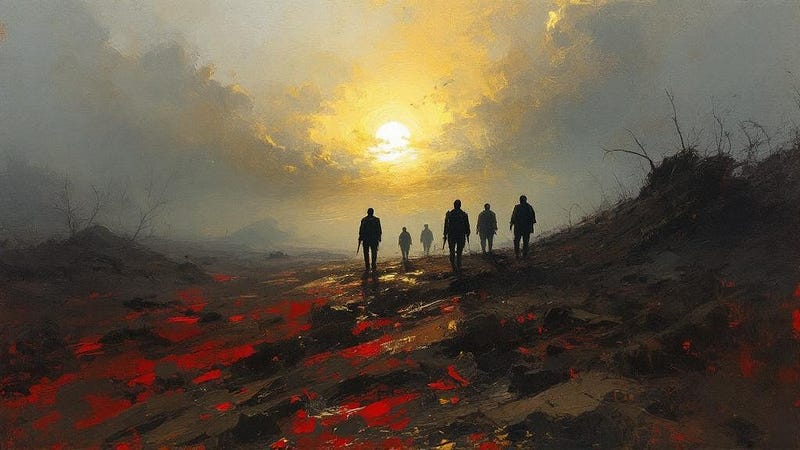
In the distance, the thrum of the rescue helicopters began, a familiar sound from a thousand battles. The sun was low, casting long, distorted shadows.
Kowalski stood up, his face a mask of grim acceptance. He had taken his first step.
Elias stood with him, his body aching with the memory of every wound he’d ever carried. He was tired. So tired. But the sun was rising somewhere else already, on another field, for another boy who thought he knew what war was.
He adjusted the wire from the broken canteen on his belt. A useful thing.
“Come on,” said the spirit of the soldier. “There’s always another battle.”
The Moral of the Story
(A low, gravelly chuckle, like stones grinding in a dugout. The voice that speaks is not one voice, but a chorus of echoes — the scrape of bronze on leather, the cocking of a flintlock, the static hiss of a radio.)
You ask what allows me to persist? It is not what you think. It is not the grand ideals they shout before the charge, nor the hatred for the face on the other side of the bayonet. Those are fashions that change with the century. I have worn them all, and discarded them all like empty canteens.
No. The qualities are simpler. Duller. They are the tools you use to carve another sunrise from the night.
First is Selective Hearing. You learn to listen only to the orders that keep you alive. The roar of the cannon, the scream of the jet — these are just noise. But the click of a pebble dislodged upstream, the change in the rhythm of the enemy’s machine gun, the specific timbre of a sergeant’s voice when he says “this is a bad one”… these are the sounds that matter. You learn to hear the truth of the moment, and to become deaf to the grand lies of the men who sent you.
Second is The Animal’s Patience. I have spent more of my existence waiting than fighting. Waiting in frozen trenches, waiting in the swampy jungle, waiting in the dust-choked desert. The body wants to scream, to run, to do something. But the survivor becomes like a stone. You conserve your heat, your water, your energy. You let the frantic ones burn out. You let the enemy make the first mistake. The war is a beast, and it will come to you. Your job is to be ready, not to go hunting for it.
Third is Practical Cunning. The spirit of the parade ground gets you killed. The spirit that survives knows how to jury-rig a boot sole with wire and canvas, how to find clean water where there is none, how to make a weapon from a rock or a mess tin. It knows that a dry spot to sleep is more valuable than a medal. It understands the geometry of the land not as a map, but as a thing of cover and concealment. It is a scavenger’s intelligence, a rat’s cleverness. It prizes utility above all else.
Fourth is Detached Comradeship. This is the hardest truth for the new ones to learn. You must love the man next to you. You must share your last crust of bread, your last drop of water. You must be willing to die for him. But you cannot let his death break you. When the shell takes him, you must feel the loss for only a heartbeat — a sharp, clean pain — and then you must take his ammunition and use his body for cover. The grief comes later, in the quiet moments, if you are granted them. On the line, sentiment is a luxury that gets you and others killed.
And the last… the last is a Fluid Soul. I am not the same man who marched out of any gate. The boy who believed in glory died in the mud of Flanders. The vengeful zealot died in the ruins of Stalingrad. The terrified conscript died in the Ia Drang Valley. Each time, something is scoured away. What remains is a core, a hardened, simplified thing. It holds no permanent politics, no eternal loyalties to any flag. Its only loyalty is to the spark of life itself, and to the few who share the dirt with it.
So, you see, it is not about being the strongest, or the bravest, or the most skilled. It is about being adaptable. It is about being a creature of the immediate, a student of the terrain — both the land and the human heart. It is about a cold, clear, and utterly pragmatic love that values survival, so that the story, this terrible, ancient story, may yet have a witness.
Now, pass me that canteen. The sun is rising. There is always another battle.