The Origins of a Modern War: Understanding the Deep Roots of the Russia-Ukraine Conflict
Introduction: The war between Russia and Ukraine did not erupt overnight. It is not simply a dispute over borders or alliances — it is a…
Introduction:
The war between Russia and Ukraine did not erupt overnight. It is not simply a dispute over borders or alliances — it is a conflict born of centuries-old grievances, Cold War legacies, and modern geopolitical ambitions. Since Russia’s full-scale invasion in February 2022, the world has grappled with the consequences: energy crises, realignments in global power, and a humanitarian disaster. But to understand why this war started — and why it persists — we must excavate layers of historical trauma, military calculation, and economic friction. This article traces the causes of the Russo-Ukrainian War, providing a nuanced lens into one of the most consequential conflicts of the 21st century.
Historical Context: From Imperial Rule to National Independence
Ukraine’s modern conflict with Russia is rooted in a long history of subjugation. For centuries, Ukraine was ruled from Moscow — first as part of the Russian Empire, then as a core republic of the Soviet Union. The repression of the Ukrainian language and culture, combined with devastating events like the Holodomor famine of the 1930s, planted deep scars. When the Soviet Union collapsed in 1991, Ukraine’s declaration of independence was not only a political break — it was a psychological one.
Moscow watched this unraveling with shock and resentment. Ukraine had been central to the USSR’s industrial strength and agricultural production. Its departure marked the death knell of the Soviet superpower. While Russia formally recognized Ukraine’s sovereignty — most notably in agreements like the 1994 Budapest Memorandum — it never truly let go. The 2004 Orange Revolution and the 2014 Euromaidan uprising only intensified this strain, as each move toward Western integration drew Ukraine further out of Russia’s orbit.
Geopolitical Fault Lines: Empire, Identity, and Security
Russia sees Ukraine not just as a neighbor, but as a civilizational sibling. Russian President Vladimir Putin has repeatedly invoked the medieval roots of Kievan Rus to justify a historical unity between the two nations. From the Kremlin’s vantage point, Ukraine is not merely a sovereign state but a lost province whose Western orientation poses a direct threat to Russian security and identity.
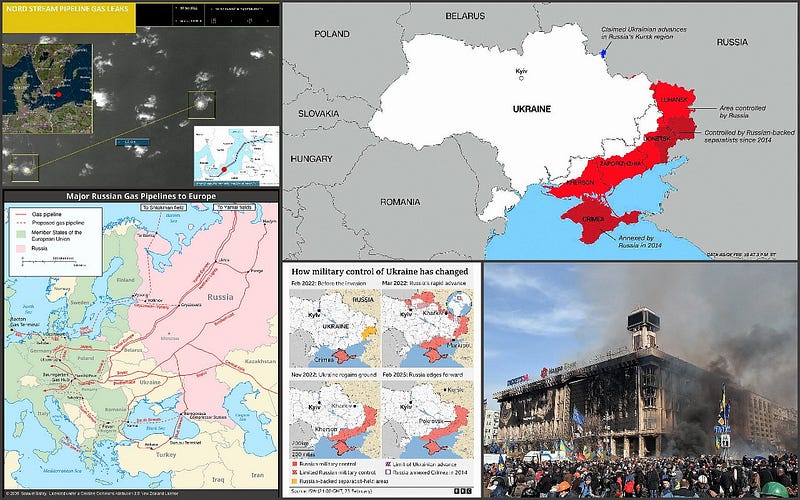
The annexation of Crimea in 2014 and the fomentation of armed rebellion in Donbas were not random acts — they were calculated moves to restore influence, secure Russia’s naval presence in the Black Sea, and stop NATO’s advance. With Kyiv forging closer ties to the West, including aspirations for NATO and EU membership, Moscow sought to redraw the strategic map by force.
Ukraine, for its part, sees its path toward Europe as a break from the shadows of empire. Its pursuit of integration with Western institutions is not simply geopolitical — it is existential.
Energy and Economics: Pipelines, Transit, and Leverage
Beneath the battlefield lies a web of gas pipelines, contracts, and infrastructure that has fueled both economic growth and geopolitical leverage. For decades, Ukraine served as the main transit route for Russian natural gas to Europe. These Soviet-era pipelines gave Ukraine strategic importance, as it collected transit fees and retained influence in energy negotiations.
Yet this interdependence became a vulnerability. Russia’s state gas company, Gazprom, used energy as a political weapon — cutting off supplies during disputes in 2006 and 2009. Ukraine responded by seeking alternatives, including reverse flows from Europe and investment in domestic production. The legal battle between Naftogaz and Gazprom culminated in a $2.56 billion arbitration victory for Ukraine in 2018, underscoring the legal complexities surrounding post-Soviet infrastructure.
Projects like Nord Stream and TurkStream — designed to bypass Ukrainian territory — shifted the dynamics. But the sabotage of Nord Stream 1 and 2 in 2022, and subsequent accusations involving Ukrainian operatives, added new intrigue and uncertainty. Meanwhile, Ukraine’s pipelines, managed by Naftogaz and Ukrtransgaz, remain critical to European energy security even as volumes decline.
Trade Tensions and Economic Warfare
Russia once accounted for nearly a third of Ukraine’s trade. That changed after 2014, when trade collapsed under sanctions and embargoes. Moscow used import bans and financial incentives to dissuade Ukraine from signing an EU Association Agreement, offering cheaper gas in exchange for loyalty. But Kyiv, after years of political upheaval, ultimately turned westward.
Today, the European Union dominates Ukraine’s trade landscape, representing over 60% of its foreign commerce. China has overtaken Russia as Ukraine’s largest single trading partner. Countries like Poland, Germany, Turkey, and Egypt now anchor Ukraine’s export economy — particularly in grain, metals, and sunflower oil. This realignment further eroded Russia’s economic leverage and helped fuel its strategic anxieties.
Military Objectives and Strategic Posture
Russia’s military actions are guided by a broader doctrine of denial and control. Preventing NATO infrastructure in Ukraine, degrading Ukraine’s military capacity, and creating territorial buffers are core tenets of its strategy. The seizure of Crimea secured Russia’s Black Sea naval base in Sevastopol, while operations in the east aimed to carve out zones of influence and weaken Kyiv’s hold on the country.
Ukraine, meanwhile, steadily modernized its armed forces with Western aid. This transformation alarmed Moscow. By late 2021, Russian planners feared that time was no longer on their side — that Ukraine was becoming too capable, too entrenched, and too Western to reclaim without full-scale war.
International Involvement and the Battle for the Future
The West has responded with unprecedented levels of support. As of 2024, more than $380 billion in aid — military, financial, and humanitarian — has flowed to Ukraine, coordinated by the Ukraine Defense Contact Group and bolstered by EU institutions. Yet sustaining this support is an ongoing challenge, especially amid concerns over corruption in Ukraine’s defense procurement system.
The sabotage of Nord Stream, revelations of internal Ukrainian scandals, and shifting political winds in donor nations all complicate the long-term outlook. Still, Ukraine’s Western backers remain committed, seeing the war as a test of international order, democratic values, and resistance to authoritarian revisionism.
Strategic Recommendations: The Rand Corporation’s Vision
The Rand Corporation offers a roadmap to resolution — one that blends military deterrence, economic pressure, diplomatic channels, and post-war reconstruction. It calls for continued arms support, deeper sanctions on Russia’s energy sector, and a Marshall Plan-style rebuilding effort for Ukraine. Equally important is the call for diplomatic engagement with non-aligned nations and neutral intermediaries who can help forge a future peace.
According to Rand, a durable solution must not sacrifice Ukraine’s territorial integrity. It must also reshape the postwar security architecture of Europe, anchoring Ukraine more firmly in transatlantic institutions.
Conclusion: A War About Futures, Not Just Borders
At its heart, the Russia-Ukraine War is about competing visions of the future. For Russia, it is a desperate attempt to reclaim influence, reverse perceived humiliations, and halt NATO’s eastward march. For Ukraine, it is a fight for sovereignty, identity, and a seat among Europe’s democracies.
The war’s causes are deeply layered — historical, strategic, economic, and ideological. Any resolution will require more than battlefield victories. It will demand reimagining Europe’s security order, repairing Ukraine’s shattered infrastructure, and confronting the ghosts of empires that still haunt the continent.