The Philosophy of Music of Kanonenfieber
In the landscape of contemporary extreme metal, few projects command attention through their aesthetic force and philosophical depth quite…
In the landscape of contemporary extreme metal, few projects command attention through their aesthetic force and philosophical depth quite like Kanonenfieber. The German musical entity, masterminded by the anonymous creator known only as Noise, transcends the conventional boundaries of blackened death metal to construct a profound meditation on the nature of warfare, memory, and human suffering. Founded in 2020, Kanonenfieber draws its creative impetus from the harrowing epoch of the First World War, yet its significance extends far beyond historical recounting. The project serves as a potent vehicle for a rigorous anti-war philosophy, using the visceral language of extreme music to interrogate the very foundations of conflict and its representation. This analysis posits that Kanonenfieber operates as a form of sonic historiography, a philosophical enterprise that uses musical composition and theatrical performance to challenge glorified narratives and force a confrontation with the brutal, dehumanizing reality of war. Through its meticulous foundation in primary historical documents, its deliberate aesthetic of anonymity, and its sophisticated musical structures, Kanonenfieber creates an auditory experience that is not merely about war, but is, in itself, a philosophical argument against it.
The foundational principle of Kanonenfieber is its unwavering commitment to historical authenticity as a path to philosophical truth. The project was born not from a fascination with militaria, but from a deeply personal encounter with history when Noise discovered and translated his great-grandfather’s diary, written on the frontlines of the Great War before he died in combat around 1916. This personal connection ignited a broader scholarly pursuit, leading Noise and a hobby historian friend to immerse themselves in a collection of letters and original documents from soldiers on all sides of the conflict. The lyrical content of albums like Menschenmühle (Human Mill) and Die Urkatastrophe (The Primal Catastrophe) is constructed directly from these first-hand accounts, transforming the music into an auditory archive. Noise explicitly frames the project as a documentary endeavor, a deliberate shift from bands that might glorify conflict. He states, “This band is not about war itself. It’s about people in war” and emphasizes that his work is “100 percent apolitical,” serving as a “historical treatise that speaks for itself”. This claim to apolitical documentation is, in itself, a significant philosophical stance — an assertion that the raw, human experience of suffering transcends political justification and that the most potent anti-war statement is the unembellished testimony of those who endured its horrors.
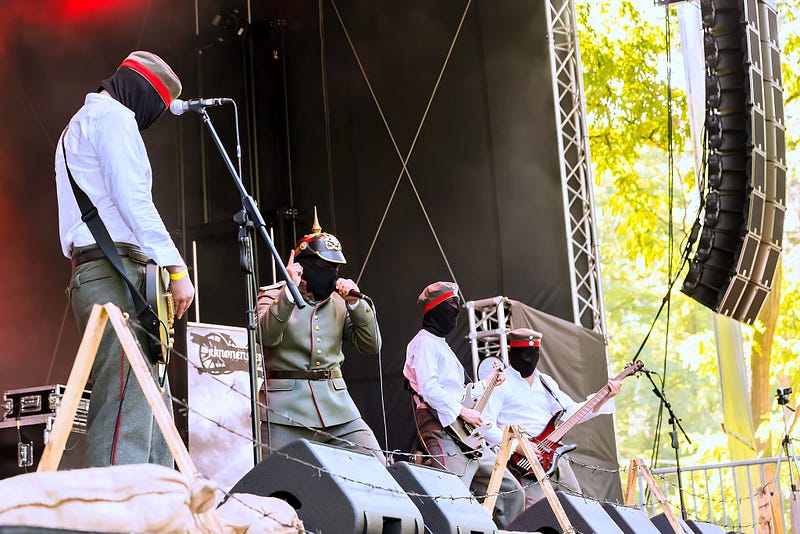
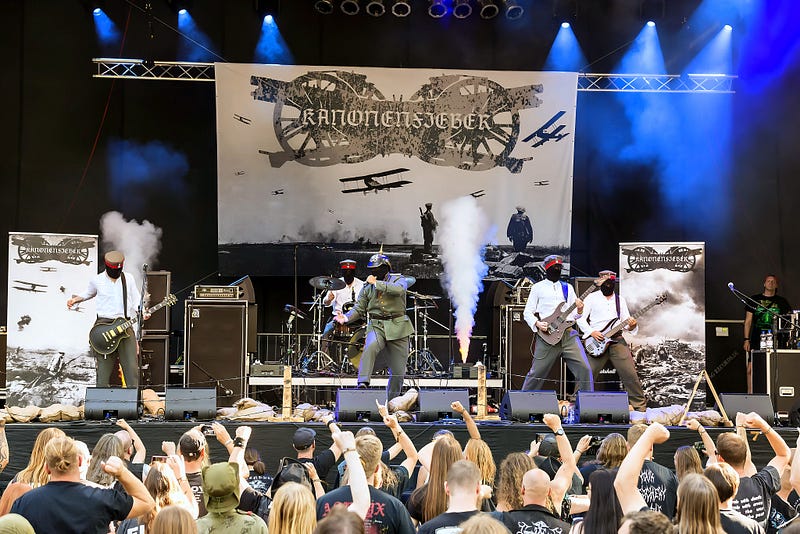
Beneath this documentary surface, however, lie profound assumptions and inherent tensions that demand critical examination. The most prominent of these is the deliberate use of a martial and extreme aesthetic to convey an anti-war message. Kanonenfieber’s live performances are spectacles of military pageantry, complete with era-appropriate German army regalia, cannons, barbed-wire fences, and functional flamethrowers. The members, their faces concealed by black masks in symbolic solidarity with the Unknown Soldier, embody the very imagery that could easily be misconstrued as glorification. Noise acknowledges this tension, noting that to the uninitiated, the show might seem “a bit cringey”. This creates a central philosophical inconsistency: can the aesthetic tools of war — its symbols, its uniforms, its thunderous power — be effectively repurposed to critique war itself, or does the spectacle inevitably risk reinscribing the very grandeur it seeks to dismantle? The project wrestles with the problem of representation that has troubled philosophers and artists for centuries: how to represent atrocity without aestheticizing it, how to make the unimaginable visceral without making it captivating.
Furthermore, the claim of being “100 percent apolitical” is a contentious one. In the highly charged context of German history, any artistic engagement with war, particularly one that utilizes imagery from the nation’s past, is inevitably politicized. Noise has faced accusations of harboring nationalist sympathies, a criticism he vehemently rejects by pointing to the historical specificity of WWI, which predates the National Socialism of WWII. He argues that fascism began with Mussolini in the 1920s and that to conflate the Great War with Nazism is anachronistic. Yet, the act of selecting a historical narrative, of choosing to amplify certain voices and not others, is inherently a political act. The philosophy of Kanonenfieber is built on the assumption that focusing solely on the universal human experience of the soldier — the fear, the longing, the trauma — can exist in a vacuum, separate from the political causes for which they fought. This perspective prioritizes a shared humanity over nationalist ideology, but it cannot fully escape the political frameworks that gave the suffering meaning and context. The philosophy is thus one of empathetic, humanist pacifism, which itself stands as a political position against nationalist fervor.
Competing perspectives within the genre highlight the distinctiveness of Kanonenfieber’s philosophical approach. Bands like Sabaton present war through a lens of heroic saga and majestic adventure, an approach that Noise directly contrasts with his own, aiming to show the “horrific side of war, teaching about the terror and sadness”. Similarly, while bands like 1914 and Minenwerfer also mine the thematic territory of WWI, Kanonenfieber’s methodology is singular in its roots in personal historiography and its intense focus on the individual soldier’s psychological interiority. The project’s philosophy is further articulated through its musical composition. The sound is not monolithic brutality; it is a carefully structured emotional journey. Tracks shift from blistering blackened death metal, representing the chaos of battle, to melancholic melodic passages and even stark acoustic ballads like “Verscharrt und Ungerühmt” (Buried and Unhonored), which serves as a somber, human-scale summation of the album’s tragedy. This musical variety functions as a philosophical device, using genre as a “stylistic device” to mirror the emotional rises and falls, the fleeting hopes and profound despairs documented in the soldiers’ letters.
The broader implications of Kanonenfieber’s work are significant, positioning music as a unique medium for historical and philosophical engagement. The project demonstrates how extreme metal, with its capacity for conveying intensity, anguish, and darkness, can be a powerful vehicle for critical thought and historical memory. In an age where contemporary conflicts persist, Kanonenfieber’s immersion in WWI is not an escape into the past but a stark reminder of its enduring lessons. This is exemplified by the 2022 single “Stop the War,” a direct response to the war in Ukraine, with all earnings donated to aid workers. This action bridges the historical with the contemporary, proving the philosophy’s present-day relevance. Noise reflects on this bleakly, calling it “a drop of water on a hot stone,” yet the act itself underscores a core tenet of the project: that remembrance must inspire action. The music becomes a warning, a plea for empathy, and a monument to the forgotten, aiming to ensure that the fates of these soldiers “be a warning for all following generations even after more than 100 years”.
In practical application, the philosophy of Kanonenfieber is manifested through every layer of the project, from the solitary act of creation to the collective experience of the live performance. The process of writing is described by Noise as emotionally brutal, requiring him to immerse himself in the topic for weeks on end, a period during which he admits, “people don’t like me that much because I’m very negative, and quite sad”. This personal sacrifice is integral to the philosophy’s authenticity; the artist must, to some degree, inhabit the emotional world he seeks to document. The anonymity of the members is another crucial practical application. By concealing their identities, they reject the cult of personality and instead embody the facelessness of the countless soldiers consumed by the war machine. On stage, they are not individuals; they are archetypes, conduits for the stories they tell. Noise’s transformation during a performance, where he dies and returns as Death wearing a skeleton mask, elevates the concert from a mere musical act to a piece of macabre musical theater, a ritualized re-enactment designed to evoke not celebration, but somber reflection. Kanonenfieber, therefore, stands as a profound philosophical statement within modern metal. It is a project that leverages the visceral power of music to conduct a rigorous audit of war, challenging both historical amnesia and aesthetic glorification. Through its documentary approach, its embrace of aesthetic tension, and its focus on human suffering, it creates a powerful, auditory war memorial — one that honors the dead not by mythologizing their deeds, but by relentlessly bearing witness to their pain.