The Regal Guardian of the Rainforest: The Great Curassow
Introduction
Introduction
In the deep green heart of Central and South America, a bird of striking nobility steps quietly through the forest understory. The Great Curassow (Crax rubra) is not just another tropical bird — it is a symbol of survival, adaptation, and ecological grace. With its crown of curled feathers and its commanding size, this species has fascinated naturalists, sustained local communities, and now stands as a powerful emblem of conservation urgency. To encounter a Great Curassow is to glimpse the rainforest’s dignity embodied in living form.
Taxonomy
The Great Curassow belongs to the genus Crax within the family Cracidae, an ancient lineage of large Neotropical birds. Its scientific name, Crax rubra, distinguishes it as one of the largest and most widely distributed curassows. Known in Spanish as “pavón grande,” it has several recognized subspecies, adapted to slightly different forest regions across its range. Unlike chickens or turkeys, its lineage stretches back millions of years, making it a living relic of Mesoamerican forests. Though domestication attempts have occurred, this bird remains firmly tied to the wild, its edible appeal tempered by conservation concerns.
Biology
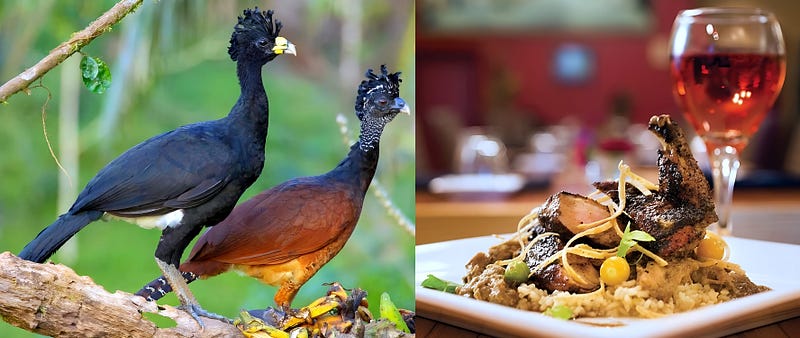
Standing at nearly 36 inches tall and weighing up to 10 pounds (4.5 kg), the Great Curassow is a commanding presence. The males are glossy black with bright yellow or orange cere ornaments, while the females dazzle in a spectrum of barred, rufous, and black morphs. The bird’s most distinctive feature is its curly crest — feathers shaped like finely sculpted ribbons. These omnivorous foragers feed on fallen fruits, seeds, insects, and small animals. Their strong legs allow them to cover ground efficiently, while their wings — though rarely used for long flight — can propel them into the canopy when threatened. Mating pairs form lifelong bonds, with both parents participating in rearing chicks, a rarity among large bird species.
Ecology
The Great Curassow is found from southern Mexico through Central America into northwestern Colombia and Ecuador. It thrives in lowland tropical forests up to 4,900 ft (1,500 m), where it plays a vital ecological role as a seed disperser. By consuming and scattering fruits, curassows help regenerate rainforest trees, linking their survival to the future of entire ecosystems. Yet, their dependence on intact forests makes them highly vulnerable. Deforestation, coupled with hunting pressures, has driven population declines. The IUCN now lists Crax rubra as Vulnerable, underscoring the fragile balance between cultural use and conservation.

Uses
Historically, the Great Curassow has been prized as wild game. Its large size and lean, flavorful meat made it a valuable protein source in rural communities. Today, however, unsustainable hunting remains a major threat, and commercial trade is largely restricted. Some conservation programs promote ecotourism as an alternative economic use, where the bird’s charisma becomes a living asset rather than a consumable commodity. Breeding programs in reserves have also been established, aiming to bolster declining populations while educating the public on sustainable stewardship.
Culinary Aspects
Though rarely encountered in modern culinary circles, traditional accounts describe curassow meat as rich, slightly gamey, and comparable to wild turkey, but with a more delicate grain. In some rural kitchens, the bird was once stewed with root vegetables or roasted over an open fire. Meat from a single bird, weighing 10 pounds (4.5 kg), could feed an entire family. The cultural significance of eating curassow tied communities to the forest, a reminder of how human diets were once inseparable from ecological cycles. Today, responsible chefs highlight these traditions in storytelling rather than active cooking, using the bird’s story to spark awareness of conservation.
Wine Pairings
If one were to imagine the curassow on the table, its flavor would pair naturally with robust but earthy wines. A bold Spanish Tempranillo, with notes of leather and dried fruits, would echo the forest depth that defines the bird’s origins. Alternatively, a medium-bodied Pinot Noir with its red berry brightness could balance the lean texture of curassow meat. While few modern gourmets will ever taste this bird, the thought experiment reveals how gastronomy and ecology intersect — the choice of wine reflecting not just palate but respect for heritage.
Conclusion
The Great Curassow stands at a crossroads of past and future. Once a staple of forest communities, now a vulnerable species demanding protection, it embodies the complex relationship between human appetite and ecological necessity. To preserve Crax rubra is to preserve the living rainforest itself, ensuring that future generations inherit not just the idea of a noble bird, but the sound of its deep booming calls echoing through unbroken forests. Its survival is a reminder that conservation is not merely about saving species — it is about protecting the dignity of the wild.