
The Scarlet Sentinel of the Wetlands: The Redshank’s Story
Introduction
Introduction
The redshank (Tringa totanus), with its striking crimson legs and piercing calls, is one of Europe’s most recognizable waders. Found along estuaries, marshes, and tidal flats, this bird has been both admired by naturalists for its ecological role and valued by communities for its historic culinary use. Its presence signals the health of wetlands, making it more than just a bird but a living gauge of environmental balance.
Taxonomy
The redshank belongs to the genus Tringa within the family Scolopacidae. Its scientific name, Tringa totanus, reflects its distinctive cry, often likened to a whistle across the marsh. Six subspecies are currently recognized, ranging from the nominate T. t. totanus of Europe to T. t. robusta in Iceland. Common names include common redshank and simply “redleg” in older hunting guides. While no domesticated or selectively bred edible varieties exist, in the past, certain populations were favored for the table due to their fattening during autumn migration.
Biology
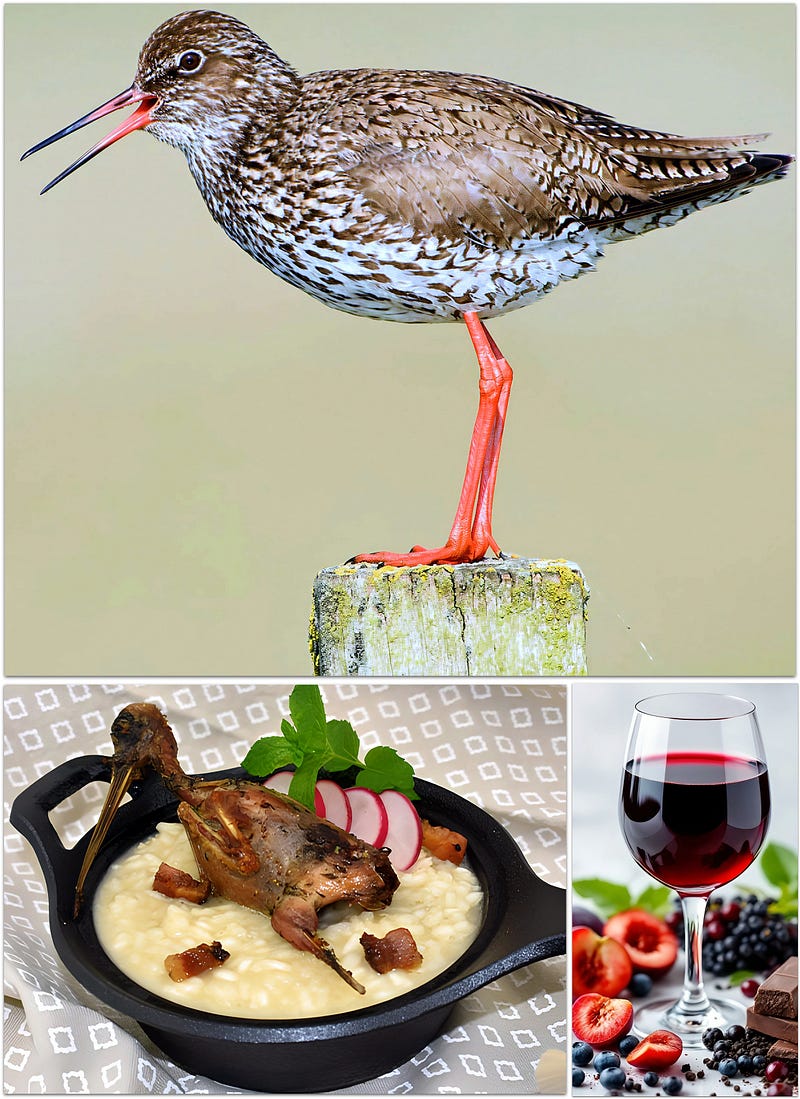
The redshank measures about 27 cm (10.6 in) in length with a wingspan of 47 cm (18.5 in). Its plumage is mottled brown and grey, offering camouflage against mudflats, while its vivid 5 cm (2 in) scarlet legs remain unmistakable. Redshanks breed in grassy marshlands, laying clutches of four eggs, with both parents involved in rearing. They migrate seasonally, with northern populations wintering as far south as Africa. Their alarm calls often alert entire flocks of waders, giving them the nickname “the sentinel of the marshes.”

Ecology
Redshanks thrive in brackish estuaries, freshwater marshes, and coastal mudflats. They feed primarily on invertebrates such as worms, mollusks, and crustaceans, using their slender 4.5 cm (1.8 in) bill to probe wet soils. As bioindicators, their presence reflects the integrity of wetland ecosystems. Habitat loss from draining marshes and coastal development has pressured populations, though conservation measures under the EU Birds Directive and wetland protection schemes have stabilized numbers in many regions. Sustainable management of wetlands ensures the species’ continued survival.
Uses
Historically, redshanks were hunted for food across Europe, especially in the 18th and 19th centuries. Today, they hold more cultural than economic significance. Birdwatching tourism in wetland reserves where redshanks are abundant contributes to local economies, reinforcing the value of conservation over exploitation. Modern hunting restrictions and protective legislation have shifted their role from quarry to ecological ambassador.
Culinary Aspects
Though rarely consumed today, historical accounts describe redshank meat as dark, lean, and strongly flavored, reflecting its diet of briny invertebrates. The taste was often compared to that of snipe but with a saltier depth. The aroma carried faint marine notes, while the texture was firm yet tender when stewed. Its mouthfeel was dense, with a lingering savory aftertaste. Traditionally, it was roasted whole or simmered in stews with root vegetables. Nutritionally, a bird weighing about 150 g (5.3 oz) provided a protein-rich meal, though its strong gaminess limited appeal to broader palates.
Wine Pairings
Pairing wines with redshank meat requires balance against its robust, saline flavor. A Jura Savagnin from eastern France, with oxidative nutty notes and bracing acidity, would cut through the gaminess while amplifying the bird’s coastal essence. For a roasted preparation with herbs, an Austrian Blaufränkisch offers bright acidity and peppery lift, harmonizing with both meat and seasoning. If stewed with root vegetables, a Spanish Mencía from Bierzo, known for its floral aromatics and soft tannins, brings complexity without overpowering. These pairings highlight regional specificity and elevate what was once a rustic fare.
Conclusion
The redshank’s story is one of transformation — from a hunted gamebird to a sentinel species whose survival signals the health of wetlands. While its culinary past lingers in old hunting texts, its true legacy today is ecological. Protecting redshank habitats safeguards more than a bird; it sustains the delicate web of life in marshes and estuaries. In its scarlet legs and piercing cries, the redshank reminds us that sustainability is not a trend but a necessity written in the rhythms of nature.