The Secret Life of the Common Octopus: Intelligence, Ink, and the Ethics of Eating Wonder
Introduction
Introduction
Beneath the surface of sun-warmed Mediterranean coves and the shadowy crevices of the Atlantic seafloor dwells a creature both ancient and astonishing: the Octopus vulgaris, or common octopus. More than just the stuff of maritime folklore, this eight-armed marvel has captivated scientists, chefs, conservationists, and storytellers alike. Its alien intelligence, remarkable adaptability, and culinary versatility make it a species worth knowing — perhaps even defending. As climate change and overfishing reshape the ocean’s rhythm, the fate of the common octopus becomes a mirror for how we treat the strange and sentient life hiding in plain sight.
Taxonomy: A Master of Disguise with Many Names
Scientifically designated as Octopus vulgaris, this species belongs to the class Cephalopoda, a group meaning “head-footed” in Greek — a fitting name for a creature whose arms seem to spring directly from its face. The genus Octopus is sprawling, but vulgaris is its most studied and most widespread member. Though dubbed “vulgaris” — Latin for “common” — there’s nothing ordinary about it. This species has numerous regional nicknames: polpo in Italy, pulpo in Spain, tako in Japan, and he’e in Hawaii. Some researchers debate whether certain regional populations — such as those in Brazil or the eastern Atlantic — are distinct species or merely subspecies, a taxonomic ambiguity that speaks to the octopus’s plasticity in both form and function.
Among edible varieties, Octopus vulgaris remains the global standard. Its tender, meaty texture and delicate brininess have secured its place in everything from Spanish pulpo a la gallega to Japanese tako nigiri. Still, it is not the only octopus on the menu — others like Eledone cirrhosa or Octopus cyanea are harvested regionally, though they lack the consistency and culinary prestige of vulgaris.
Biology: Eight Arms, Three Hearts, and a Mind of Its Own
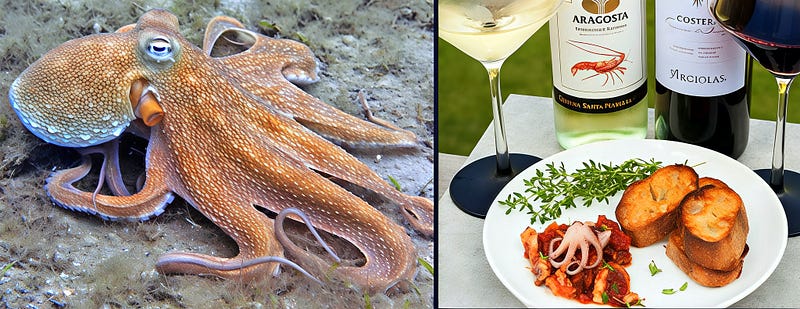
There’s no mistaking the common octopus. With a soft, bulbous mantle, large, intelligent eyes, and eight agile arms lined with suckers, it looks more like a creature from a sci-fi novel than a terrestrial animal. But what truly sets it apart isn’t its appearance — it’s its brain. Distributed partly in its head and partly throughout its arms, the octopus’s neural network allows each limb to operate semi-independently, coordinating movements with eerie precision. It can unscrew jars, navigate mazes, and even mimic other sea creatures.
The common octopus is a master of camouflage, capable of shifting both color and texture to blend seamlessly into its surroundings. Thanks to specialized skin cells called chromatophores, iridophores, and leucophores, it can display sudden flashes of white, brown, or even electric blue. Its life cycle is short and tragic: males die shortly after mating, while females starve themselves to death guarding their clutch of eggs, which can number in the hundreds of thousands.
Ecology: Ghosts of the Reef and Keepers of the Balance
Octopus vulgaris thrives in coastal waters ranging from the intertidal zone to depths of 200 meters. It prefers rocky outcroppings and seagrass meadows where it can hide from predators like moray eels and sharks. As both predator and prey, the octopus plays a crucial ecological role. It hunts crustaceans, fish, and mollusks, keeping populations in check while itself providing sustenance for larger marine species.
But the common octopus is also a bellwether of change. Rising ocean temperatures and habitat degradation are pushing it into unfamiliar waters. Interestingly, octopus populations have flourished in some regions where overfishing has reduced their predators. This “mesopredator release” offers a false sense of abundance; though adaptable, octopuses are vulnerable to rapid environmental shifts and unsustainable harvesting. Responsible fisheries management and octopus-friendly aquaculture methods — still in their infancy — will determine whether this species endures or vanishes beneath the tide.
Uses: A Delicate Dance of Economy and Ethics
The common octopus is not only biologically fascinating — it’s economically significant. Global demand for octopus, particularly in Mediterranean, East Asian, and South American markets, fuels a multimillion-dollar industry. Artisanal fishers in Portugal and Morocco rely on the seasonal octopus harvest for their livelihood, while chefs from Tokyo to New York tout it as a sustainable seafood choice.
But herein lies the paradox: How do we reconcile the intelligence of the octopus with our appetite for it? Can we ethically farm or harvest a creature capable of curiosity and problem-solving, one that recognizes itself in a mirror and learns through observation? These questions have ignited a storm of debate among scientists and ethicists, many of whom argue that octopuses should not be farmed in captivity due to their cognitive complexity and solitary nature. As consumer awareness grows, so too does the demand for transparent sourcing and traceable catch methods, making the octopus not just a commodity — but a conversation.
Culinary Aspects: From Tide to Table, an Oceanic Elegance
When prepared with care, the common octopus delivers a sublime dining experience. Its flesh, when gently braised or grilled, transforms into something between scallop and steak: tender, subtly sweet, with a whisper of the sea. In Galicia, it’s boiled and sliced into medallions, dusted with smoky paprika and coarse salt, then drizzled with olive oil. In Greece, it’s sun-dried and flame-seared. In Japan, it’s served raw or lightly blanched as sushi.
Cooking octopus requires a balance of technique and patience. Overcooked, it turns rubbery; undercooked, it’s tough. Traditionalists often massage or freeze the flesh to tenderize it, while others opt for sous-vide or slow simmering. Regardless of method, the goal is to coax from it the complex interplay of umami, minerality, and maritime essence that only octopus can offer.
From a nutritional standpoint, octopus is rich in lean protein, vitamin B12, iron, and omega-3 fatty acids — an oceanic superfood by any measure. Yet, its very consumption challenges us to consider what it means to eat with consciousness and respect.
Wine Pairings: Liquid Poetry for a Seaborne Muse
Pairing wine with octopus is an art in itself. The subtlety of the flesh demands wines that enhance without overpowering. A dry Albariño from Spain, with its briny citrus edge, harmonizes beautifully with Galician preparations. Assyrtiko from Santorini, with its volcanic minerality and crisp acidity, is ideal for grilled Mediterranean-style octopus. Even a chilled Beaujolais, with its light red fruit and refreshing bite, can elevate octopus carpaccio or ceviche.
The key is restraint and balance — qualities shared by both the cephalopod and the finest wines. Let the wine mirror the ocean: clean, precise, and full of mystery.
Conclusion: The Intelligence We Eat
To gaze into the eye of a common octopus is to confront the limits of our understanding. Here is a being that remembers, learns, dreams — perhaps even suffers. And yet, we eat it. That contradiction haunts the plate, challenging chefs, diners, and scientists alike to ponder what it means to consume something so wondrous.
In a world increasingly shaped by our appetites, the story of Octopus vulgaris is more than a culinary journey — it’s a test of our ethical imagination. Will we protect what we value, or devour it until it’s gone? The answer may lie in the next dish, the next dive, or the next choice we make as stewards of the sea.