The Secret Life of the Moorhen: Nature’s Scarlet-Footed Forager
Introduction
Introduction
The moorhen, Gallinula chloropus, is a bird that walks a fine line between the familiar and the overlooked. With its green marshland haunts, bright scarlet bill, and cautious but curious nature, it is both commonplace and mysterious. Found across Europe, Asia, Africa, and the Americas, this member of the rail family is not only an ecological player but, in some traditions, a modest contributor to the table. Its story weaves together biology, folklore, gastronomy, and sustainability — making the moorhen a creature worth watching more closely.
Taxonomy
The moorhen belongs to the family Rallidae, which also includes coots, rails, and crakes. Its full classification is:
- Kingdom: Animalia
- Phylum: Chordata
- Class: Aves
- Order: Gruiformes
- Family: Rallidae
- Genus: Gallinula
- Species: Gallinula chloropus
Commonly called the common moorhen in Europe and the common gallinule in North America, it has several regional subspecies. For instance, Gallinula chloropus orientalis thrives in Asia, while Gallinula galeata in the New World is often considered a separate but closely related species. No distinct edible varieties exist, though historically, moorhens were hunted in rural Europe as a substitute for partridge or duck.

Biology
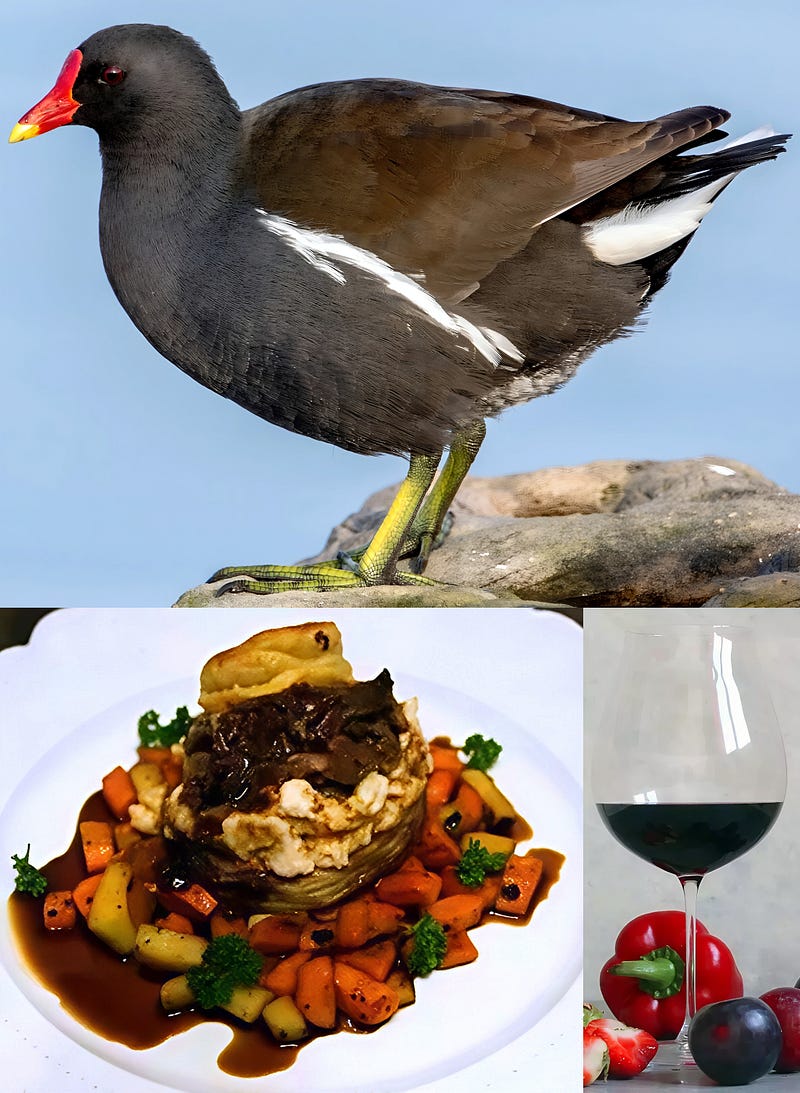
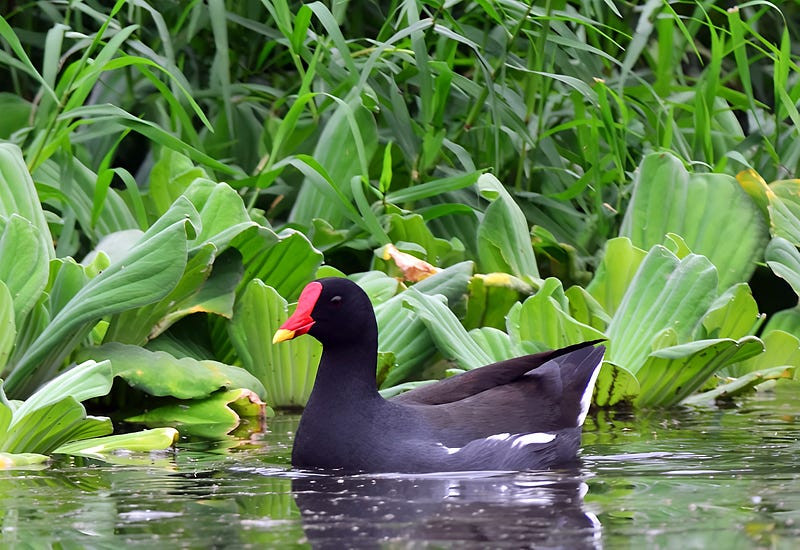
At first glance, the moorhen appears to be a small duck, but with longer legs and striking colors. Adults measure around 12–15 in (30–38 cm) in length and weigh about 12 oz (340 g). Their plumage is mostly dark slate-gray with a white streak along the flanks, but their most striking feature is the vivid red bill tipped with yellow, matched by their red forehead shield. Their legs are long, greenish, and unwebbed, with extraordinary agility in swimming and walking on floating vegetation.
The species breeds in reedy wetlands, building floating nests from twigs and reeds. Females lay clutches of six to ten eggs, with both parents sharing incubation duties over 19–22 days. Chicks hatch covered in black down and are precocial, swimming within hours of birth. Remarkably, older siblings often act as helpers, feeding younger broodmates — an unusual cooperative behavior in birds.
Ecology
Moorhens thrive in freshwater habitats: ponds, marshes, canals, and rice paddies. They forage on aquatic plants, seeds, and invertebrates, acting as both grazers and pest controllers. In turn, they serve as prey for herons, raptors, foxes, and otters, thus securing their place in the food web. Their adaptability is legendary — they flourish in urban parks as easily as remote swamps, though they remain sensitive to water pollution and habitat loss. Sustainable wetland management, including careful water-level regulation and protection of reedbeds, directly supports moorhen populations.
Uses
While rarely hunted today, moorhens once provided supplementary food for rural communities. In Britain and Ireland, they were considered a “poor man’s fowl,” taken when ducks and geese were scarce. In some Asian and African cultures, they were also trapped for meat. Today, their primary economic relevance lies in ecotourism and birdwatching. They embody the value of biodiverse wetlands, drawing enthusiasts to preserves and contributing to sustainable local economies.
Culinary Aspects
Though not a staple of modern cuisine, moorhen has a place in historical cooking. Its flesh is dark, slightly gamey, akin to wild duck but leaner. Traditional recipes often called for roasting the bird with herbs and serving it with root vegetables or barley. In France, it might have been simmered in a light broth with wine and onions, reflecting rustic countryside fare. Nutritionally, it offered protein and iron to communities where access to domestic fowl was limited. Today, consuming moorhen is rare and often regulated, reflecting both conservation priorities and changing tastes.
Wine Pairings
Were one to revisit moorhen at the table in a legal and sustainable context, the pairing would require wines that balance the bird’s lean but game-forward flavor. A medium-bodied red such as a Pinot Noir, with its earthy notes of mushroom and cherry, would highlight the bird’s rustic profile. Alternatively, a Loire Valley Cabernet Franc, with its peppery freshness, could provide a lively counterpoint. For white wine enthusiasts, an oaked Chardonnay — creamy with hints of hazelnut — would harmonize with roasted preparations.
Conclusion
The moorhen is more than a marsh-dweller with a splash of crimson; it is a quiet witness to the health of wetlands, a bird that straddles the human world of myth, food, and conservation. Once a modest meal for the hungry, now a feathered ambassador for ecological stewardship, it invites us to look again at the watersides we take for granted. To protect the moorhen is to safeguard the wetlands, and in doing so, to preserve a vital piece of living heritage.