The Silence of the Reedbeds: The Vanishing Song of the Yellow-breasted Bunting
Introduction
Introduction
Once affectionately called the “rice bird” for its love of grain, the yellow-breasted bunting was so abundant across Eurasia that its flocks once darkened the skies. Today, that same sky has grown ominously quiet. Emberiza aureola isn’t merely a bird in decline — it’s a canary in the coal mine for the ecological impact of human appetite, overharvesting, and vanishing wildlands. What was once a staple in traditional cuisines has now become a symbol of international conservation failure — and perhaps redemption.
Taxonomy
Belonging to the genus Emberiza, a widespread group of Old World buntings, the yellow-breasted bunting bears the full scientific name Emberiza aureola. The name “aureola” evokes “golden halo,” a poetic nod to the male’s brilliant yellow breast, especially vibrant during the breeding season. Although it has no formally recognized subspecies, subtle variations in plumage have been noted depending on breeding geography. Common names include “rice bird” and “golden bunting,” titles that once hinted at its culinary value more than its conservation plight. While no edible varieties are formally bred, its place in traditional cuisine gave it unintended status as one of the most hunted wild songbirds in the modern era.
Biology
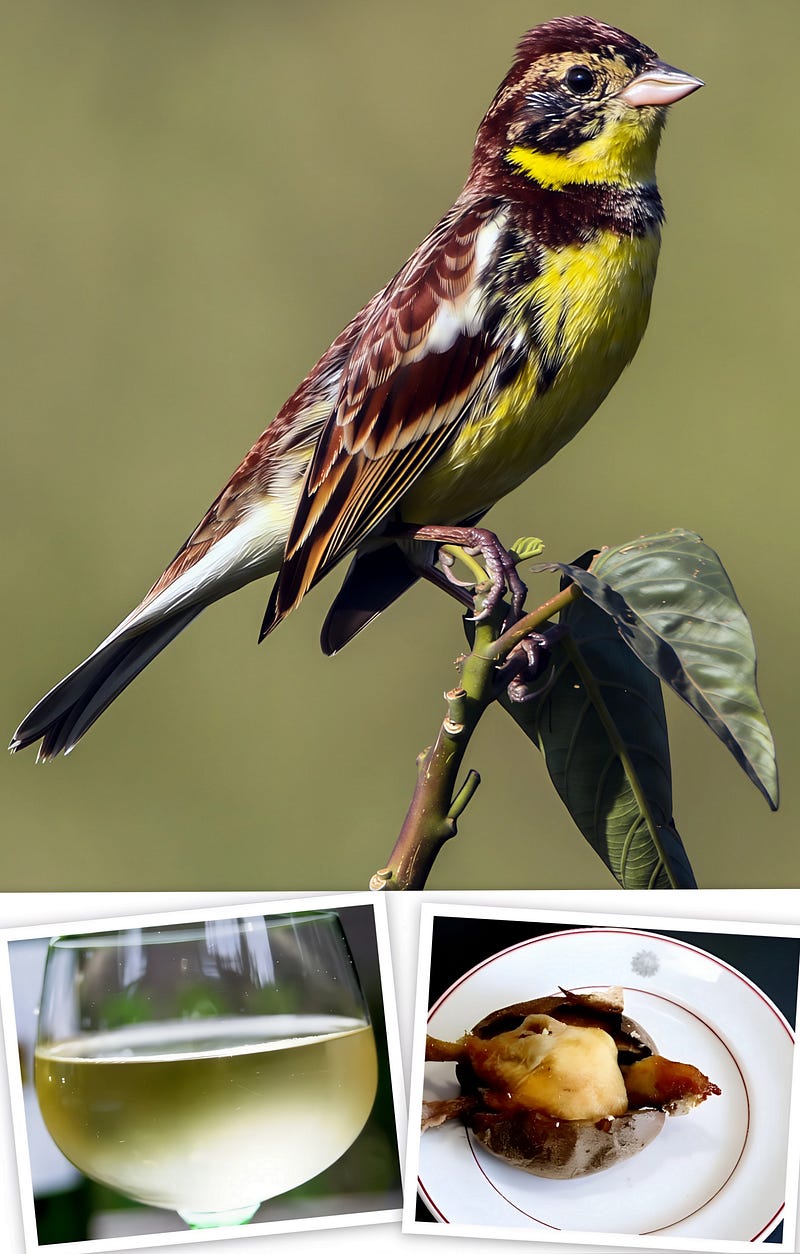
With its vivid saffron chest, chocolate-brown streaked back, and stout conical beak, the yellow-breasted bunting is visually striking. Males in full breeding plumage are especially luminous, flaunting their colors across meadows and wetlands. On average, this species measures about 5.5 inches or 14 cm in length and weighs just 0.5 oz or 15 g — small in stature, but once immense in number.
Their life cycle is typical of temperate songbirds. Nests are constructed near the ground, often hidden among reeds or tall grass. Females lay 3 to 5 eggs, which hatch after an incubation period of roughly 13 days. Nestlings fledge in just over a week. Adults feed primarily on grass seeds, rice, and grains but switch to insects during nesting to fuel chick growth with high-protein fare. Their long-distance migrations — often over 3,100 miles or about 5,000 km — require significant fat accumulation and metabolic precision. Their physiology is a testament to evolutionary craftsmanship, but even the most efficient design is no match for habitat loss and human traps.
Ecology
Historically, the yellow-breasted bunting nested from northern Europe through Siberia and into Northeast Asia. It favored open spaces — wetlands, scrubby fields, riverbanks, and cropland edges. Its wintering grounds extended through southern China, northern India, and mainland Southeast Asia. It was once a ubiquitous presence in both the breeding and non-breeding seasons.

Now, the bird’s range is a patchwork. Vast areas of its habitat have been degraded by mechanized farming, pesticide use, and urban expansion. The greatest threat, however, came during migration. Large-scale trapping — particularly in China and Vietnam — devastated the species. From the 1980s onward, its population plummeted by more than 90 percent. Today, it is listed as Critically Endangered by the IUCN.
Still, signs of hope remain. Governments in East Asia have banned trapping and sale. Local conservationists in Russia and Mongolia are restoring wetland breeding grounds. Agricultural reforms that support mixed-use land and reduce chemical runoff may yet allow for slow population recovery. If we act with urgency and humility, the bird may yet sing again.
Uses
Once deemed a culinary treasure in parts of Asia, the yellow-breasted bunting was harvested by the millions. During peak migration, nets were strung across forest gaps and rice paddies. The birds were bundled, sold live or plucked by the dozen, and prepared in celebratory dishes. In southern China, 1 kg or 2.2 lb of “rice birds” fetched high prices during holidays.
Today, that trade is largely underground. International laws forbid it, but demand among black-market gourmands keeps poaching alive. As a result, the bird has become an ecological liability rather than a cultural asset. However, some regions have begun exploring ecotourism as a revenue stream. By monetizing the bird’s presence without killing it, these communities are forging a more sustainable economic relationship with nature.
Culinary Aspects
Historically, the yellow-breasted bunting was served whole, including the head, bones, and feet. Flash-fried, stewed with spices, or marinated in soy and Shaoxing wine, it was described as rich in flavor, with a fatty texture and mild gamey notes. Gourmands likened it to duck, but more tender. It was prized not only for its taste but also for its rarity, particularly among the upper class.
This culinary tradition is now illegal and rightly controversial. Conservationists argue that romanticizing the bird’s flavor perpetuates demand. Yet understanding the dish’s cultural significance is vital if we are to change hearts as well as laws. Modern chefs in Southeast Asia have begun creating ethical reinterpretations of the dish — using quail, Cornish hen, or even plant-based proteins marinated in umami-rich broths. The goal is not to erase memory, but to evolve it.
Wine Pairings
For those exploring legal, sustainable substitutes, the question arises — what to drink alongside these bold, nostalgic flavors? A well-aged Pinot Noir, with its earthy undertones and crisp acidity, offers a fine balance to the umami-laced richness of soy-marinated fowl. A Gewürztraminer from Alsace, with floral and lychee notes, provides a counterpoint to any chili heat or sweetness in the marinade. Even non-alcoholic pairings — such as aged oolong tea or a fermented plum soda — can echo the complexity and heritage of the original dish.
Conclusion
The yellow-breasted bunting is more than a cautionary tale. It is a test of our will to preserve what we once took for granted. From sky-darkening flocks to near silence in less than a lifetime, this bird embodies the cost of unrestrained appetite and careless modernity. But it also offers redemption.
We can transform our relationship with the wild — by savoring traditions without consuming the creatures at their heart, by choosing sustainability over sentimentality, and by listening closely for the returning chorus of a song nearly lost. In saving the yellow-breasted bunting, we preserve not just a bird, but the sound of conscience.