The Tyranny of Political Tribalism in Modern Society
Political tribalism represents one of the most pervasive and destructive forces in contemporary societies, undermining democratic…
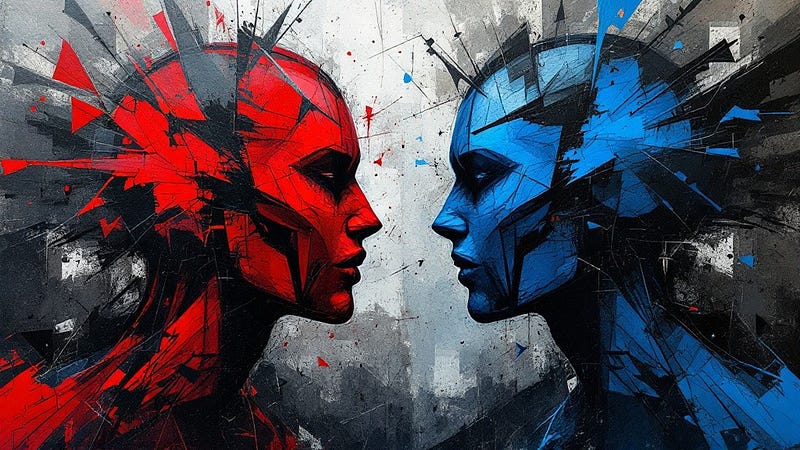
Political tribalism represents one of the most pervasive and destructive forces in contemporary societies, undermining democratic institutions, fueling polarization, and eroding the very fabric of civil discourse. This phenomenon transcends ordinary political polarization, morphing into a rigid mindset where group loyalty overwhelms factual evidence, moral reasoning, and even basic human decency. Unlike mere partisan disagreement, political tribalism operates as a form of identity politics that divides the social world into irreconcilable camps of “us” versus “them,” where the out-group is viewed not merely as incorrect but as morally corrupt and existentially threatening. The corrosive effects of this tribal mentality manifest across multiple dimensions, from the dysfunction of governance systems to the breakdown of community trust and the erosion of shared reality.
The psychological underpinnings of political tribalism reveal its profound resilience against rational engagement. Human beings are evolutionarily wired for tribal affiliation, a survival mechanism that enabled cooperation within groups while promoting suspicion toward outsiders. This innate tendency expresses itself through cognitive biases such as group-based categorization, where even arbitrary distinctions can trigger favoritism toward one’s own group and discrimination against others. Experiments demonstrate that individuals will allocate resources in ways that maximize the gap between their group and outsiders, even at the expense of their own material benefit. This instinctual drive becomes dangerously amplified in modern politics, where partisan identities converge with racial, religious, and cultural markers to form what scholars term “mega-identities.” These consolidated identities transform political disagreements into existential conflicts, where compromise feels like betrayal and dialogue becomes replaced by mutual demonization.
The manifestations of political tribalism extend beyond psychological dynamics to produce tangible societal consequences. Democratic governance depends on norms of compromise, institutional legitimacy, and mutual tolerance, all of which tribalism systematically undermines. When political opponents are viewed as evil rather than merely mistaken, the foundation for good-faith negotiation collapses. Legislative processes grind to a halt as lawmakers prioritize partisan warfare over problem-solving, while public trust in electoral systems, judiciary institutions, and media organizations deteriorates along tribal lines. This institutional decay creates vulnerabilities that authoritarian leaders exploit, leveraging tribal loyalties to concentrate power and undermine democratic checks and balances. The situation becomes particularly dangerous when tribal sentiments merge with conspiracy theories, as seen in contexts like Hungary, where political elites weaponize misinformation to reinforce tribal identities and attack democratic norms.
Beyond governance challenges, political tribalism inflicts profound damage on social cohesion and intergroup relations. The phenomenon fuels what researchers identify as “political sectarianism,” characterized by three interlocking components: othering, aversion, and moralization. Othering involves perceiving political opponents as fundamentally different or alien; aversion entails intense dislike and distrust of these others; and moralization involves viewing opponents as morally wicked or corrupt. This poisonous cocktail transforms political differences into moral absolutes, destroying the possibility of mutual understanding or reconciliation. Social relationships become strained across tribal lines, with families, friendships, and communities fracturing under the weight of political hostility. The destructive impact is particularly acute for minority groups who become scapegoats or symbolic targets in tribal conflicts, as demonstrated by the experiences of Muslim communities in the United States when political tribalism intersects with religious prejudice.
The global dimensions of political tribalism reveal both common patterns and distinct manifestations across different contexts. In Central Asian countries, ethno-political tribalism has fueled corruption, inequality, and violent conflict, with dominant tribes using state power to suppress competing groups and undermine national identity. In Slovakia, far-right movements employ tribalist rhetoric that excludes those who do not share specific beliefs, while maintaining transnational connections with like-minded groups abroad. Even during the COVID-19 pandemic, tribalism generated unlikely alliances between ideologically disparate groups united by shared skepticism toward mainstream medicine, demonstrating how tribal identities can override traditional ideological boundaries. These cross-national examples illustrate how tribalism operates through both exclusionary nationalism and transnational value-based affiliations, creating divisions that are simultaneously more and less exclusive than conventional nationalism.
Addressing the challenges of political tribalism requires moving beyond superficial solutions and confronting the deeper psychological and social roots of the phenomenon. Efforts must recognize that tribalism is not merely a political problem but a human one, rooted in evolutionary instincts for belonging and identity. Effective responses should therefore work with rather than against these instincts, seeking to expand the circle of tribal inclusion rather than denying the reality of tribal impulses. This might involve fostering superordinate identities that transcend political divisions while respecting legitimate diversity of thought and experience. Building resilience against tribalism also requires strengthening civil society institutions that create spaces for cross-tribal interaction, promoting media literacy and critical thinking skills to counteract tribal misinformation, and developing political narratives that emphasize common interests over tribal conflicts.
The struggle against political tribalism represents one of the defining challenges of contemporary democracy. This phenomenon preys upon deep human instincts while exploiting the vulnerabilities of modern information ecosystems, creating a feedback loop of polarization and hostility that threatens to unravel the social contract. Overcoming this threat requires acknowledging the power of tribal impulses while channeling them toward more constructive ends, building societies that honor human needs for belonging and identity without sacrificing democratic values of pluralism and mutual respect. The alternative is a future where political life becomes increasingly characterized by mutual hatred, institutional dysfunction, and the constant threat of violence — a future where democracy gives way to tribal warfare conducted through political means. Avoiding this fate represents both a practical necessity and a moral imperative for all who value free, open, and pluralistic societies.