The WNBA Is Finished Without Caitlin Clark
Introduction The WNBA has long been a league of extraordinary athletes and underappreciated artistry, but one player has shifted its…
Introduction
The WNBA has long been a league of extraordinary athletes and underappreciated artistry, but one player has shifted its gravitational center. Caitlin Clark isn’t simply a star; she is the fuse that ignited a dormant powder keg of potential. To dismiss her as just another talented rookie is to ignore the tectonic movement beneath the surface. What we are witnessing is not a mild bump in interest — it is a cultural and financial transformation driven almost entirely by one singular figure.
The Irreplaceable Spark: Clark’s Attendance and Ratings Surge
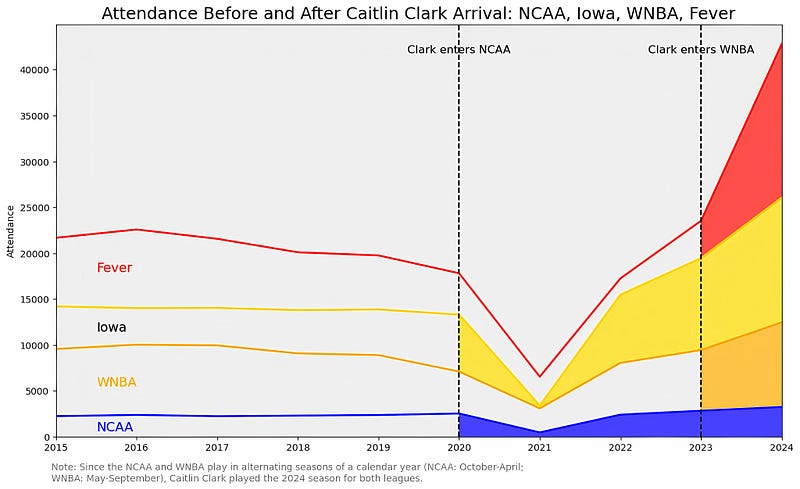
When Caitlin Clark takes the floor, arenas swell with energy and ticket lines curl around city blocks. Road games featuring her Indiana Fever average nearly double the attendance of other matchups. The numbers are stark: the Atlanta Dream sold out State Farm Arena solely for her visit, drawing over 17,600 fans, while other games rarely crack 5,000.
The same pattern holds on television. Fever broadcasts routinely triple the viewership of other WNBA games, with more than a million tuning in to see Clark orchestrate her team’s offense. Remove her from the equation, and the league’s viewership plunges by more than half. These aren’t abstract metrics; they are the very lifeblood of a professional sports league.
A Boom Built on Her Back: Merchandise and Sponsorships
The WNBA’s sudden commercial renaissance is not evenly distributed. Clark’s jersey sales alone outpace every single NBA rookie from her draft class — a staggering feat given the gulf in market size. Sponsors have noticed, too. Fever-related partnerships soared 400% after her arrival, while Nike rushed to launch a $28 million signature shoe line.
The uncomfortable truth is that her rookie peers — despite being talented athletes — are not driving engagement. Paige Bueckers’ modest scoring and Cameron Brink’s season-ending injury underscore the league’s reliance on Clark’s singular magnetism. Without her, that economic surge would wither.
A Stagnant Past Meets an Uncertain Future
For decades, the WNBA hovered at a steady yet stagnant level of support. Average attendance rarely moved beyond 7,000 per game. Clark’s emergence jolted that figure to over 10,800, but analysts estimate that nearly a third of those gains exist solely because of her road draws. Even the league’s landmark $240 million TV deal was negotiated on the heels of her NCAA heroics, networks openly citing her as a “must-watch” phenomenon.
The Fever Illusion: Team Success Hinges on Clark
Look closer at the Indiana Fever’s record, and the mirage becomes clear. With Clark running the offense, they sit comfortably above .500. In games without her, they are winless. Advanced metrics reveal an even starker reality: offensive efficiency plummets from elite levels to bottom-tier production when she’s absent. This is not merely a promising rookie; she is the linchpin of her franchise and, by extension, the league itself.
The Uncomfortable Truth: A Bubble Waiting to Burst
The WNBA’s current boom is thrilling — but precarious. Clark has already missed eleven games due to a nagging groin injury, and the ripple effects of her absence are immediate. Sponsors start to hesitate. Television partners quietly question ratings sustainability. Expansion markets like Toronto slow their timelines. A league that feels suddenly vibrant could just as quickly fade back into niche obscurity.
Conclusion
Caitlin Clark has not merely joined the WNBA; she has redefined its trajectory. The league’s newfound relevance, its surge in attendance, and its lucrative sponsorships rest on her shoulders. That reality demands a sobering question: What happens if she falters? For now, fans and league executives alike should cherish her presence while also investing in broader growth strategies that ensure the WNBA’s future isn’t tied to one remarkable player.
Clark has shown what’s possible. Now, it’s up to the league to prove it can stand tall even when its brightest star is off the court.