
Ukraine is Not Trump’s War — It’s the West’s Wound, and Biden’s Failure
By any rational geopolitical measure, calling Ukraine “Trump’s war” is not just a stretch — it’s a distortion. The conflict in Ukraine…
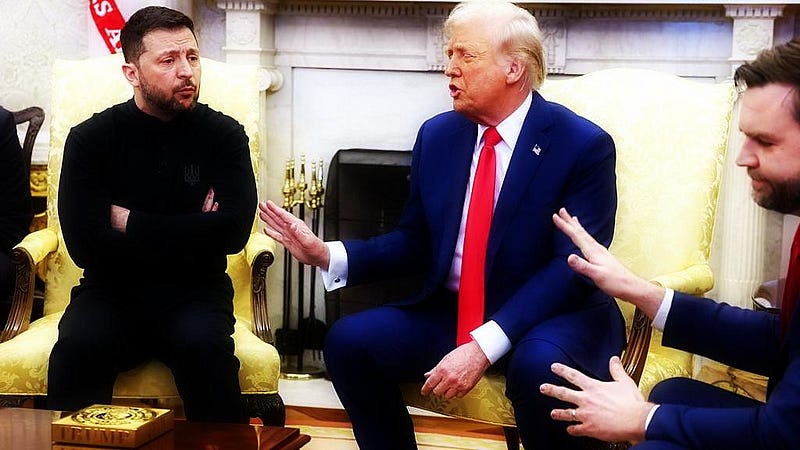
By any rational geopolitical measure, calling Ukraine “Trump’s war” is not just a stretch — it’s a distortion. The conflict in Ukraine began long before Trump’s fingerprints ever touched the levers of global diplomacy. The war belongs to the architects of Western indecision, the acolytes of NATO expansionism, and the long arc of failed deterrence that began not in Mar-a-Lago, but in Brussels and Washington under previous administrations. To place the blame squarely on Trump’s shoulders now is not only historically dishonest — it’s politically convenient.
Vladimir Putin started the war. The initial invasion of Crimea occurred in 2014 under Barack Obama. The full-scale invasion in 2022 happened while Joe Biden was commander-in-chief, a president who, despite lofty rhetoric, repeatedly failed to impose meaningful consequences for Russian aggression in Syria, in cyberattacks, in energy coercion, and election interference. If this war “belongs” to any American president, it is Biden’s — for projecting weakness, for delaying aid, and for insisting on a strategy that tried to bleed Russia without arming Ukraine to win.
Trump, by contrast, has never once been in office during a Russian invasion of Ukraine. Not in 2014. Not in 2022. Not at any time during his first term. That’s not opinion — it’s chronology. During Trump’s presidency, the Kremlin remained contained, in part because it was never quite sure what Trump would do. His unpredictability — mocked by the very media now blaming him — served as a crude but real form of deterrence. Trump didn’t start new wars. He struck back hard when needed, as in the Soleimani killing. And crucially, he greenlit lethal military aid to Ukraine when Obama wouldn’t — including Javelin missiles that helped slow the Russian onslaught.
Now, suddenly, because Trump is involved in ceasefire talks, or threatening secondary sanctions, or publicly mulling escalation, the war is his? That logic is not just flawed — it reeks of projection. It’s Biden who presided over the botched Afghanistan withdrawal. It’s Biden who failed to preemptively sanction Nord Stream 2. And it’s Biden who slow-walked weapons deliveries that could have turned the tide early. Trump is being handed a crisis — again — and the establishment blames him for how loudly he yells while trying to put out their fire.
What about Trump’s “deadline” promises to end the war in 24 hours or 100 days? Critics jeer them as unrealistic, but they miss the point. The message is leverage, not literalism. Trump negotiates by brinkmanship — he always has. That may not sit well with think tank elites, but it’s the only language Putin respects. Biden’s measured tones and multilateral roundtables haven’t stopped the shelling of Kharkiv. They’ve only prolonged the stalemate.
Let’s also dispense with the sanctimony surrounding NATO. Trump’s demands that European countries pay their fair share were not insults — they were overdue corrections. If Europe truly sees this as its existential war, why did it need a real estate mogul from Queens to shame it into rearming? The American taxpayer has borne the defense of the continent long enough. If Trump forces Europe to grow a spine, good.
Finally, consider the grotesque irony of invoking Colin Powell’s broken pottery metaphor — “you break it, you own it.” The architects of the Iraq War, the Libya debacle, and the Syria collapse dare to claim Trump “owns” Ukraine because he talks about ending it? This is not statesmanship. This is scapegoating.
No, Ukraine is not Trump’s war. It’s the West’s failure. It’s the result of decades of arrogant diplomacy, virtue-signaling without force, red lines that weren’t enforced, and summit photo-ops that produced nothing but paper. If Trump steps into this mess, he does so because he’s been handed it — just as he was handed a decaying NATO, a destabilized Middle East, and a broken immigration system.
Trump may not solve the war. But if he dares to try, he should be judged by results, not headlines from a pundit class desperate to rewrite its legacy. This is not his war. It’s their wreckage. And he’s walking into it with eyes open.