Where Does Spacetime Come From?
Introduction For more than a century, we’ve imagined the universe as unfolding upon an unshakable stage — three dimensions of space and…
Introduction
For more than a century, we’ve imagined the universe as unfolding upon an unshakable stage — three dimensions of space and one of time. This was Einstein’s grand tapestry, stretching and bending under the weight of stars and planets. But a new generation of physicists is whispering a radical idea: what if this stage isn’t real at all? What if space and time are not the bedrock of reality but the shimmering surface of something deeper, stranger, and far more fundamental?
The Black Hole Clue: A Universe Written on the Edge
Black holes, once thought of as cosmic traps, surprised the world when Jacob Bekenstein and Stephen Hawking discovered they carry entropy — a measure of information — based on their surface area, not their volume. Imagine a sealed box where the secrets inside are written only on its lid. This revelation seeded the holographic principle: that everything within a region of space might be encoded on its boundary. Spacetime began to look less like a solid stage and more like a hologram.
Gravity and Heat: A Thermodynamic Twist
In 1995, physicist Ted Jacobson connected the dots between gravity and thermodynamics. By treating space as if it possessed temperature and entropy, he derived Einstein’s equations of gravity from the laws of heat. Gravity, in this light, is no fundamental force — it is the universe’s tendency toward equilibrium, like steam rising from a kettle. This hinted that spacetime itself could be a side effect of deeper statistical rules.
Verlinde’s Vision: Gravity Emergent from Information
Erik Verlinde pushed this idea further, proposing in 2011 that gravity is an emergent phenomenon born from shifting information and entropy. His equations reproduced Newton’s gravity without treating gravity as a true force. Some even hope this framework could illuminate the mystery of dark matter. If Verlinde is right, gravity isn’t a fundamental player on the stage — it’s the performance itself, a consequence of hidden quantum data.
The Holographic Universe: Two Worlds in One
Juan Maldacena’s discovery in string theory, known as AdS/CFT, brought startling evidence. He showed that a universe with gravity can be perfectly mirrored by a universe without gravity living on its boundary. A three‑dimensional world is mathematically identical to a two‑dimensional system of quantum interactions. The stage and the script may be two views of the same underlying reality.
Entanglement: The Threads Weaving Space
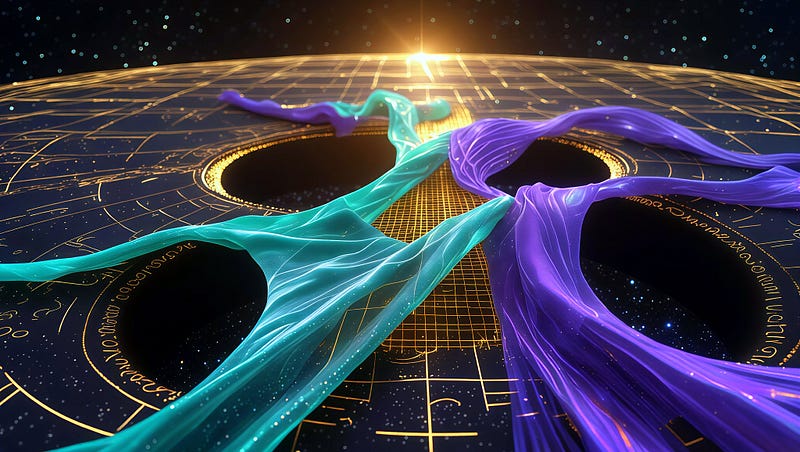
Mark Van Raamsdonk took the argument to its poetic conclusion: spacetime is stitched together by quantum entanglement. When entanglement between regions fades, space itself begins to tear apart. In his picture, distance and geometry are not givens; they are born from the invisible bonds of quantum information. Without entanglement, there would be no fabric of space at all.
Rethinking Reality
Across these clues, a bold vision emerges. Space and time are not eternal foundations — they are emergent phenomena arising from quantum entanglement, information, and entropy. Gravity, once a titan among forces, might be a thermodynamic afterthought. The universe is not a stage but a performance woven from hidden threads of data.
Conclusion
If these theories hold, our picture of reality will shift as profoundly as when Copernicus moved Earth from the center of the cosmos. The next revolution in physics may not reveal what fills the universe — it may reveal what the universe itself is made of, beyond space and beyond time. Perhaps our quest is not to map the stage but to learn the script written underneath it, in the strange language of quantum information.
Let this thought linger: the world around you, the very space between your hands, might be nothing more than an intricate illusion spun from deeper truths we are only beginning to glimpse.