Whispers of the Timberdoodle: The Secret Life and Flavor of the American Woodcock
The first time you hear the nasal “peent” of an American woodcock at dusk, it feels like the forest itself is clearing its throat. Then, a…
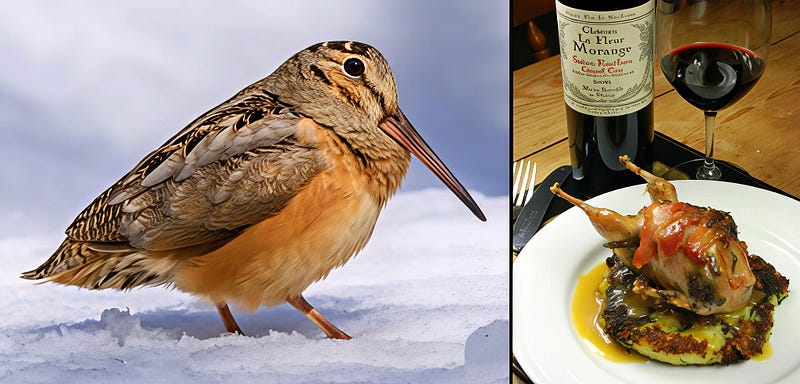
The first time you hear the nasal “peent” of an American woodcock at dusk, it feels like the forest itself is clearing its throat. Then, a blur of wings spirals into the twilight sky, tracing a dizzying dance that has inspired hunters, chefs and poets for centuries. Scolopax minor, known affectionately as the timberdoodle, is far more than a curious bird with a comical name. It is a lesson in adaptation, a fleeting delicacy in the culinary world, and a quiet cornerstone of North America’s woodland ecology.
A Taxonomic Jewel of the Forest
The American woodcock belongs to the family Scolopacidae, which includes sandpipers and snipes. Its scientific name, Scolopax minor, reflects its lineage within a group of migratory waders, yet it is uniquely tailored to life in dense forests rather than open shorelines. It has no recognized subspecies, though it is often nicknamed bogsucker, night partridge or Labrador twister depending on local folklore. Unlike its Old World cousin, Scolopax rusticola, celebrated in European cuisine, this New World bird remains a largely untapped culinary treasure outside traditional hunting circles.
Biology Etched in Earth and Sky
Small, rotund and cloaked in cryptic brown plumage, the woodcock is a master of camouflage. Its eyes are set high and far back on the skull, allowing nearly panoramic vision, a necessary adaptation for spotting predators while probing the soil for earthworms with its preternaturally sensitive bill. Each spring, males perform an elaborate courtship flight known as the “sky dance,” ascending in a musical spiral before tumbling back to earth in a cascade of chirps and trills. This dramatic display marks the beginning of a life cycle synced with the greening of the forest floor. Females build shallow nests among leaf litter, rearing broods whose downy forms seem to vanish into the underbrush at the slightest alarm.
Ecology Rooted in Conservation
Unlike many ground-nesting birds, the American woodcock thrives in young, regenerating forests and brushy edges — habitats often overlooked in conservation planning. Its reliance on early successional woodlands makes it a biological indicator, signaling the health of landscapes shaped by logging, fire or storm. Yet this dependence also makes it vulnerable to the decline of such habitats as development and mature forest monocultures spread. Conservation groups now manage clearings and create rotational thickets to sustain woodcock populations, balancing tradition with ecological responsibility.
An Unlikely Marketplace Muse
While not a commercial staple, the American woodcock carries economic and cultural weight through regulated hunting seasons in regions like the Upper Midwest and New England. Harvested in small numbers, it symbolizes sustainable use when hunting is paired with habitat stewardship. For those who curate wild game for niche markets, the woodcock is a rarity that invites both caution and reverence — its value lies not in abundance but in the fleeting opportunity it represents.

Culinary Poetry on the Plate
To those lucky enough to taste it, the American woodcock offers a flavor that defies comparison. The dark, iron-rich breast meat is tender and earthy, while the traditional preparation often leaves the heart and liver tucked within, infusing each bite with a whisper of the wild. In rural hunting lodges and select haute cuisine circles, chefs roast them whole, basting with butter and herbs until the skin crisps and the aroma fills the room with something primal and profound. Paired with foraged mushrooms or a drizzle of blackberry reduction, the bird becomes more than sustenance — it becomes an evening’s conversation, a story to share.
A Toast to the Timberdoodle
The woodcock’s gamey richness sings alongside wines that offer both brightness and depth. A young Pinot Noir from Oregon or Burgundy, with its red fruit and subtle earthiness, mirrors the bird’s woodland character. For those inclined toward white, a dry Chenin Blanc or a mineral-driven Chablis provides a crisp counterpoint, lifting the palate and balancing the rustic notes of the dish.
Conclusion: A Dance Worth Protecting
To follow the woodcock through its seasonal rhythms is to witness resilience in miniature. Its spiraling courtship flight is a reminder that beauty often hides in plain sight, waiting for the patient observer. Its place in the kitchen, though rare, is a celebration of sustainable connection between land, tradition and table. As forests shift and generations pass, may we honor this humble bird not only with careful management and thoughtful gastronomy but with the wonder that first drew us to its twilight dance.