Yanbian’s Weird Web: China, Russia, North Korea, and South Korea Collide
The Yanbian Korean Autonomous Prefecture occupies a singular position in the complex geopolitical cartography of Northeast Asia. Nestled…
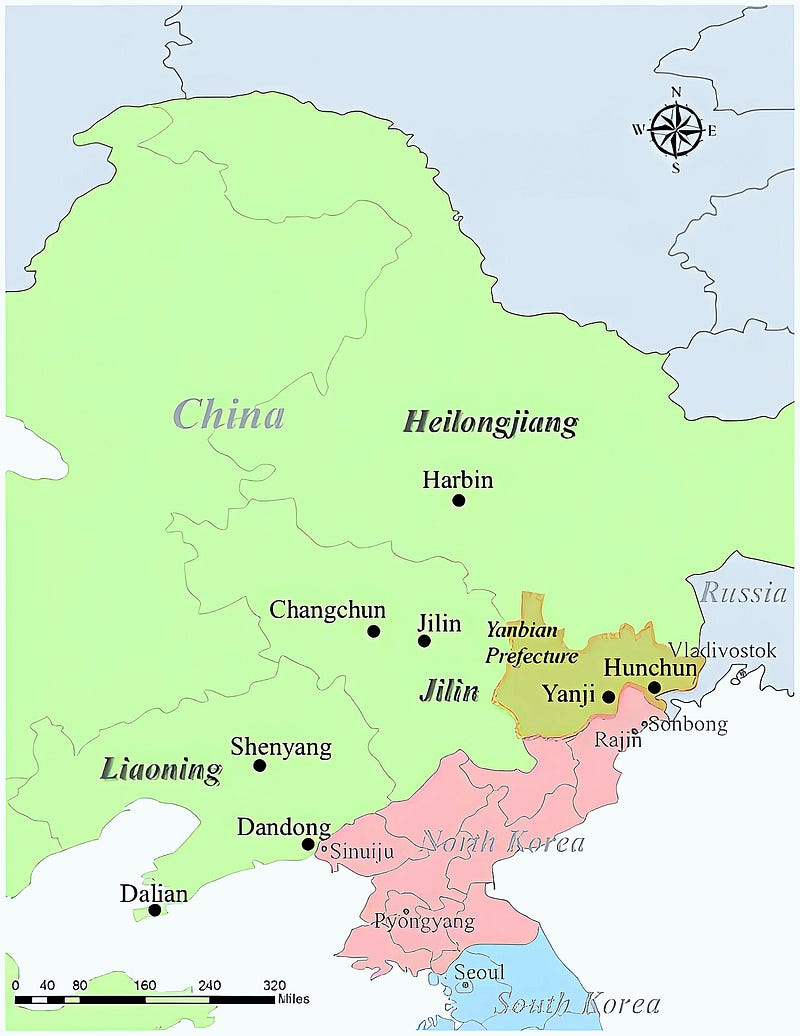
The Yanbian Korean Autonomous Prefecture occupies a singular position in the complex geopolitical cartography of Northeast Asia. Nestled where China, North Korea, and Russia converge, this mountainous territory represents more than merely a jurisdictional anomaly — it constitutes a living laboratory of competing sovereignties, contested identities, and cross-border flows that defy conventional nation-state boundaries. Established formally in 1952 as China’s first ethnic autonomous prefecture, Yanbian became home to the Chaoxianzu (ethnic Koreans with Chinese citizenship), whose presence predates the current political divisions of the Korean peninsula. The region’s spiritual and territorial significance is anchored by Mount Paekdu (Changbai in Chinese), the volcanic peak straddling the China-North Korea border that serves as the foundational site in the Korean creation myth. This shared sacred geography has made Yanbian simultaneously a “Third Korea” in cultural terms and an integral part of China’s political framework — a duality that continues to generate fascinating contradictions. Half of this sacred mountain lies within Yanbian, leading ethnic Koreans to assert “Mt. Paekdu is our land” during the 2007 Asian Games controversy when South Korean athletes challenged China’s territorial claims, demonstrating how historical memory remains powerfully alive in this borderland.
The prefecture’s capital, Yanji, functions as the epicenter of these multidimensional relationships. Airport signage in five languages — Korean, Chinese, Japanese, Russian, and English — offers immediate testimony to its cosmopolitan character. Unlike Pyongyang’s de jure segregation or Seoul’s de facto ethnic boundaries, Yanji presents a rare space of relatively integrated coexistence, earning it the moniker “Little Hong Kong” for its cultural fluidity. This apparent harmony, however, masks underlying tensions. The region has witnessed substantial emigration since China and South Korea normalized relations in 1992, with nearly half of Yanbian’s ethnic Korean population seeking economic opportunity in the South — a diaspora that has reshaped the region’s demographics and created complex transnational kinship networks. Those who remain navigate a delicate balance between Chinese citizenship and Korean heritage, often describing themselves as “one people” with Koreans globally while experiencing discrimination in South Korea, where they are perceived as insufficiently Korean. This identity paradox manifests linguistically through hybrid Korean-Chinese phrases like “oori chuzuche-rel taja” (Let’s get a taxi), where Mandarin terms are grammatically integrated into Korean syntax, reflecting a creolized daily existence.
Assumptions and Analytical Tensions
The conventional statist perspective views Yanbian through the lens of China’s successful ethnic autonomy model — a showcase of harmonious diversity within the unitary multinational state. Official celebrations like the 70th-anniversary events extol Yanbian as a testament to “development and ethnic unity,” emphasizing infrastructure investments and cultural preservation. This narrative, however, rests upon several problematic assumptions. First, it presumes that economic development automatically reinforces political integration, ignoring how prosperity has enabled emigration that weakens the prefecture’s Korean character. Second, it assumes cultural autonomy remains equally meaningful when detached from linguistic vitality — a questionable premise given the precipitous decline of Korean-language education, with Korean elementary schools plummeting from over 1,000 in 1990 to just 31 by 2009. Third, it treats ethnic identity as static rather than recognizing its reactive evolution amid changing geopolitical currents.
The South Korean perspective reveals different biases. While officially embracing Chaoxianzu as “jaeoe dongpo” (compatriots who live abroad), South Korean society often marginalizes them as cultural hybrids who speak an “impure” Hamyong dialect (originating from North Korea) and lack authentic Korean consciousness. This bias manifests structurally through discriminatory visa policies that make it harder for Chaoxianzu to obtain work visas than other diaspora Koreans, functionally restricting them to manual labor positions despite their nominal ethnic kinship. The representation of Chaoxianzu in South Korean cinema as criminal figures further demonstrates how cultural proximity can breed particular forms of prejudice. Meanwhile, North Korea engages Yanbian through calculated cultural diplomacy — dispatching music teachers from Pyongyang to offer traditional drumming classes — while simultaneously using the region as a conduit for illicit activities, including narcotics distribution. These competing instrumentalizations reveal how each neighboring state engages Yanbian not as a subject in its own right, but as an object to advance national interests.
Competing Visions of a Borderland
The economic sphere reveals perhaps the starkest contradictions. Yanbian exemplifies what scholars term the “remittance paradox” — the simultaneous dependence on and undermining effects of diaspora capital. Wages from South Korea, often three to four times higher than local earnings, have transformed Yanji’s skyline with new apartment complexes while devastating its social fabric. The gendered nature of this diaspora has created a demographic crisis: Chaoxianzu women disproportionately leave for work or marriage in South Korea, while men remain behind, sometimes descending into unemployment and alcoholism. This phenomenon has reshaped local marriage markets, with cross-ethnic unions between Han Chinese men and Chaoxianzu women increasingly favored (considered “a match made in heaven”) while the reverse pairing is discouraged due to stereotypes about Chaoxianzu male “laziness” and Han female “independence.” These social dynamics illustrate how economic globalization can reinforce patriarchal structures even as it creates new hybrid identities.
Geopolitically, Yanbian functions as what international relations theorists call a “permeable frontier” — a zone where state control is necessarily incomplete due to competing sovereignties. For North Korean defectors, Yanji serves as the crucial first stop after crossing the frozen Tumen River, creating a shadow population that exists in legal limbo. For Christian missionaries (both South Korean and American), the region operates as a staging ground for clandestine operations across the border. For Russian interests, Yanbian represents a commercial conduit to Chinese markets, facilitated by historical ties to the Russian Far East. These overlapping networks create what one observer termed a “curious location” — a space where intelligence operatives, cross-border traders, defectors, and cultural diplomats uneasily coexist. The 2022 opening of the RCEP Yanbian Cross-border Import and Export Center within Yanji’s airport development zone represents China’s attempt to formalize and capitalize on this permeability, integrating Yanbian into regional supply chains under state supervision rather than suppressing its cross-border character.
Cultural Resilience and Hybrid Futures
Against these structural pressures, Yanbian’s cultural institutions demonstrate remarkable resilience. The Yanbian Funde Football Club, competing in China’s second-tier league, has become an unlikely vessel for hybrid identity. With over half its players being Chaoxianzu and a South Korean manager, the club attracts thousands to Yanji’s stadium every other Sunday, where unified chants in Korean and Mandarin proclaim “Our nation is the greatest!” — a deliberately ambiguous formulation that allows fans to celebrate ethnic pride without challenging Chinese sovereignty. Similarly, the veneration of poet Yun Dong-ju — born in Yanbian village of Myeongdong in 1917, martyred in a Japanese prison in 1945 — has become a powerful unifying symbol. His poetry, taught in Korean schools across the peninsula, transforms Yanbian from periphery to spiritual center, attracting literary pilgrims from both Koreas to his birthplace despite its namesake’s ironic contrast to Seoul’s commercial Myeongdong district. Yun’s verse articulates the Yanbian condition with haunting precision: “I must walk the road / That has been given to me” expresses the burden and dignity of borderland existence.
The prefecture’s environmental and economic vulnerabilities further complicate its position. Multi-scale poverty analysis reveals how deprivation concentrates in remote villages where geographic capital — natural environment, transport access, facilities, and socioeconomic development — remains weakest. At the township level, poverty correlates primarily with transport and economic factors, while village-scale poverty shows stronger links to environmental constraints like topography and climate. This creates what researchers term an “island effect,” where poverty agglomerates in isolated pockets, requiring hyper-localized anti-poverty strategies rather than one-size-fits-all approaches. Climate change intensifies these vulnerabilities, as warming temperatures disrupt traditional agriculture even as they potentially extend tourist seasons for Mount Paekdu’s “sacred” landscapes.
Practical Manifestations of Complexity
The region’s strategic ambiguity generates fascinating practical applications. Culturally, Yanbian serves as a diplomatic valve for inter-Korean relations. When Kim Jong-un visited China, Yanbian’s elite performers entertained the North Korean leader with traditional music — a subtle assertion of Chinese stewardship over Korean heritage. Economically, the prefecture has developed a niche in vocational training for North Korean defectors, leveraging linguistic affinity to prepare them for South Korean resettlement. Illicitly, the region functions as a distribution node for North Korean-produced narcotics destined across East Asia, demonstrating how legitimate and illegitimate cross-border flows often share the same channels.
Tourism reveals another layer of instrumentalization. South Korean visitors experience Yanbian as a site of nostalgic authenticity — a preserved “old Korea” contrasting with Seoul’s hypermodernity. Chinese domestic tourists encounter it as an exoticized “Korea within borders,” consuming hanbok experiences and Korean barbecue without needing passports. This dual tourism economy produces its tensions: infrastructure development prioritizes experiences that confirm external expectations rather than serving local needs, while commercialization risks reducing living culture to consumable folklore. The Yanji Cultural and Arts Research Center walks this tightrope daily, preserving authentic traditions while staging performances for visitors.
Looking forward, Yanbian’s significance lies precisely in its resistance to easy categorization. It challenges China’s narrative of seamless ethnic integration while simultaneously disproving Korean claims of exclusive cultural ownership. It functions as both a bridge and a buffer between geopolitical rivals, benefiting from and suffering from its strategic position. As climate change accelerates and regional tensions fluctuate, Yanbian’s adaptive hybridity may offer insights for other borderlands navigating sovereignty disputes. The opening of the RCEP trade center suggests China’s long-term strategy: formalizing Yanbian’s permeability through institutional frameworks that maximize economic benefit while minimizing uncontrolled flows. Yet as long as Mount Paekdu’s snow-cated peak continues to symbolize Korean origins while physically residing partially within China, Yanbian will remain what it has always been — a territory where mythology and territory intertwine, where identities are perpetually performed rather than fixed, and where the very concept of “Korea” expands beyond the peninsula to encompass its diasporic frontier. In this liminal space, the future of Northeast Asian relations is being written not in treaties or summits, but in the daily struggles of a people walking the road given to them.