A Silver Thread Through the Deep: The Haddock’s Journey from Ocean Lore to Culinary Art
Introduction In the cold northern reaches of the Atlantic, where the sea’s breath carries both salt and myth, there swims a fish whose…
Introduction
In the cold northern reaches of the Atlantic, where the sea’s breath carries both salt and myth, there swims a fish whose reputation has endured for centuries. The haddock, known to science as Melanogrammus aeglefinus, is more than just a menu item. It is a linchpin in marine ecosystems, a fixture of traditional fisheries, and a canvas for culinary craftsmanship. To know the haddock is to glimpse the delicate balance between nature’s bounty and human ingenuity, and to appreciate a story where sustainability, taste, and heritage weave together like a silver thread through the deep.
Taxonomy
Haddock belongs to the family Gadidae, which also includes cod and pollock. Its scientific name is Melanogrammus aeglefinus, a monotypic species with no recognized subspecies, though it is sometimes marketed under regional names such as Finnan haddie or scrod haddock. These names, steeped in tradition, reflect local curing methods or the fish’s size class rather than distinct genetic varieties. This singular classification underscores its unique evolutionary path within the broader cod-like lineage.
Biology
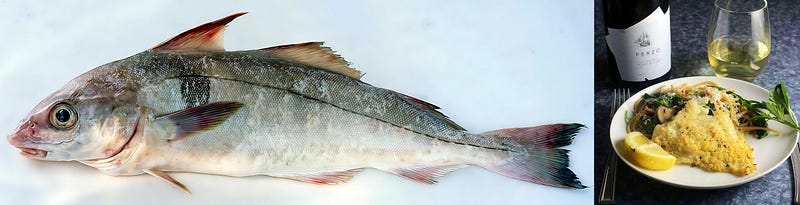
The haddock is instantly recognizable by the inky black blotch behind its pectoral fin, a mark old fishermen romantically call the “Devil’s thumbprint.” Reaching lengths of up to 69 cm, or roughly 27 in, and weights often exceeding 3.6 kg, or about 8 lb, it is built for life in cold, nutrient-rich waters. Haddock mature quickly, usually within two to three years, and spawn in massive numbers, ensuring their resilience in the face of natural predation. Their flesh is white, lean, and firm, a testament to their active lives roaming continental shelves.
Ecology
Haddock thrive in the North Atlantic, from the icy Norwegian Sea to the banks off New England. They are demersal, hugging the sea floor at depths between 80 m and 200 m, or about 262 ft to 656 ft. In these shadowed realms, they play a vital role, feeding on benthic invertebrates and small fish while serving as prey for larger predators such as seals and sharks. Yet their abundance is not guaranteed. Overfishing and habitat disruption have, at times, pushed stocks to critical lows. Today, carefully managed quotas and sustainable fishing certifications aim to keep their populations healthy, protecting both the species and the livelihoods dependent on them.

Uses
The haddock has long been a pillar of North Atlantic economies. Smoked into the famed Finnan haddie or sold fresh at bustling fish markets, it supports coastal communities and international trade alike. Modern sustainability practices — such as gear modifications to reduce bycatch and seasonal closures to protect spawning grounds — ensure that this economic engine does not run at the expense of the future. For many fishing families, the haddock is not only income but identity, linking them to generations who faced the sea before them.
Culinary Aspects
In the kitchen, haddock is revered for its mild, slightly sweet flavor and flaky texture. Pan-fried fillets sizzle into golden perfection, while smoked haddock adds a subtle, savory depth to creamy chowders. A traditional Scottish Cullen skink, made with smoked haddock, potatoes, and cream, warms both body and soul on a cold night. Nutritionally, a 100 g portion — 3.5 oz — delivers high-quality protein with very little fat, making it a wise choice for health-conscious diners. Whether poached in butter or baked with herbs, the haddock rewards simplicity with elegance.
Wine Pairings
The subtlety of haddock calls for wines that complement rather than overwhelm. A crisp Sauvignon Blanc from the Loire Valley pairs beautifully, its citrus notes dancing alongside the fish’s delicate sweetness. For smoked preparations, a lightly oaked Chardonnay brings just enough depth to match the savory richness. In coastal taverns and modern bistros alike, these pairings honor both the catch and the craft of those who bring it to the table.
Conclusion
The haddock’s story is one of endurance and adaptation, from deep-sea habitats to human history. It reminds us that our choices — what we catch, what we cook, what we cherish — echo across ecosystems and generations. To savor haddock is to partake in a legacy that is as much about the health of our oceans as it is about the pleasures of the plate. May we continue to honor this fish not only with our palates, but with our stewardship, ensuring that the silver thread remains unbroken for centuries to come.