Ancient Predator, Modern Treasure: The Untold Story of the Alligator Gar
Introduction In the quiet backwaters of the Mississippi River basin, a shadow moves beneath the cypress knees and reeds — slow, deliberate…
Introduction
In the quiet backwaters of the Mississippi River basin, a shadow moves beneath the cypress knees and reeds — slow, deliberate, armored like a medieval knight and older than the dinosaurs themselves. This is the Alligator Gar, a living fossil with a reputation as both a fearsome predator and a culinary curiosity. Long dismissed as a “trash fish” by some and revered as a trophy by others, the Alligator Gar has recently begun to capture global fascination. Its story is one of survival, adaptation, and the delicate balance between human appetite and ecological stewardship.
Taxonomy
The Alligator Gar, known scientifically as Atractosteus spatula, belongs to the family Lepisosteidae, a lineage that stretches back over 100 million years. Within the genus Atractosteus, it stands as the largest species, distinguished by its massive head and crocodilian snout. Common names include “gator gar,” “diamond gar,” and, in parts of Louisiana, simply “garfish.” Unlike other gars, the Alligator Gar reaches immense size and lacks the subtle variations found in smaller relatives such as the Spotted Gar (Lepisosteus oculatus) or Longnose Gar (Lepisosteus osseus), making it a singular culinary and biological specimen rather than one among many edible varieties.
Biology
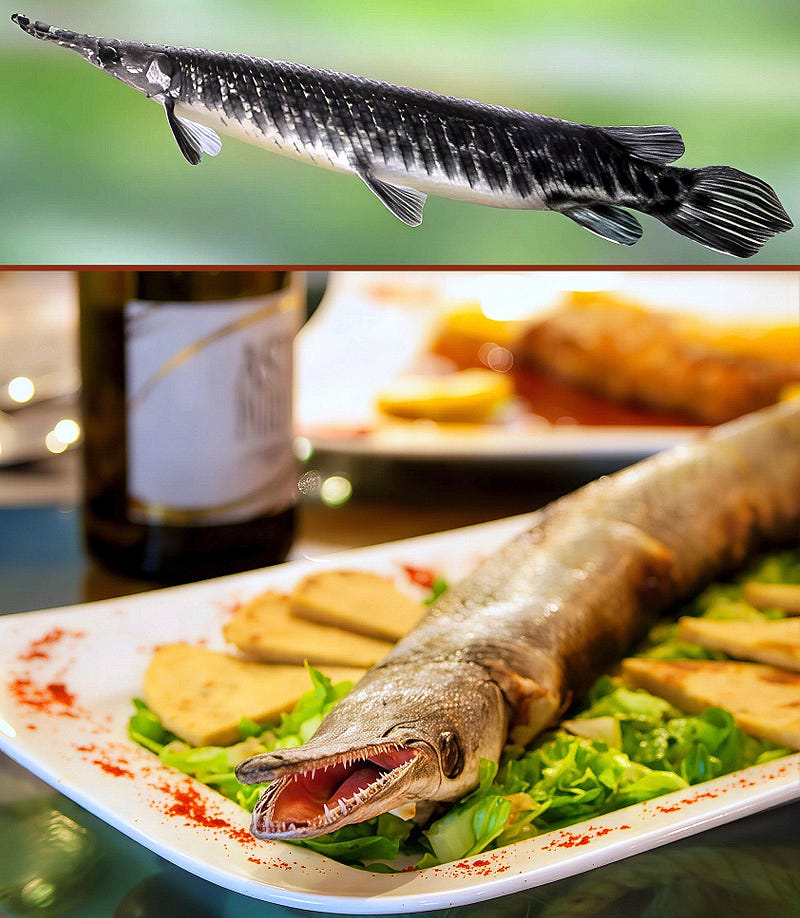
Picture a fish armored in interlocking ganoid scales, each one glinting like polished stone. The Alligator Gar can grow beyond eight feet and weigh over 300 pounds, a true leviathan of freshwater. It boasts a dual respiratory system, with a vascularized swim bladder allowing it to gulp air at the surface, an adaptation that lets it survive in oxygen-poor waters where other fish would perish. Its life cycle is patient and measured; females mature only after a decade, releasing adhesive eggs in hidden shallows, their young hiding among roots until they can fend for themselves. With a head reminiscent of an alligator and a jaw lined with needle-sharp teeth, it embodies evolution’s ruthless artistry.
Ecology
The Alligator Gar thrives in sluggish rivers, oxbow lakes, and floodplain bayous, playing the role of both apex predator and ecological regulator. It feeds on rough fish such as carp and shad, maintaining balance in ecosystems that might otherwise be overrun by invasive species. Yet this ancient fish faces modern threats. Overfishing, habitat loss, and misconceptions about its danger to humans have reduced populations in some regions. Conservation programs now spotlight its value as a keystone species, urging sustainable harvests and catch-and-release practices to ensure its survival for generations.
Uses
For centuries, indigenous peoples of North America harvested Alligator Gar not only for food but for tools; its scales were used as arrowheads and its hide as protective coverings. Today, the fishery has economic significance in the southern United States, with guided gar-fishing expeditions drawing anglers from around the world. Artisans still use its scales for jewelry, while some commercial processors smoke, jar, or freeze fillets for niche markets. Sustainable practices, such as quota systems and seasonal restrictions, are crucial to prevent history from repeating itself as yet another overexploited species.
Culinary Aspects
On the plate, Alligator Gar is a surprise. Its flesh, firm and pale, flakes into sweet, mild portions that many compare to crab or lobster rather than traditional fish. In Cajun country, gar balls — savory meatballs seasoned with green onion, garlic, and spices — are a festival staple. Along the Gulf Coast, gar steaks are smoked over pecan wood, their aroma thick and nostalgic, a testament to culinary traditions that refuse to fade. High in protein and low in fat, gar meat offers nutritional benefits, though the roe is toxic and must be carefully removed, a reminder that even nature’s bounty demands respect and knowledge.
Wine Pairings
Pairing Alligator Gar with wine is an exercise in nuance. A crisp Sauvignon Blanc with bright citrus notes elevates the natural sweetness of smoked gar, cutting through its richness with a clean finish. For gar prepared in a hearty Cajun sauce piquante, a chilled Riesling brings balance with its slight sweetness, taming the heat without overpowering the flavors. Those who favor red will find that a light Pinot Noir complements gar’s delicacy, its earthiness echoing the bayou’s dark waters and the ancient lineage swimming within them.
Conclusion
The Alligator Gar is more than a relic; it is a bridge between past and present, a testament to resilience in a changing world. Its survival challenges us to reconsider our relationship with the wild — how we harvest, how we protect, and how we honor the living history swimming at our feet. To taste it is to taste time itself, to catch one is to wrestle with an ancient spirit, and to conserve it is to ensure that future generations, standing on those same riverbanks, will feel the same shiver of awe.