Blood and Brine: The Enigmatic Legacy of the Sea Lamprey
Introduction In the cold rivers and coastal waters of the North Atlantic, a creature slithers with ancient menace and prehistoric grace…
Introduction
In the cold rivers and coastal waters of the North Atlantic, a creature slithers with ancient menace and prehistoric grace. Petromyzon marinus, the sea lamprey, is a survivor from an era long before jaws gripped the marine food chain. A parasite to some, a delicacy to others, the lamprey straddles the line between reviled invader and culinary treasure. With its jawless, sucker-like mouth ringed by concentric teeth, this fish stirs both ecological concern and gastronomic intrigue. As we navigate its evolutionary oddity, its ecological imprint, and its traditional place at European feasts, we find that the sea lamprey is far more than just an aquatic vampire.
Taxonomy
Petromyzon marinus belongs to the superclass Agnatha, a lineage of jawless fish that predates the dinosaurs. It is a member of the order Petromyzontiformes and the family Petromyzontidae. As a species, it is commonly referred to as the sea lamprey, though regional vernacular includes “lamproie” in French or “lampreda” in Spanish and Portuguese cuisines. While Petromyzon marinus dominates both freshwater and marine ecosystems of the North Atlantic basin, other edible species include Lampetra fluviatilis, the river lamprey, prized in medieval Europe. Unlike many fish, lampreys lack paired fins and scales, further cementing their primitive evolutionary status.
Biology
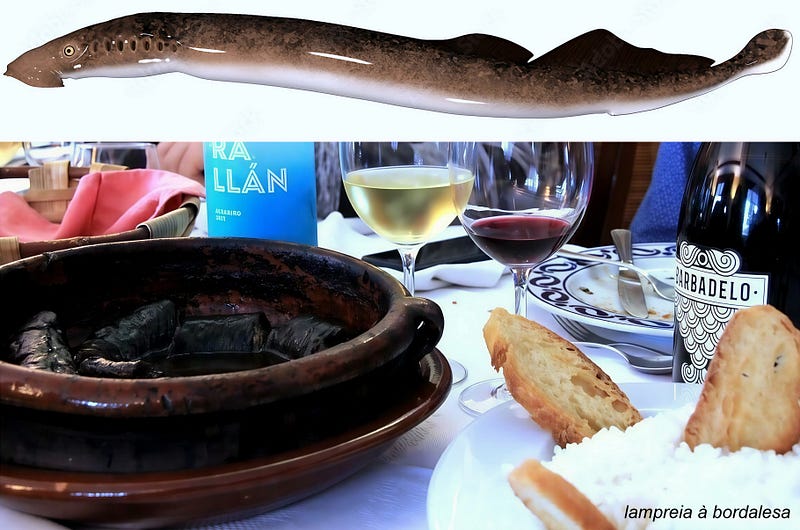
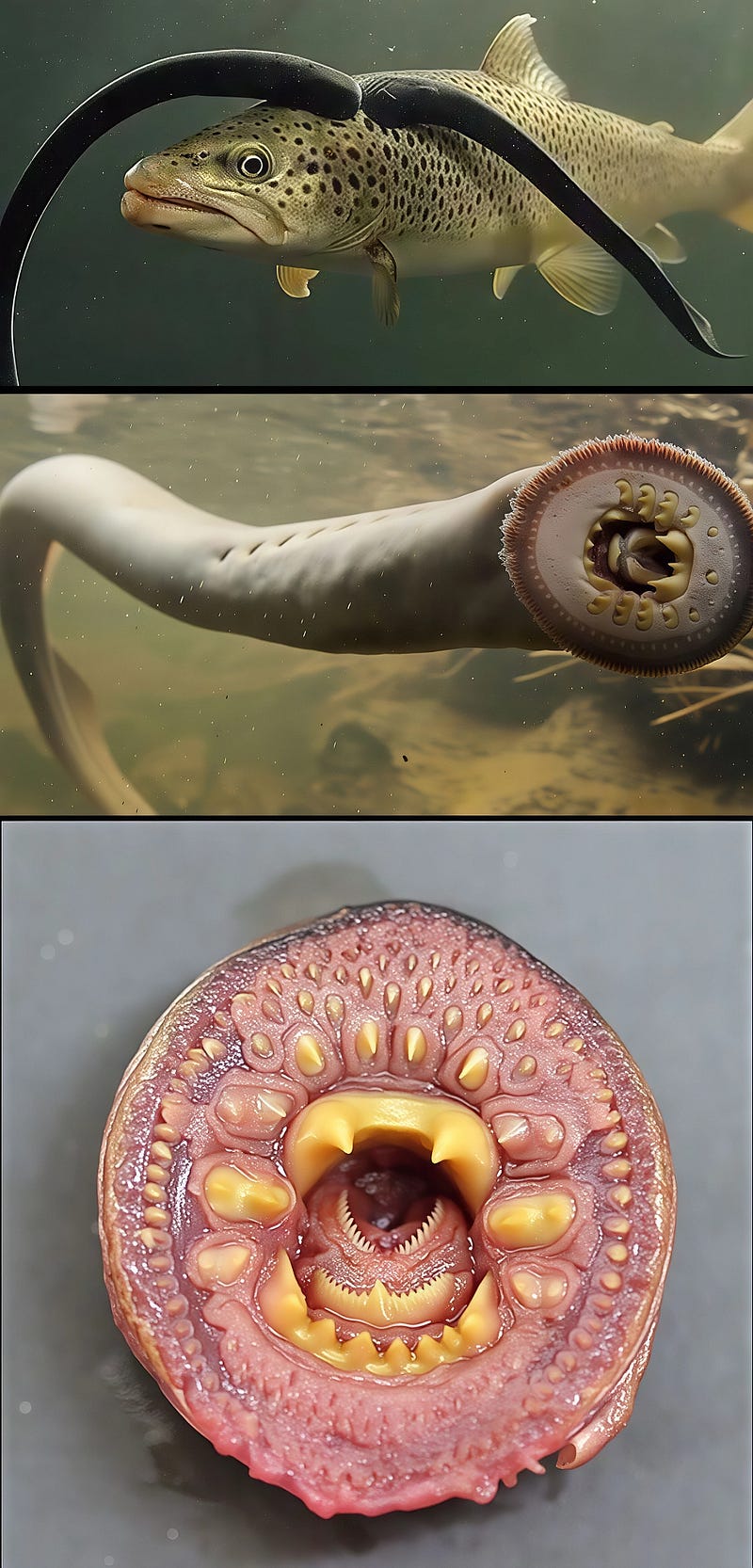
Physiologically, the sea lamprey is both grotesque and fascinating. Adults can reach lengths of 35 in, which converts to roughly 89 cm, and weigh up to 5.5 lb, or about 2.5 kg. Their eel-like bodies shimmer in mottled gray-brown hues, but it’s their mouth that commands attention — a rasping oral disc lined with horn-like teeth and a central tongue that drills into the flesh of host fish. They are anadromous, migrating from saltwater to freshwater to spawn, much like salmon. Once spawning is complete, adults die, their life cycle lasting six to seven years, most of which is spent buried in sediment as larvae. These ammocoetes, which can be as small as 5 cm or 2 in, filter feed for up to seven years before undergoing a radical metamorphosis into their parasitic adult form.
Ecology
Lampreys are native to the Atlantic Ocean and its tributaries, from Europe’s Iberian Peninsula to Canada’s Gulf of St. Lawrence. However, they became invasive in the Great Lakes of North America following the construction of man-made canals. There, freed from predators and armed with their insatiable feeding habits, sea lampreys decimated native fish populations, particularly lake trout. Control programs — ranging from barriers to specialized pesticides called lampricides — have curbed their impact, but they remain a costly challenge, with millions of dollars spent annually in mitigation. Conversely, in their native range, lampreys play vital ecological roles, serving as prey for larger fish, birds, and mammals, while also enriching spawning streams with marine-derived nutrients upon their death.

Uses
In native habitats, lampreys have been harvested for centuries for food, oil, and bait. Historically, they were a luxury food in medieval England, served in pies at royal banquets. King Henry I allegedly died from eating “a surfeit of lampreys.” Their oily flesh makes them rich in calories, ideal for pre-modern European winters. In modern times, lampreys have become a managed fishery in parts of Spain, Portugal, and France, where traditional methods of capture and preparation persist. However, commercial harvesting is tightly controlled due to conservation concerns, with quotas and seasonal restrictions balancing market demand with species preservation.
Culinary Aspects
Sea lamprey flesh is dense, fatty, and unlike typical fish. When cooked properly, it delivers a rich, earthy flavor with deep umami notes, often described as reminiscent of liver or eel. In the Portuguese city of Porto, lamprey is braised in red wine and its blood, creating a dish called “lampreia à bordalesa.” In northern Spain’s Galicia, locals serve it with rice in thick, garlicky stews. In medieval English cuisine, the traditional lamprey pie — spiced with clove and cinnamon — was a seasonal delicacy. While the flesh can be intense for unaccustomed palates, for connoisseurs, lamprey offers a gastronomic experience as singular as its anatomy. Nutritionally, it is high in omega-3 fatty acids, with approximately 15 g of fat per 100 g serving and rich in vitamins A and D.
Wine Pairings
Given the bold flavor of lamprey, it requires equally assertive wine companions. Full-bodied reds with firm tannins cut through the fatty texture, while nuanced fruit and spice notes mirror the dish’s traditional wine-blood sauces. A robust Rioja or a Portuguese Douro red at around 13.5% ABV (or 135 mL of alcohol per 1 L of wine) can stand up to the intensity of a braised lamprey. For those venturing into white wine territory, an aged white Burgundy or an oaked Arinto offers the acid backbone and complexity needed to balance the dish. Sparkling wines are generally too light unless used as contrast in cold lamprey terrines or pâtés.
Conclusion
The sea lamprey may be a symbol of ecological horror in North America, but across the Atlantic, it is a creature of legacy, lore, and luxury. From its ancient jawless form to its singular culinary profile, Petromyzon marinus defies categorization. In an age of sustainability and rediscovery of ancestral foods, perhaps the lamprey — reviled parasite or revered delicacy — invites us to reexamine our biases toward what is monstrous, what is nourishing, and what is worth preserving.