
Conquering with Compassion: The Strategic Brilliance and Beliefs of Winfield Scott
Winfield Scott (1786–1866) was a prominent United States Army general who served for over 50 years. Known as “Old Fuss and Feathers” for…
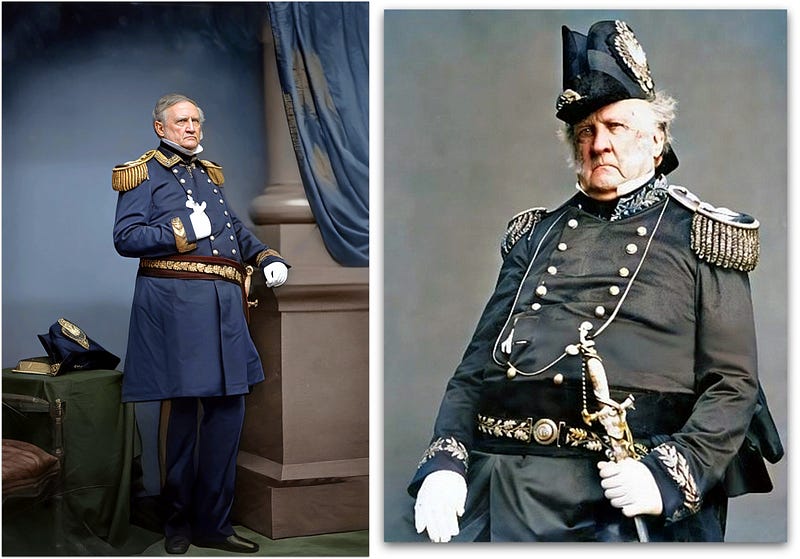
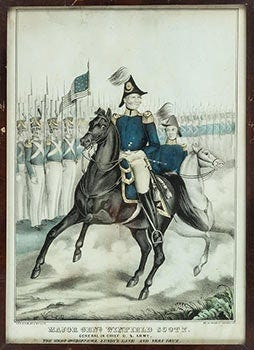
Winfield Scott (1786–1866) was a prominent United States Army general who served for over 50 years. Known as “Old Fuss and Feathers” for his emphasis on military discipline and the “Grand Old Man of the Army” for his long service, he is considered one of America’s most accomplished commanders. Scott distinguished himself during the War of 1812 and later commanded the forced removal of the Cherokee Nation, known as the Trail of Tears. His most notable military achievement was his brilliant campaign in the Mexican-American War, which included an amphibious landing at Veracruz and the capture of Mexico City, effectively ending the war in 1847. He became Commanding General of the U.S. Army in 1841. In the lead-up to the Civil War, Scott, despite his age, remained loyal to the Union and devised the strategic “Anaconda Plan” to defeat the Confederacy through blockade and control of the Mississippi River. The Whig Party’s presidential candidate in 1852, Scott was promoted to Brevet Lieutenant General in 1855, a rank previously held only by George Washington. He retired in 1861 and died at West Point in 1866.
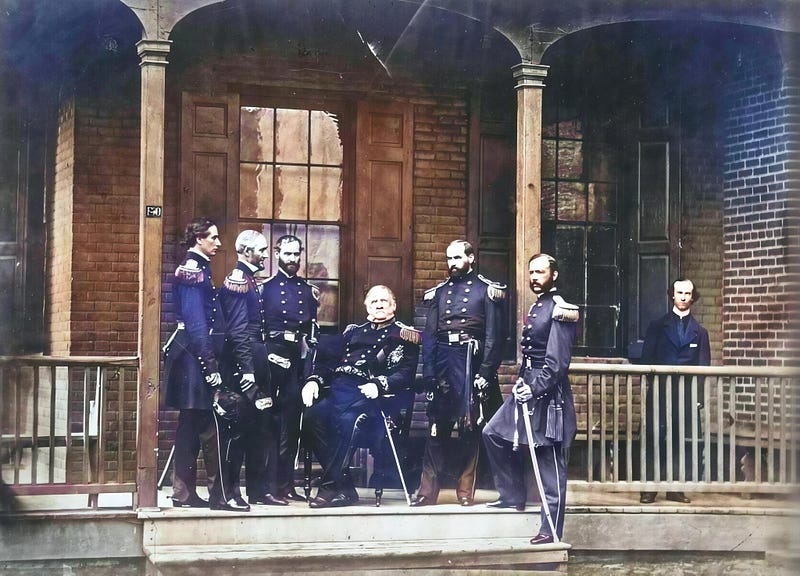
Writings
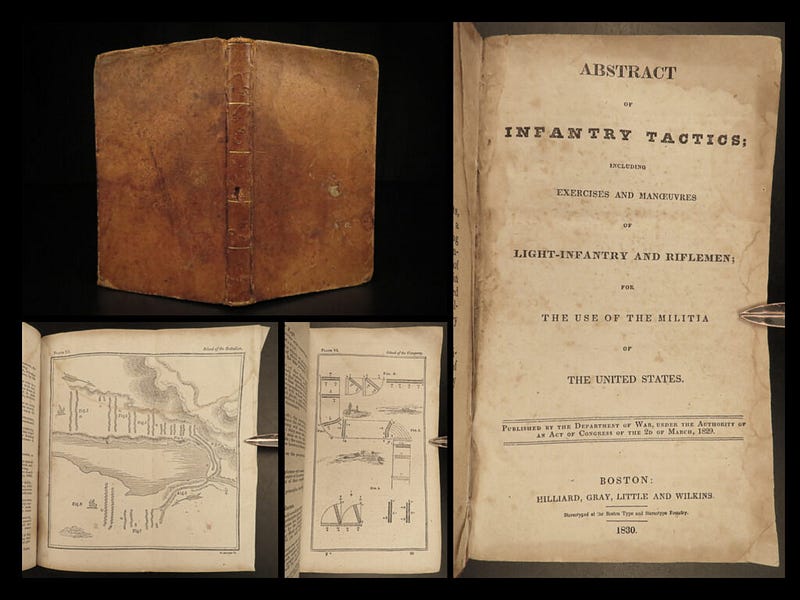
Winfield Scott’s legacy includes influential military writings that codified the practices of the U.S. Army. After the War of 1812, Scott spearheaded the creation of the Army’s first comprehensive training manual, later published in 1835 as Infantry Tactics — a three-volume work that set standards for drills and maneuvers well into the late nineteenth century. This manual reflected Scott’s commitment to professionalizing the military, drawing on lessons from European warfare (he even traveled to France to study tactics) and emphasizing strict discipline and organization.
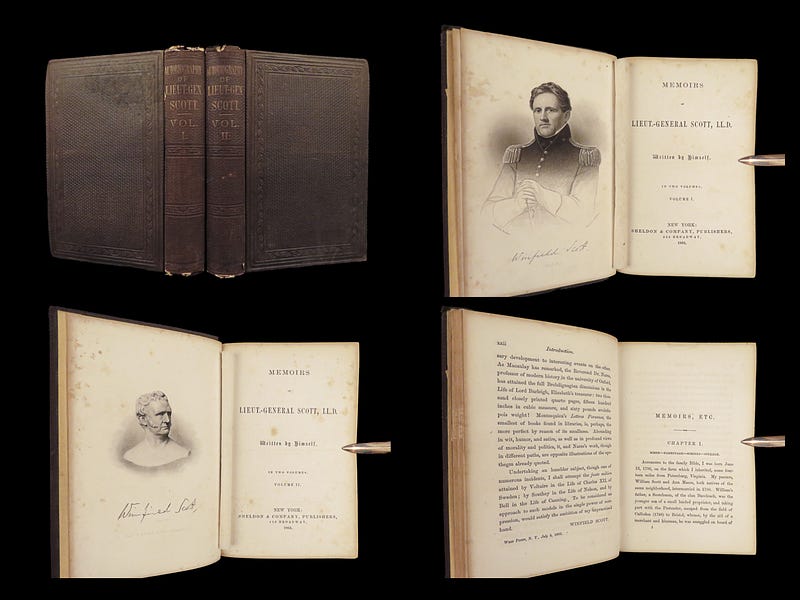
In his later years, Scott turned to reflecting on a half-century of service, authoring his memoirs, Memoirs of Lieut.-General Winfield Scott, which were published in 1864. The memoirs offered an extensive firsthand account of his experiences from the War of 1812 through the Civil War. Through these writings — from field manuals to personal memoirs — Scott disseminated his ideas on military science and leadership, cementing his intellectual contributions to American military tradition.
Arguments
Throughout his career, Scott consistently argued for the value of preparation, discipline, and strategic foresight in military affairs. Confronted with the disarray of the early U.S. Army, he maintained that rigorous training and organization could transform raw recruits into effective soldiers. He put this into practice during the War of 1812 by drilling American troops incessantly and even teaching basics like camp sanitation and proper conduct — measures that soon paid off when his once-green soldiers stood firm against British regulars for the first time at Chippewa and Lundy’s Lane.
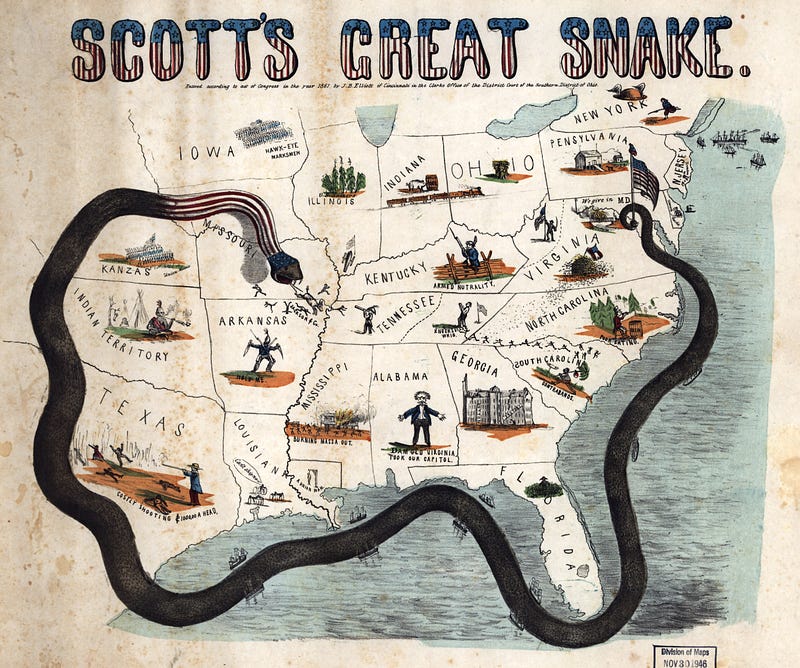
Strategically, Scott favored careful planning over rash offense. During the Mexican–American War, he devised an audacious but methodical plan to strike at Mexico City via an amphibious landing at Veracruz, followed by a calculated march inland, rather than a hasty frontal invasion. This approach proved brilliantly successful and showcased Scott’s belief that deliberate strategy wins wars. Later, as the Union’s General-in-Chief at the start of the Civil War, Scott formulated his famously “unpopular but thoughtful” Anaconda Plan — a long-range strategy to blockade and squeeze the Confederacy’s resources. Initially ridiculed for its caution, the plan aimed to preserve the Union while minimizing bloodshed by avoiding unnecessary direct assaults, and it ultimately presaged the strategy that ultimately won the war. In all these cases, Scott’s central argument was clear: military success required patience, professionalism, and a willingness to think beyond quick glory in favor of sustained, well-organized efforts.
Psychology
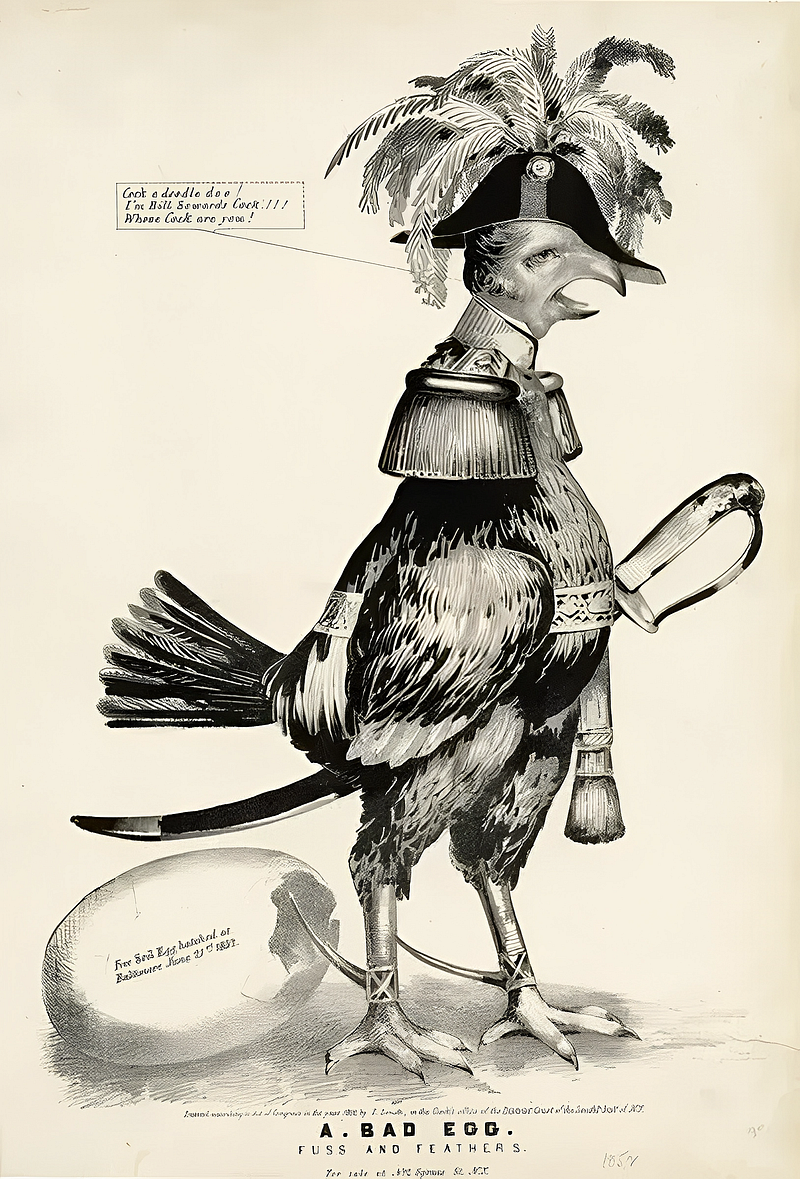
Though not a psychologist, Winfield Scott demonstrated a keen understanding of morale and human behavior in leadership. He recognized that soldiers needed confidence and unity as much as they needed muskets. To instill this, Scott enforced strict drills, smart uniforms, and a proud bearing — earning him the nickname “Old Fuss and Feathers” for his insistence on military polish — because he believed such discipline would forge esprit de corps and psychological resilience in his men.
His experiences showed that well-trained troops were far less likely to panic or falter, a fact proven when his disciplined regiments held their ground against veteran British forces. Scott also understood the power of humane treatment and respect: he was known to temper the era’s customary harsh punishments, preferring reforms that maintained order without breaking a soldier’s spirit. He cared for the welfare of his troops, introducing sanitation practices and insisting on proper rations and rest, knowing that a soldier who felt valued and healthy would fight with greater determination. Even in dealing with adversaries and civilians, Scott’s comportment suggested an intuitive grasp of psychological warfare — he treated defeated Mexican citizens fairly and the Cherokee with as much compassion as orders allowed, aiming to win hearts and minds as well as battles. In summary, Scott’s leadership leveraged psychological insight by building pride, enforcing discipline with fairness, and showing empathy, which motivated loyalty and courage in those under his command.
Philosophy
Principles of honor, humanity, and prudence underpinned Scott’s philosophy of leadership and war. A product of the Virginia gentry, Scott upheld an old-fashioned code of honor and duty, evidenced by his personal courage and even a willingness to duel to defend his integrity early in his career. Yet his martial ethos was tempered by a firm belief that warfare should be conducted with restraint and civilized conduct. Scott held that victory should not come through barbarity: he consistently sought to “avoid unnecessary casualties,” preferring tactics that would achieve objectives without needlessly sacrificing lives. During his Mexico City campaign, for example, he paused for an armistice in hopes of a negotiated peace. He later bombarded fortress positions instead of ordering futile frontal assaults, explicitly because he calculated that a direct attack “would cost too many lives”. This cautious, life-preserving approach reveals a moral philosophy rare among generals of his era. Moreover, Scott believed occupying forces had a duty to behave justly. Once Mexico City fell, he enforced strict discipline to protect civilians from abuse, guided by a conviction that respecting the enemy’s populace was both ethically right and strategically wise. In his own words and actions, Scott advanced a philosophy that blended strength with benevolence — a conviction that an army could be relentless in battle yet magnanimous in victory. He saw professionalism and virtue as complementary: an honorable soldier must also be a humane one. This guiding outlook helped shape the laws and norms of military conduct in America, as Scott’s standards for humane leadership influenced those who followed.
Political Ideas
Politically, Winfield Scott was a staunch nationalist and Unionist with a distinctly conservative bent. He aligned himself with the Whig Party, sharing its belief in a strong federal union and skepticism of unchecked expansionism and populist demagoguery. Scott’s Whiggish values came to the forefront when sectional tensions rose over slavery. Although a Virginian by birth, he did not embrace the slaveholding ethos — indeed, he won support from anti-slavery “Conscience Whigs” who noted that, unlike many Southern leaders, he was not an enslaver. Still, Scott was above all a pragmatist devoted to national unity. He joined Whig luminaries Henry Clay and Daniel Webster in championing the Compromise of 1850, a package of measures designed to preserve the Union by balancing the interests of free and slave states. This revealed Scott’s readiness to countenance compromise on slavery if it meant averting disunion. When he ran as the Whig candidate for President in 1852, he maintained support for the Compromise (including the controversial Fugitive Slave Act) as official party policy — a stance aimed at conciliation, though it alienated many anti-slavery Northerners and did little to win over Southern trust. Scott’s political ideology thus centered on preserving the American Republic even at personal or partisan cost.
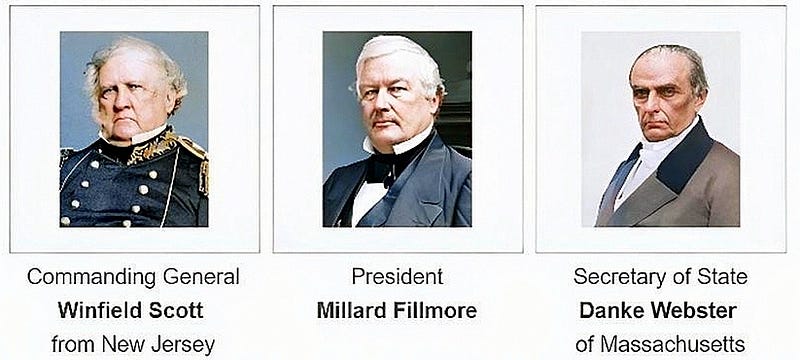
In the ultimate test of loyalty, Scott’s convictions proved unshakeable. As the secession crisis erupted in 1860–1861, this career officer remained fiercely loyal to the United States despite his Southern roots. He rejected pressures to join the Confederacy, putting country above birthplace. In failing health but still determined to serve the Union, Scott counseled President Abraham Lincoln and urged a strategy of attrition against the rebelling states. His much-derided “Anaconda Plan” — envisioning a prolonged blockade to strangle the South’s war effort — encapsulated his political-military vision of saving the Union with minimal destruction. Scott opposed rash offensives (he even objected to the Union army’s ill-fated charge at Bull Run) because he feared they would only sow deeper national wounds. Fundamentally, Scott’s political thought was guided by an aversion to extremism and disunity: he believed in the authority of the federal government, the sanctity of the Constitution, and the idea that American greatness rested on keeping the states united. In an age of intensifying sectional passion, Scott stood for moderation, lawful order, and the preservation of the Union above all else.
Beliefs
At the heart of Winfield Scott’s character lay a blend of martial discipline and deeply held personal virtues. He was a firm believer in order, decorum, and duty — qualities he both embodied and demanded. Scott’s almost obsessive emphasis on military etiquette and precision (the source of his nickname “Old Fuss and Feathers”) sprang from a genuine belief that a soldier’s bearing reflected his honor. He kept the Army impeccably drilled and dressed not out of vanity alone, but because he thought professionalism and pride were moral obligations for a military officer. Alongside this strictness, however, Scott prized compassion and justice. He introduced reforms as General-in-Chief to soften the once brutal military discipline, curbing flogging and other cruel punishments, because he believed an effective army could maintain discipline without forfeiting humanity. Those who knew him noted that for all his pomp, Scott was “known for his kindness and humane approach to leadership”. This kindness extended beyond his troops: Scott felt a sincere responsibility to minimize suffering in war. He famously enforced protections for Mexican civilians under American occupation, guided by a conviction that innocent lives and rights should be respected even amid conflict. Such actions were not just strategic but rooted in personal creed — a reflection of Scott’s chivalrous sense of right and wrong.
Morally, Scott was guided by a strong code of personal conduct. A devout Protestant and a man of his word, he abided by principles of honesty, courage, and self-restraint. Perhaps nowhere is this more evident than in his crusade for temperance. In an era when alcohol flowed freely in the ranks, Scott became a leading voice of the temperance movement, convinced that sobriety was essential for a sound mind and disciplined life. He even employed a dramatic object lesson for drunkards under his command: offending soldiers were forced to dig their own grave so that “they could see where they would end up if they kept drinking”. Such stern but morally driven measures reflected Scott’s belief that vice and intemperance were enemies of the soldier’s soul. His personal values also emphasized faith and family — he was a churchgoing man and a devoted husband — but above all, patriotism was his lodestar. Scott’s love of country was uncompromising; he viewed his five decades of service as a sacred duty to the United States. In the end, he sacrificed his presidential ambitions and risked the scorn of compatriots because he would not betray the Union or his own conscience. Winfield Scott’s core beliefs in honor, discipline, compassion, and patriotism not only defined his character but also left an indelible imprint on the American military ethos. His lifelong labor to bring “professionalism and dignity” to the U.S. Army transformed it from a ragtag force into a respected institution, making military service a calling that could be pursued with pride and principle.