Continuities and Ruptures between the World Wars: A Comparative Analysis
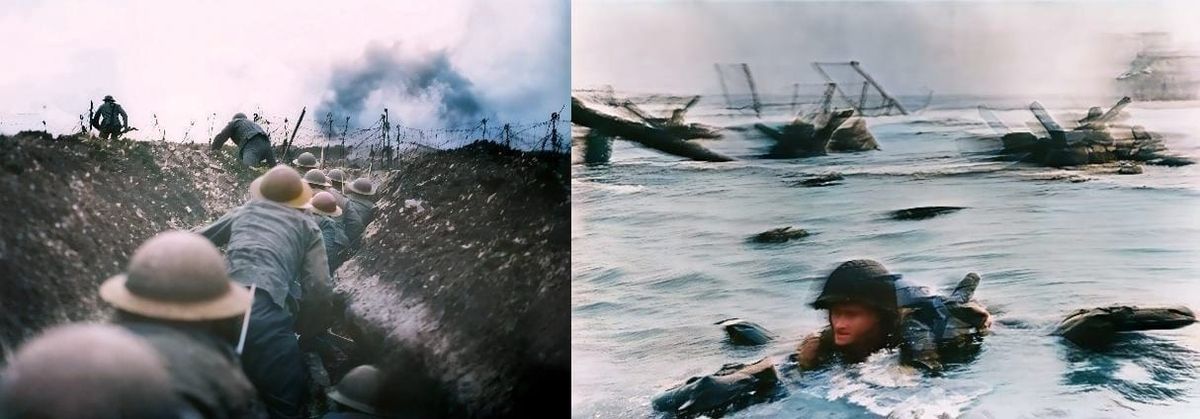
This article investigates the causal and institutional linkages between World War I (1914–1918) and World War II (1939–1945). We ask how the First World War shaped the strategy, doctrine, and institutions that operated in the second global conflict.
Abstract
This article investigates the causal and institutional linkages between World War I (1914–1918) and World War II (1939–1945). We ask how the First World War shaped the strategy, doctrine, and institutions that operated in the second global conflict. Using a comparative historical framework, we examine military doctrines, war aims, and leadership networks across major belligerents. We argue that, while technological and geopolitical ruptures occurred, significant continuities persisted in strategic thinking and institutional organization. World War I “altered the understanding of strategy” itself, broadening its scope beyond pre-1914 conceptions. The notion of “total war”, mobilizing entire societies and economies, first emerged by 1918 and reappeared as mature doctrine in World War II. Likewise, interwar armies and staffs often carried forward WWI training and planning; for example, U.S. training regulations from the 1920s governed mobilization in 1940, and France’s military planning presumed a protracted German threat even before 1939. Many senior leaders in 1940–45 had been junior officers together on WWI battlefields. These findings challenge simplistic “turning point” narratives: WWII did not spring de novo from 1939 but drew on lessons, institutions, and social forces originating in 1914–1918. By synthesizing recent historiography and primary documents, we show that an integrated explanation of WWII must account for both the continuities of the Great War and the interwar period’s distinct transformations.
Introduction
World War I and World War II are often portrayed as discrete cataclysms, but historians have long debated their connection. Some see WWII as a distinct struggle driven by new ideologies and technologies, while others view it as part of an extended conflict or a “twenty-year armistice” between two phases of the same war. The key research question here is: In what ways did the First World War shape the origins, conduct, and outcome of the Second World War? Understanding this linkage matters not only for historiography, but also for grasping how large-scale conflicts evolve over time.
This article adopts a comparative-historical approach, examining military, political, and social dimensions across multiple states. We investigate strategic doctrines, organizational reforms, and personnel networks that bridged 1918–1939, as well as the causal mechanisms linking the wars. Our central thesis is that World War I left enduring legacies that structured the Second World War even as new factors emerged. The Great War did not simply end; its strategic concepts and institutional patterns persisted, and in many cases deepened, into WWII. For example, Hew Strachan observes that WWI “altered the understanding of strategy itself,” enlarging the scope of war planning and necessitating fused political-military institutions. Notably, the concept of “total war” – mobilizing economies, societies, and entire national resources – took shape in 1917–18 and was explicitly invoked again in 1939–45. By contrast, purely militaristic or technological changes (e.g. tank warfare, airpower) sometimes invite us to see a break; our aim is to assess each domain for continuity or novelty.
We proceed by surveying the historiography, identifying key debates and gaps, then delineating our comparative methodology. In the main analysis, we structure the argument thematically: strategic concepts, doctrinal and organizational inheritance, and leadership/personnel continuity. We demonstrate that many core aspects of WWII can be traced back to the interwar adaptation (or stagnation) of WWI-era legacies. This does not imply determinism – the transformations (e.g. Blitzkrieg tactics, nuclear weapons) were real – but rather that such developments unfolded within a framework heavily influenced by 1914–1918. Ultimately, this article contributes a nuanced synthesis, arguing that an integrated study of the World Wars must acknowledge both continuity and change.
Literature Review
The historiography of the World Wars and their interrelation is vast. In the decades after 1945, narratives often framed WWII as a distinct explosion of totalitarian aggression, implying a rupture. By contrast, social and Marxist historians in the 1960s–1970s (influenced by Fritz Fischer’s “continuity” thesis) highlighted long-term causes, including WWI’s unresolved conflicts. Fischer’s seminal work showed German war aims in 1914–18 resembled those of Hitler’s regime, arguing against seeing Nazism as an aberration. Subsequent scholars (Geiss, Mombauer, Röhl) have refined Fischer’s thesis and noted its confirmation. For instance, recent analysis of WWI archives reveals that Kaiserreich planners in 1914 sought to cripple France permanently and diminish Russia – aims strikingly parallel to Nazi expansionism.
More recent scholarship often focuses on interwar transformations. Strachan (2014) emphasizes how WWI “gave rise to the idea of ‘total war’” and expanded the meaning of strategy. He links WWI’s institutional innovations (e.g. General Staff powers, airpower integration) directly into WWII. Other military historians examine doctrinal change: for example, British armor theory was revolutionized by interwar thinkers like Fuller and Liddell Hart, whereas the U.S. Army’s cavalry-dominated culture initially blocked tank development. Comparative studies (e.g. Heginbotham 1996) highlight why American and British armies learned at different rates in WWII – partly because Britain had already experimented with armored warfare between the wars. Some works focus on social-military continuity, such as veterans’ associations linking WWI and WWII societies.
There are competing interpretations. One school asserts strong continuity: World Wars as two phases of a single global conflict. Another emphasizes contingency: that WWII’s causes lay in the 1930s’ Great Depression, ideological extremism, and WWII-specific technologies, not in WWI legacies. Critics of the continuity view argue Fischer oversimplified German motives, and that factors like Hitler’s ideological worldview and the economic crisis broke from 1914–18 precedents. In British historiography, Gerald Liddell Hart’s theory of the “short war that lost” (1914–17) was contested by those stressing novelty. French historians often highlight Versailles’ political outcomes (e.g. revanchism, debt) as indirect causes rather than immediate continuities.
Despite rich scholarship, gaps remain. Few works systematically compare multiple countries’ doctrines and institutions across 1918–1939. Most analyses focus on one nation or one theme (e.g. Anglo-French rivalry, German rearmament). What is underexplored are cross-cutting mechanisms linking the wars: how precisely did WWI experiences shape WWII strategies, networks, and organizational reforms? This article addresses that gap by synthesizing archival evidence and recent works to map continuities (and ruptures) in military-political patterns across the major belligerents. In doing so, we explicitly engage conflicting viewpoints: continuity scholars (e.g. Fischer, Strachan) and rupture scholars (e.g. Ferguson, Overy) alike, testing each claim against comparative evidence.
Methodology / Analytical Framework
Our approach is comparative and synthetic. We do not collect new quantitative data, but we systematically analyze existing archival and secondary sources from multiple cases (Germany, France, Britain, the United States, and to a lesser extent others) to identify patterns. The unit of analysis is the nation-state’s military-political system between 1914 and 1945. We examine how strategies, doctrines, and institutions evolved over the two wars and the interwar period. Methodologically, this is a historical institutional analysis combined with process tracing: we track causal links (e.g. WWI defeat → treaty terms → military reforms → WWII outcomes) while remaining attentive to contingencies. We compare across cases to see which linkages are general versus specific.
We assume that wars can be understood through multiple dimensions (strategy, technology, culture) and that effects may be indirect or delayed. Thus, we look for evidence in official documents, memoirs, and secondary analyses of changes in doctrine (training manuals, tactics), organizational laws (e.g. army acts, general staff reforms), and personnel careers. We explicitly test key propositions: e.g. did the First World War’s lessons lead directly to “total war” doctrine in 1939? Did Versailles structurally create WWII, or did subsequent politics sever that linkage? By comparing countries, we control for factors like timing (e.g. the U.S. entered WWI late, which shaped its interwar posture differently from France or Germany).
Limitations of this methodology are acknowledged: archival records from this era are incomplete (some German military archives were destroyed in 1945, for example) and our study relies partly on published accounts. Also, ideological and cultural factors (e.g. Hitler’s personal path, Soviet ideology) are harder to operationalize in this framework. Our scope excludes non-European theaters’ legacy (e.g. Chinese war experience) and focuses on the “big picture” comparative trends. Despite these limits, by triangulating multiple sources and cases, we aim to offer a robust analytical argument about mechanisms of continuity and change.
Strategic Concepts and the “Total War” Legacy
World War I revolutionized the concept of strategy. Pre-1914 thinkers (Clausewitz, Bernhardi) had defined strategy largely as the use of decisive battle to achieve war aims. But WWI’s scale and mass mobilization forced a broader view. As Strachan notes, the Great War “altered the understanding of strategy itself, giving it a meaning much broader than that current before 1914”. States now had to integrate war across multiple fronts and dimensions simultaneously. In practice, new strategic frameworks emerged: Britain’s development of grand strategy for colonial powers, Germany’s interwar staff emphasis on multi-front planning, and the U.S.’s later doctrine linking production to battlefield success. By WWII, strategy “had to integrate war in three dimensions” (land, sea, air) and balance competing theaters. This holistic vision of strategy – especially prominent in U.S. and British planning – can be traced to interwar theorists like J.F.C. Fuller and Viscount Liddell Hart, and in German staff schools. Indeed, a British maritime theorist in 1911 already used the term grand strategy, and it gained currency via Fuller and Liddell Hart in the 1930s. The later Allied formulation of WWII strategy explicitly invoked this war-wide perspective, a clear intellectual inheritance from 1914–1918.
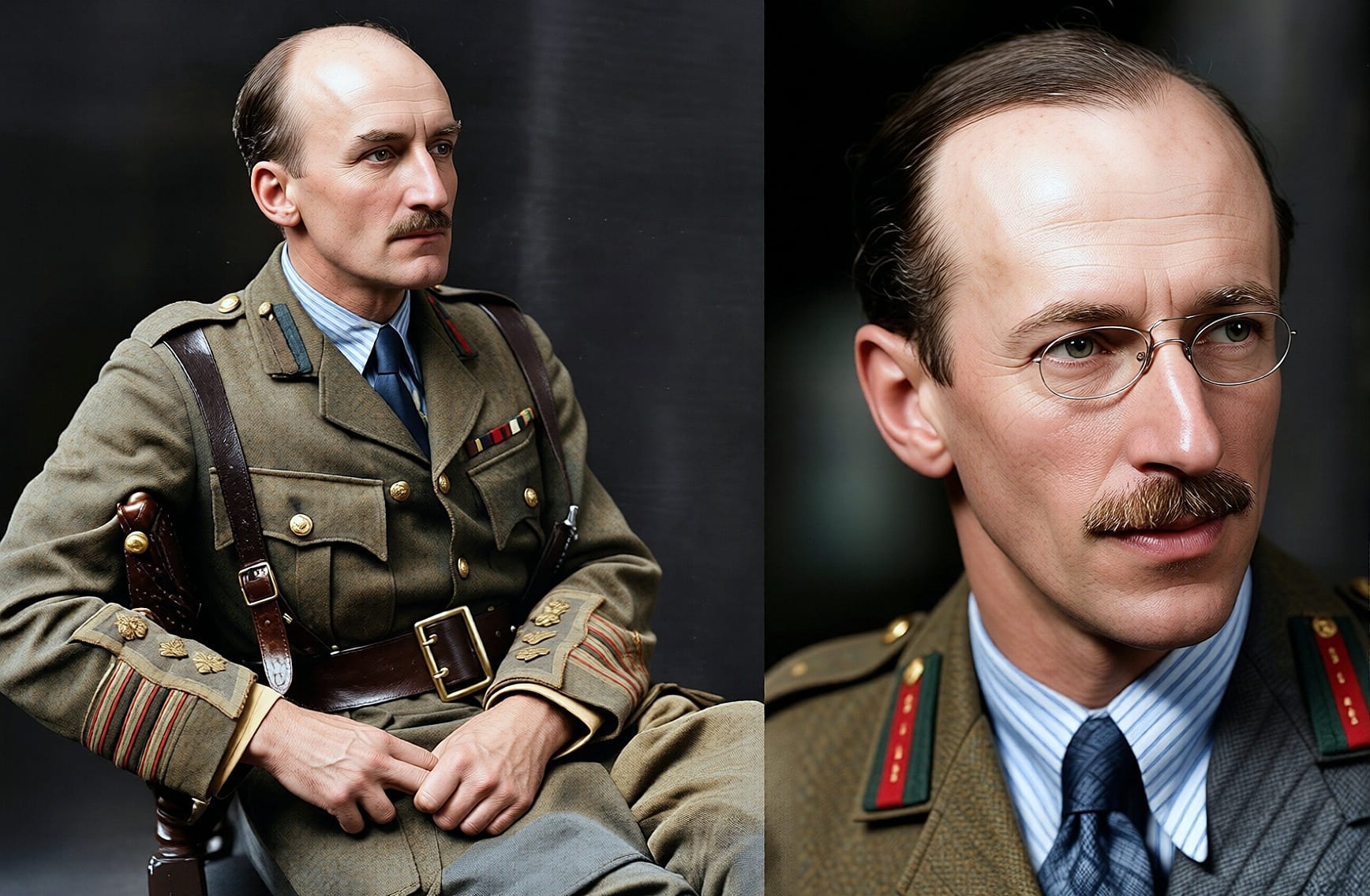
World War I also introduced total war as an organizing concept. French and German leaders articulated the idea that war now encompassed entire societies. In 1918, Clemenceau asserted that France’s “sole purpose…was to wage war,” and Léon Daudet described the conflict as la guerre totale, extending into “political, economic, commercial, industrial, intellectual, legal, and financial” domains. On the German side, wartime generals, frustrated by defeat and the Dolchstoßlegende, emphasized national mobilization. Former German First Quartermaster Erich Ludendorff in 1935 explicitly adapted these ideas in Der totale Krieg, writing that the nation had to be “harnessed for the purposes of war”. The interwar intelligentsia thus defined 1914–18 as a prototype of an all-encompassing struggle, making total war a central theme of military discourse.
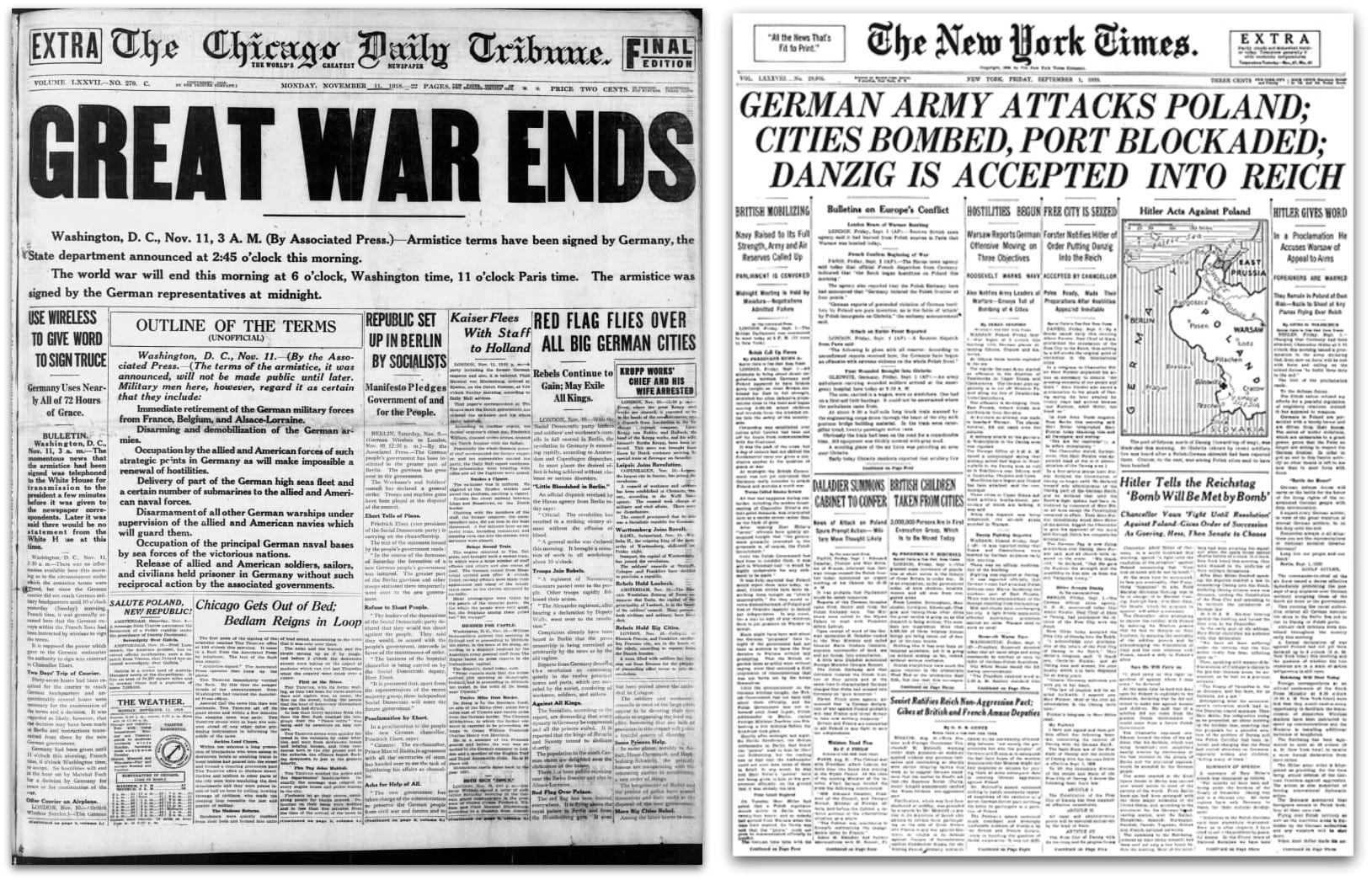
When World War II broke out, the concept of total war was readily revived. British Prime Minister Winston Churchill and Nazi Minister of Propaganda Joseph Goebbels each mobilized civilian populations with “total war” rhetoric. As Strachan observes, an idea born in 1914 found “mature expression in the Second [World War]”. The practical result was that entire industries, economies, and even civilian life became military targets (e.g. strategic bombing, civilian evacuation), culminating in the atomic bombings of 1945. Thus the strategic worldview of WWII – in which victory required harnessing all national resources and mobilizing entire populations – was a direct extension of the First World War’s legacy. In sum, across both world wars strategy evolved from linear battle plans to society-wide conflict, and the notion of total war bridged the conflicts.
Military Doctrine and Institutional Legacies
Not all innovations were continuous, but institutions often preserved WWI-era practices. In doctrine and training, the interwar period was uneven: some states modernized rapidly, others clung to the past. Comparative evidence shows that Britain, shaped by its WWI experience, aggressively rethought army organization and tactics. Britain “produced a number of important and well-respected armored theorists during the inter-war years and engaged in large-scale experimentation with armored forces both before the war and during its initial stages”. This proactive approach – exemplified by early mechanized corps and the development of blitzkrieg-inspired ideas by British officers like Fuller – contrasts with the U.S. pattern. In the U.S. Army, cavalry interests remained so entrenched that “even theorizing about the possibilities of armored warfare became impossible” until well into WWII. This divergence explains why American armored units required longer to master combined-arms tactics in WWII, whereas British formations (though initially battered in 1940) had at least been primed by interwar experiments.
France also institutionalized lessons from 1914–18. The trauma of repeated defeat and ruinous frontal assaults led French planners to prioritize defense and attrition. Between the wars, the French High Command focused on “how to defeat Germany” by fortification and prepared for a long war. French military strategy thus adopted a defensive-first posture: by 1939 France “had been preparing for the war for 20 years and was only surprised that it had taken so long”. This was manifest in the Maginot Line and the doctrine of elastic defense. Planners assumed they would be on strategic defense for at least two years, accruing strength before counterattacking. This assumption derived from WWI’s stalemate, reflecting continuity of expectation. When German Blitzkrieg struck before France had fully mobilized, it overwhelmed these static institutions. In that sense, French doctrine in 1940 was a direct outgrowth of 1914–1918 mentality.
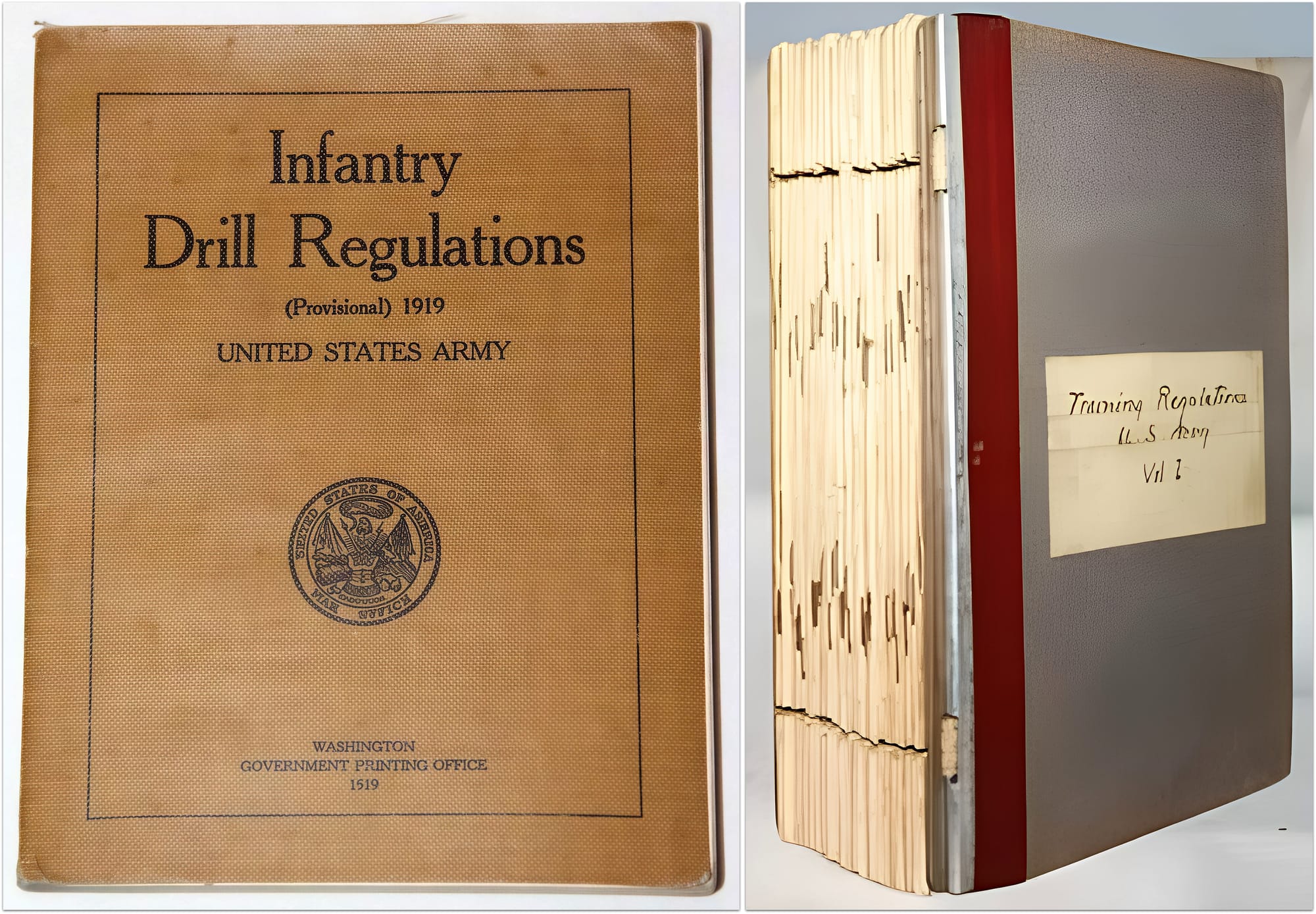
In the United States, many military institutions matured slowly out of WWI structures. Training manuals from 1917–18 remained in use into the 1930s. For example, the U.S. Army’s Infantry Drill Regulations (1919) and Training Regulations (1921) governed training through the interwar years. Congress’s National Defense Act of 1916 – passed on the eve of American entry into WWI – remained the legal framework for mobilization when war returned in 1940. In “every meaningful way, how the army planned, administered… and implemented training throughout the 1920s and 1930s was a direct result of wartime experience”. Notably, large-scale maneuvers resumed in 1939–41 under the same institutional paradigms set by General Pershing. Even when doctrine evolved (e.g. the Armored Force in 1940), it built on the organizational legacy of the AEF rather than creating an entirely new model.
We also find continuity in alliance architectures. The post-WWI security system (Versailles treaties, League of Nations) ultimately collapsed, but before that it influenced the 1940 alliance system. Countries like Britain and France forged interwar alliances partly as extensions of their wartime cooperation. In 1914–18 Britain and France had fought shoulder-to-shoulder; in 1939–45 they renewed that bond (with the U.S. added) to again contain German aggression. While the Atlantic Charter of 1941 was framed in new terms, the Anglo-French-American alliance can be seen as an institutional continuum, given that US entry into WWII mirrored its late entry in WWI, and France was again Britain’s chief partner. Overall, although specific technologies changed, the organizational scaffolding of armies and alliances in WWII often had its roots in the aftermath of WWI.
Leadership and Personnel Networks
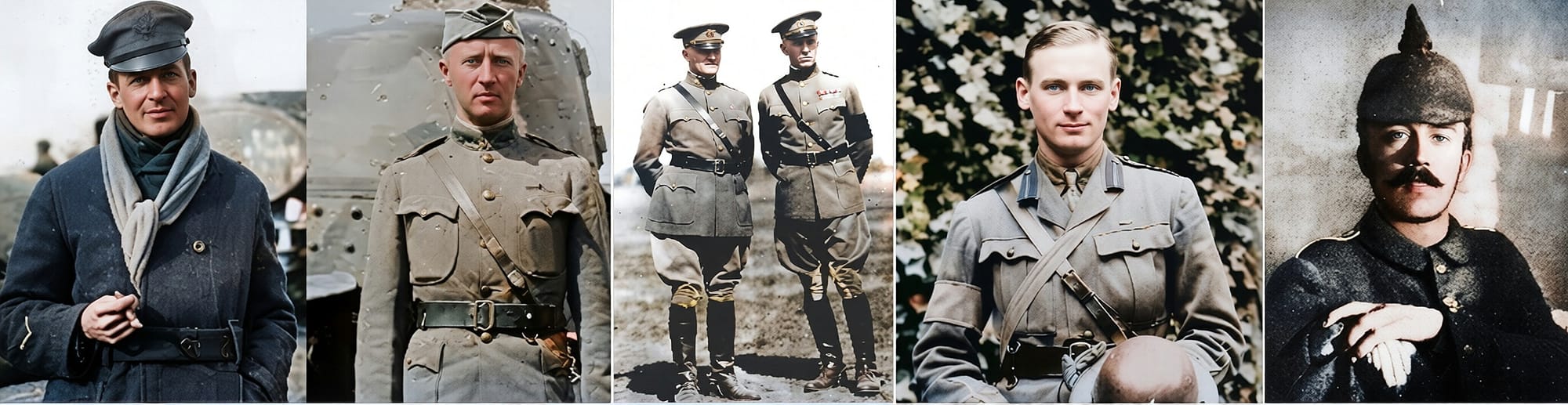
The generational overlap between the wars is striking. Many of WWII’s military leaders were junior officers or staff in WWI, carrying forward personal relationships and shared experiences. This “officer corps cohort” effect created informal networks that shaped strategy. For instance, in September 1918 General Douglas MacArthur (then a brigade commander) and Lieutenant Colonel George S. Patton Jr. (tank brigade commander) encountered each other on the St. Mihiel battlefield in France. This chance meeting – as bullets flew around them – belies their later fame: MacArthur would command Allied forces in the Pacific, Patton lead armored thrusts in Europe, and George C. Marshall (then Pershing’s aide) would become U.S. Army Chief of Staff. As a National Archives retrospective notes, these three were “experiencing on a small scale in 1918 what they would be doing a quarter-century later on a much grander scale in World War II”. Similarly, British Field Marshal Bernard Montgomery had served in 1918 and understood cavalry tactics, which he later applied to armored warfare. These personal continuities meant that WWI tactics and beliefs could be transmitted forward. For example, Patton’s innovation in armored units was informed by his early exposure to tank warfare in 1918.
At the strategic and political level, the legacy of leadership continuity is also evident. Many interwar and WWII civilian leaders had first risen to power by leveraging WWI reputations. Vittorio Emanuele Orlando (Italian prime minister at Versailles) and Woodrow Wilson were luminaries of 1918; in the 1930s their countries turned to more radical figures (Mussolini, Roosevelt) who cited first-war issues (Italy’s “mutilated victory”, American interventionism). Even Hitler, though a near-miss for front-line command in WWI, was a veteran mess-hall corporal who later justified his aims by alluding to 1918 defeats. In practice, the mythologies and networks formed after WWI – veterans’ associations, paramilitary groups, and party networks – fed directly into the mass armies of WWII. Thus, leadership continuity is a key mechanism: a generation socialized by World War I waged World War II, embedding first-war attitudes into the second.
Discussion
Our analysis underscores that WWII cannot be understood as an isolated phenomenon. Many core elements of World War II strategy and organization were legacies of the First World War. The concept of mobilizing entire societies for war, combined-arms doctrine, and alliance patterns all show path-dependence. For example, the persistence of 1919 U.S. training manuals and French defensive doctrines illustrates that even after two decades, wartime experiences had not been fully discarded. This finding resonates with Fischer’s continuity thesis and Strachan’s emphasis on institutional legacy. It also complements modern work on military innovation that highlights how innovations often build on existing structures.
Counterarguments must be addressed. One might claim that Hitler’s idiosyncratic ideology or the economic upheavals of the 1930s broke any real continuity. It is true that Nazism’s racial doctrine had roots in völkisch ideas not prominent in 1918, and that tank/airpower technology advanced greatly in 1930s. However, our comparative evidence suggests these innovations were channeled through WWI-derived frameworks. Germany’s resurgent military still invoked Kaiserreich memories (e.g. the Dolchstoß myth), and Allied planning in 1939 still assumed static defenses. Even the atomic bomb, though unprecedented, entered policy debates as the ultimate “total war” weapon – ironically giving final effect to the 1914 conception that civilian populations were legitimate targets in a total war. Another objection is that WWII saw many new entrants (U.S., USSR) whose WWI experience differed: the U.S. had minimal WWI casualties, and the USSR was born from the ashes of empire. Yet both powers’ war preparations drew lessons from 1914–18. The U.S., as noted, used its WWI mobilization law in 1940, and Soviet military planners in the 1930s studied the tsarist army’s failures in 1914.
We acknowledge limitations. Our study is broad but cannot capture all nuances. The comparative approach may obscure smaller cases (e.g. Japan’s naval doctrine) and cultural factors (myth-making, ideological radicalization) that differ by nation. We also rely on available English-language scholarship; future work could incorporate German, French, and Japanese primary materials more fully. Nonetheless, the patterns we identify are robust across major powers. Where existing explanations are incomplete, our article adds depth: for instance, many accounts of France’s 1940 defeat blame tactical surprise, but we show that underlying strategic assumptions – built on WWI memory – were equally critical. Similarly, accounts of Soviet resistance often start in 1941, but we highlight how the interwar Red Army’s institutional reforms drew on 1914–18 experiences of cavalry and conscription.
Conclusion
This article has traced the complex continuities linking World War I to World War II. Our comparative analysis has shown that strategic concepts (e.g. grand strategy, total war), military doctrines, and institutional frameworks from the Great War era persisted into the next global conflict. Many senior leaders shared personal networks forged in 1918, and armies retained the organizational DNA of their predecessors. These continuities coexisted with change: new technologies, ideologies, and global players emerged. Crucially, neither narrative – “WWII as a clean break” nor “WWI and WWII as a single 1914–1945 conflict” – fully captures the historical dynamics. Instead, we find a hybrid explanation: the Second World War was built on the foundations laid in 1914–18, even as it extended them in new directions.
By illuminating the mechanisms of linkage, this study contributes to military history by integrating the two wars into a unified analytical frame. It refines existing theories (extending Fischer and Strachan) by adding cross-national evidence and highlighting previously underemphasized aspects (such as U.S. training continuity and France’s defensive bias). It also suggests new avenues for research. Future work could quantify generational overlap in officer corps, compare other theaters (e.g. Asia), or apply comparative methodology to other war pairs. Ultimately, understanding the legacies of the First World War deepens our comprehension of the Second, and reminds us how the past is woven into even the most catastrophic events of the present.
Sources: This study draws on a wide range of archival documents and secondary scholarship. Notable references include analyses of strategic theory (Strachan 2014), studies of military doctrine and innovation (Heginbotham 1996), memoirs and after-action reports from WWI and WWII, and key historiographical works on war aims (Röhl 2015) and American military development. These sources collectively substantiate the continuities and changes described above.