The Stoic on the Throne: Marcus Aurelius’s Rule of Reason
Marcus Aurelius (121–180 CE) was a Roman emperor who became an enduring symbol of the “philosopher-king.” Uniquely among rulers, he viewed…
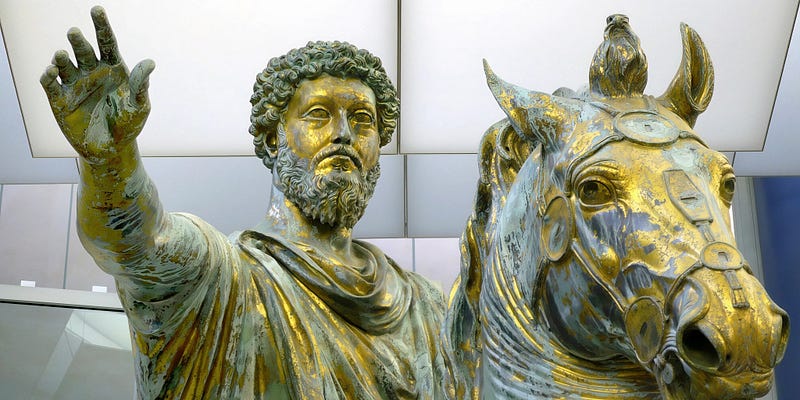
Marcus Aurelius (121–180 CE) was a Roman emperor who became an enduring symbol of the “philosopher-king.” Uniquely among rulers, he viewed the practice of philosophy as essential to governing himself and his empire. During a reign marked by wars and plague, he turned inward to Stoicism for guidance, striving to uphold virtue and wisdom in the face of the supreme power he wielded. His personal reflections, later known as the Meditations, reveal an intellect deeply engaged in questions of duty, morality, and the nature of the universe. Through his writings and example, Marcus Aurelius’s impact has transcended his era, offering later generations a timeless guide to inner strength and ethical leadership.
Writings
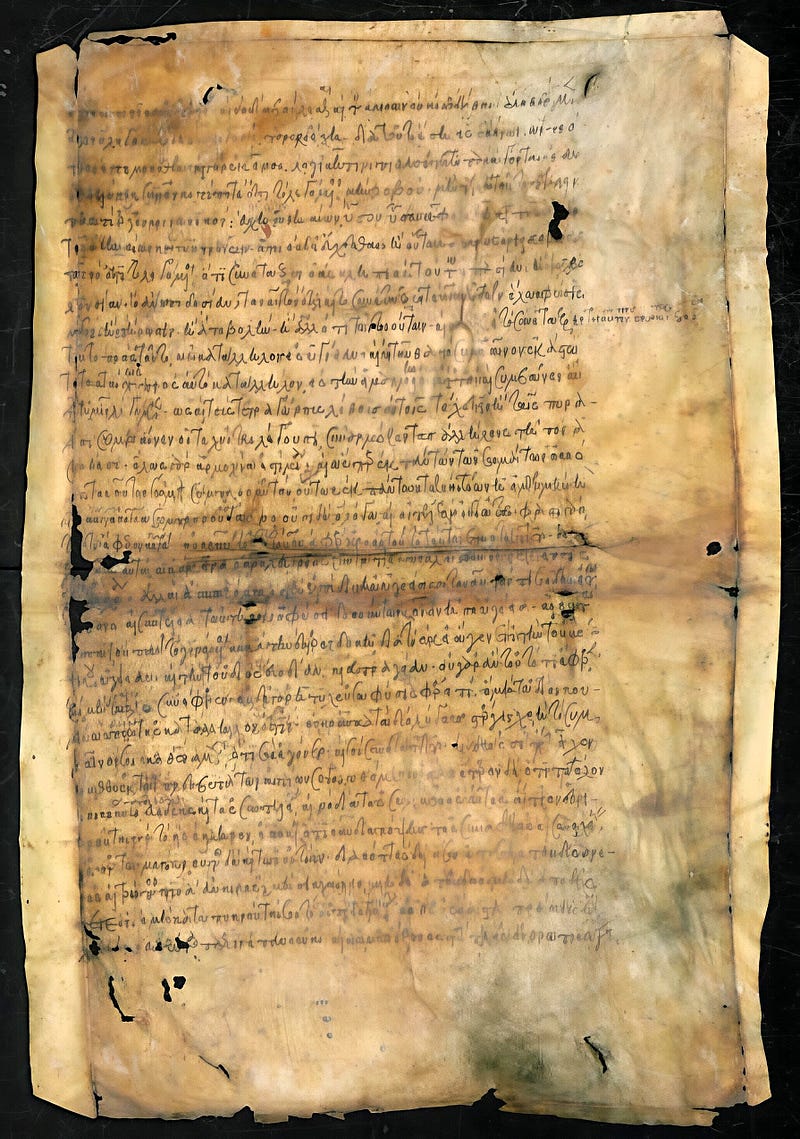
Marcus Aurelius’s most famous work is the Meditations, a series of private notes and aphorisms he wrote in Greek for his own guidance and self-improvement. Composed during military campaigns on the empire’s frontiers, these notebooks were never meant for publication. (The modern title Meditations, and the alternate Greek title “To Himself,” were assigned long after his death.) Without a clear narrative or intended audience, the text reads like a diary of moral exercises rather than a formal treatise. Outside of this, the emperor’s literary output was limited: a collection of letters and official edicts survives, including a lengthy correspondence with his friend and rhetoric teacher Fronto. Yet it is the Meditations — the solitary musings of an emperor in the field — that form his chief legacy as a writer and thinker.
In the Meditations, Marcus returns repeatedly to a set of core themes. He reflects on the brevity of life and the inevitability of death, using these meditations on mortality as a spur to virtuous living and a broader perspective. He reminds himself that “all things are fleeting” and that even the glory of emperors fades quickly, an attitude often summarized by the Stoic maxim memento mori (remember you will die). He urges self-discipline and purity of intention: “If it is not right, do not do it; if it is not true, do not say it,” he admonishes himself, emphasizing the integrity of his actions and speech. Throughout the twelve books of the Meditations, the writing is personal, direct, and unadorned. Marcus often addresses himself in the second person (“you”), chiding or encouraging his own soul to stay on the path of Stoicism. The work lacks systematic structure — Marcus jots down insights as they arise — but this fragmentary style contributes to its power. Each passage stands alone as a concentrated lesson or reminder, ready to be applied in daily life. This has made Meditations one of the most quotable of philosophical texts, full of pithy sayings and vivid metaphors drawn from the emperor’s experience. For example, he counsels himself to “begin each day” by anticipating difficult people and resolving to meet them with understanding rather than anger. He describes fine food and luxury in blunt physical terms (as mere dead fish or wine-fermented grape juice) to blunt the edge of temptation. Such passages depict a ruler philosophizing in real time, employing Stoic techniques to strengthen his character against indulgence, ego, and despair.
Although intended only for Marcus’s eyes, Meditations has had an extraordinary afterlife. It survived through obscure manuscripts and was first published in the 16th century, after which its reputation grew steadily. Today, it is hailed as a masterpiece of philosophy and a spiritual classic. Generals, statesmen, writers, and ordinary readers across centuries have drawn insight and solace from Marcus’s words. The stoic emperor’s notebook — written in tents on the battlefield or in the dead of night at the palace — became a guidebook for humanity. Its key lessons on humility, resilience, and virtue have proved to be “for all ages, for all men,” confirming the truth of Marcus’s own observation that “very little is needed to make a happy life; it is all within yourself in your way of thinking.” His writings, born of personal struggle, thus secured his legacy as a philosopher of enduring influence and hope.
Arguments
At the heart of Marcus Aurelius’s thought is a set of philosophical arguments largely drawn from Stoic doctrine. First and foremost is the ethical conviction that only virtue is truly good, and vice is truly bad — everything else is indifferent to a person’s moral worth. He argued that qualities like wisdom, justice, courage, and self-control are the sole constituents of a good life, whereas external conditions such as wealth, health, or reputation are ultimately irrelevant to one’s happiness. This core idea is consistently present throughout the Meditations. Marcus constantly reminds himself that loss or suffering cannot harm his inner self or derail his pursuit of virtue, unless he allows his own judgments to mislead him. In one passage, he frames the Stoic position succinctly: if one’s mind holds to what is right, then “no one can implicate me in ugliness” (wrongdoing), and the slights or injuries from others cannot truly hurt him. The only true harm is moral degradation, which lies within one’s own control.
Marcus Aurelius also embraced the Stoic argument that one should live in accordance with nature. By this, he meant both accepting the natural order of the cosmos and fulfilling one’s own rational and social nature as a human being. He often speaks of the Whole (the universe) as an intelligent living organism, of which each person is a part. His famous motto “live according to nature” involves recognizing that the world, whether guided by divine Providence or composed of random atoms, has an underlying order to which we must adapt our will. Indeed, Marcus sometimes presents a striking philosophical dichotomy: either a provident Order or mere atoms. He tells himself that if a wise Providence governs the universe, we should trust it completely. If, instead, everything is ultimately chance and chaos, we should still not complain, because random events have no intent to wrong us. In either case, grumbling about our lot is irrational. This “providence or atoms” argument is used to cultivate an attitude of acceptance: one should meet whatever occurs — good or ill — with equanimity, as it either proceeds from the rational order of things or is and must be faced.
Another central argument in Marcus’s thought is the insignificance of earthly fame and fear in light of mortality. He repeatedly points out that fame is fleeting and death comes for all, from the lowliest peasant to the greatest Caesar. In Meditations, he catalogs examples of once-famous men now forgotten, driving home the point that posterity will eventually forget us as well. This is not nihilism but a call to focus on what truly matters — living virtuously in the present moment. By keeping death and the vast sweep of time in mind, Marcus argues, we can free ourselves from vanity, fear, and distraction. The inevitability of death also underpins his argument that we must do good now and be ready to let go when nature calls: life is a loan, and one must return it without complaint. In one noted passage, he imagines the soul preparing to leave the body as calmly as a ripe olive falling from a tree, blessing the earth that nourished it. Through such reflections, Marcus hammers home the Stoic idea that memento mori is not morbid, but liberating — reminding us that our duty is to act well while we live and not cling to life itself.
Marcus Aurelius did not develop new logical or scientific theories; rather, his originality lies in the clarity and urgency with which he restated Stoic arguments for his own era. He drew on earlier Stoics like Epictetus (whom he quotes or paraphrases) to reinforce points about controlling one’s judgments and desires. He even finds common ground with other schools. For instance, he approvingly cites the Epicurean idea that pain is either bearable or brief, using it to bolster his Stoic resolve to endure hardship. In the Meditations, Marcus often aligns different philosophies to demonstrate that all wise thinkers agree on certain ethical fundamentals: virtue is more important than pleasure, the mind’s response is more significant than external events, and suffering can be overcome through wisdom. By harmonizing these perspectives, he argues that a universal rational standpoint is accessible to anyone seeking truth. This reflects his broader belief in the unity of truth and virtue, beyond sectarian differences.
One notable practical argument Marcus returns to is against anger and resentment. As an emperor, he faced daily provocations — inept officials, treachery, selfish petitioners — and he knew the temptation of anger. But he reasoned himself out of rage by recalling that human beings are naturally fallible and interconnected. When annoyed at someone, he would remind himself: “they act out of ignorance of good and evil”. Thus, rather than taking offense, he should instruct or tolerate them, as one would a mistaken but well-meaning relative. He famously compares humanity to a body or a team: we were “born to work together like feet, hands, and eyes”. To hate or oppose one another is as unnatural as one hand fighting the other. This line of reasoning leads Marcus to conclude that anger at others only harms oneself and the greater whole. By framing social harmony and forgiveness as rational imperatives, he turns an ethical principle into a logical argument about human nature. In sum, throughout his Meditations, Marcus Aurelius weaves arguments that reinforce a single premise: our highest calling is to perfect our own character and help our fellow creatures, aligning ourselves with the rational and moral order of the cosmos.
Psychology
Although Marcus Aurelius did not write a psychological manual, his Meditations abound with insights into the workings of the mind and techniques for emotional resilience. In many ways, Marcus anticipated principles of modern cognitive psychology and therapy by nearly two millennia. He understood that what disturbs human beings is not events themselves, but our judgments about those events. This idea, inherited from Epictetus, is a cornerstone of Stoic psychology and appears throughout Marcus’s reflections. For example, when facing pain, loss, or provocation, he consistently urges himself to examine his impressions and strip away any misleading value judgments. “Erase impressions!” he writes as a kind of mental slogan. By this, he means: when something happens, pause before reacting emotionally; look at the event plainly, without exaggeration or labeling it “terrible” or “unbearable.” In Stoic epistemology, impressions are the immediate perceptions or thoughts that flood our minds, and they can be involuntary. Marcus’s practice was to interrogate these first impressions and refuse his assent to any that were biased or unhelpful. If a courtier’s rudeness sparks anger, for instance, he tells himself it is simply a man speaking certain words — it is his choice whether to interpret it as an insult and become angry. This discipline of mind, constantly separating facts from opinions, is a hallmark of Marcus’s approach to his own psychology.
Marcus Aurelius also employed what we might call visualization and reframing techniques for emotional mastery. He frequently imagines worst-case scenarios or the transient nature of things as a way to defuse anxiety and attachment. When he felt a strong desire or attraction, he would analyze the object of longing into its basic components: fine wine is old, fermented grape juice; rich food is a dead fish or boiled vegetables; purple imperial robes are just sheep’s wool dyed in shellfish gore. By mentally breaking things down, he robbed them of glamor and his mind of excessive craving. Likewise, to cope with anxiety about the future, Marcus reminded himself that the present moment is all we ever have, and that he has overcome many past hardships by meeting them with reason and patience. This anticipates the modern concept of mindfulness: staying grounded in the present moment rather than being carried away by “what if” worries. Marcus advises himself to be like the rock against which waves continually crash, yet it stands unmoved, and the raging waters eventually fall still. This vivid image illustrates his aim of unshakable inner stability amid life’s turbulence.
One of Marcus Aurelius’s most effective psychological strategies is cultivating acceptance (amor fati) — the love of one’s fate. He worked to welcome everything that happens as necessary or natural. Rather than merely enduring adversity, Marcus strove to genuinely embrace it as part of the divine plan (or, if there is no plan, as part of the neutral flow of the universe). In a therapeutic sense, this is an advanced form of cognitive reappraisal. By viewing misfortunes as self-chosen in a way (since a Stoic’s will aligns with what nature ordains), he could alleviate feelings of victimhood or bitterness. For instance, when death took several of his children and beloved friends, Marcus grieved but checked his grief from turning into despair or rebellion against reality. He reminded himself that death is a natural and inevitable part of life; one should “meet it with a cheerful mind, as nothing new,” and certainly not curse the heavens. A later commentator observed that Marcus “still sheds tears and mourns losses, but as a wise man does… He no longer adds to his natural grief by complaining and shaking his fist at the universe”. In these lines, we see the Stoic ideal of feeling emotions (for Stoicism never asked us to be unfeeling stones) but not letting them dominate or distort one’s soul. Marcus’s gentle self-admonitions in the Meditations — to not “turn your back” on those who wrong you, not to rage at pain, and not to overly exalt pleasure — serve as reminders to maintain emotional balance. By practicing daily what he called “moral self-examination”, scrutinizing his motives and reactions, he cultivated a mind that is at once compassionate and unperturbed, engaged with life’s duties yet untouched by its tempests.
Modern psychological disciplines have recognized the power of Marcus’s methods. His writings have been cited as a precursor to cognitive-behavioral therapy (CBT) because he so clearly focuses on changing one’s thought patterns to change one’s emotional life. For example, to counteract anger or frustration, Marcus would perform an exercise almost identical to what therapists now call perspective-taking: he would try to understand the other person’s viewpoint or remember that everyone is prone to error, thus dissolving his indignation in empathy. He even speaks of yielding tasks to others who are better suited if his own capabilities fall short, showing a lack of ego that can reduce stress. His emphasis on daily journaling of thoughts and feelings has been compared to therapeutic journaling, a tool for identifying negative thinking and reinforcing positive principles. In summary, Marcus Aurelius’s psychological outlook was characterized by rigorous self-awareness and gentle self-correction. He treated the mind as an inner citadel that one must constantly secure against fear, anger, and false belief. The garrison for that citadel was philosophy and reason. By keeping his mind disciplined and aligned with nature’s reality, Marcus achieved a state of resilience that modern psychology validates as profoundly healthy: a mindset engaged with truth, undisturbed by baseless fears, and capable of maintaining equanimity in the face of life’s vicissitudes.
Philosophy
Philosophically, Marcus Aurelius is classified as a Stoic, and indeed, he saw himself as a student of Stoicism, the school founded by Zeno of Citium. He absorbed the teachings of earlier Stoics — Chrysippus, Seneca, Epictetus — and sought to live those teachings rather than merely contemplate them. His philosophy centers on ethics, with logic and physics (the other branches of Stoic doctrine) serving mainly to buttress his moral outlook. The fundamental principle of his philosophy is that the cosmos is an ordered whole (cosmopolis) guided by divine Reason (Logos), and that human reason is an extension of this cosmic reason. Therefore, living well means aligning one’s personal will with the rational, virtuous order of the universe. In practical terms, this means exercising the virtues given to us by nature — wisdom, justice, courage, and temperance — so that our soul remains in harmony with the Whole.
Marcus’s metaphysics is reflected in his frequent references to nature and the gods. He speaks of Nature or Universal Nature as a kind of providential force that assigns roles to all parts of the cosmos. Whether one is an emperor or a beggar, one’s duty is to play the part well, like an actor who doesn’t choose his role but performs it with excellence and grace. This worldview has a religious coloration: Marcus thanks the gods for their gifts in Book I of Meditations, acknowledging their role in providing him with a good family, teachers, and moral examples. Yet his concept of the divine is Stoic mainly and impersonal — a rational structure pervading reality, rather than a personal deity intervening in human affairs. Famously, Marcus contemplates the possibility that the gods may not exist or may not care, but even this does not shake his commitment to virtue. For him, if the gods are just, then a righteous life will align with their will; if the gods are indifferent or if there are no gods, a righteous life is still the best course by our own nature. Thus, his philosophy is inherently resilient: it does not rely on divine reward or fear of punishment, but on the intrinsic worth of a good life.
In ethics, Marcus Aurelius’s philosophy is uncompromising and practical. He holds that happiness (eudaimonia) is attainable only through virtue. Pleasure, wealth, and status are at best secondary and at worst distractions. To live philosophically is to focus on what is within one’s own power — namely, one’s thoughts and actions — and to relinquish worry over what is not (external events, others’ opinions, bodily conditions). This echoes the Stoic dichotomy of control, which Marcus practices assiduously. He strives to meet every situation by first asking: “Is this something that depends on me or not?” If not, he reminds himself, it is not truly his concern and cannot harm his soul. This led to an attitude of calm resilience that impressed even his contemporaries. The historian Herodian, noting Marcus’s philosophical bearing, wrote that the emperor “gave proof of his learning not by mere words or knowledge of philosophical doctrines but by his blameless character and temperate way of life”. In other words, Marcus’s philosophy was validated by how he lived: with self-restraint, kindness, and dedication to duty even amid hardship.
Marcus Aurelius’s moral philosophy also has a strong social dimension. He was deeply aware that humans are social animals, “born for cooperation”, and thus our virtue is expressed in our conduct toward others. He emphasizes the Stoic concept of oikeiosis, the natural inclination that begins with one’s family and can expand to encompass all humanity. In his view, all people, as rational beings, are citizens of a single cosmic city. This conviction appears in his frequent urging to himself to love and forgive others, to “wish them well” even when they err, and to perform social duties without seeking applause. Justice, for Marcus, entails treating others fairly and with understanding, since all share in the spark of the divine Logos. One striking aspect of his philosophy is the equality of human worth it implies: even as emperor, he regarded the needs of the empire’s citizens as equal to his own. He even muses that a humble life of virtue is as honorable as the grandest achievement, since both are in accord with nature and contribute to the common good. This philosophical egalitarianism — “the same law for all, administered about equal rights” as he phrases it — was ahead of its time, though tempered by his acceptance that society has roles and hierarchies which we must work within.
While Stoic philosophy traditionally prizes apatheia (freedom from passions), Marcus Aurelius’s version is notably humane. He does not advocate a cold detachment from loved ones or society; instead, he encourages deep appreciation for others and for the beauty of the cosmos, with the caveat that we must not cling to them against the will of nature. In one meditation, he advises himself to love the people with whom fate has surrounded him, but to do so philosophically — meaning without selfish attachment or expectation, and always prepared for change or loss. This balance of love and reason is a distinctive mark of Marcus’s philosophy. It shows that, in his hands, Stoicism was not about suppressing all emotion but about refining emotions through reason. Love becomes gratitude and benevolence rather than possessiveness; fear becomes cautious foresight rather than panic; anger is transformed into resolve to educate or to accept.
In summary, the philosophy of Marcus Aurelius is Stoicism lived to its highest level of expression. It is a philosophy of personal responsibility and moral universality. Marcus distilled its principles in memorable maxims: “You have power over your mind — not outside events. Realize this, and you will find strength.” “Waste no more time arguing about what a good man should be. Be one.” These exhortations capture the urgency of his thought. Philosophy, to Marcus, was no ivory-tower endeavor, but a daily battle to become a better human being and a wiser ruler. In his own era, he was a singular figure — an emperor who preferred the company of philosophers and the study of his own character to the pleasures of the court. In the long history of ideas, he became a guiding light for all who seek to reconcile worldly responsibilities with inner spiritual growth.
Political Ideas
As a statesman, Marcus Aurelius navigated the challenges of running a vast empire, and his Stoic convictions unmistakably influenced his political ideas. Although he never wrote a political treatise, his Meditations and actions as emperor reflect a vision of governance grounded in virtue, duty, and respect for the governed. One of the most transparent windows into his political ethos comes from Meditations Book I, where he credits his adoptive brother and mentor, Severus, with teaching him “the idea of a polity in which there is the same law for all, … administered with regard to equal rights and equal freedom of speech, and of a kingly government which respects most of all the freedom of the governed.”. This remarkable statement shows Marcus’s admiration for the principles of justice and liberty, even within an autocratic system. He essentially envisions the ideal ruler as one who governs according to universal law and values the freedom and well-being of his subjects above personal or partisan interests. In a regime like Rome’s, where the emperor’s word was law, Marcus’s commitment to the rule of law and equitable administration stands out. It suggests he aspired to be a just ruler who restrained his own power through adherence to higher principles.
Marcus Aurelius’s political thinking was also shaped by Stoic cosmopolitanism. He believed, as the Stoics taught, that all human beings are fellow citizens of one great city, comprising both gods and men. This concept of the cosmopolis informed his emphasis on the common good and the unity of mankind. In practice, Marcus worked closely with the Roman Senate and senior advisors, sharing power more than many of his predecessors. There are accounts that he would defer to experts in areas where they knew better, anecdotally asking, “Is my understanding equal to this or not? If not, I will cede to someone who can do it better for the community’s advantage”. This humility in leadership was an application of his Stoic belief in reason: the best decision should win out, not merely the emperor’s ego. He once wrote that a ruler must “accept help from others who are more knowledgeable or skilled,” seeing it as natural that individuals contribute their particular talents to the whole. Such a collaborative approach was relatively unusual for a Roman emperor and earned him a reputation for wisdom and moderation.
Importantly, Marcus Aurelius was wary of tyranny and the corruption that accompanies absolute power. A famous entry in his Meditations warns himself “not to become Caesarified”— in other words, not to let the purple robes turn him arrogant or cruel. He held up as heroes those figures in Roman history who had stood against tyranny: Thrasea and Helvidius (Stoic senators who defied Nero), Cato the Younger (who resisted Julius Caesar’s dictatorship), Brutus (one of the assassins of Caesar), and others. The fact that an emperor would praise such republican heroes is striking. It shows that Marcus’s allegiance was not to autocracy for its own sake, but to a form of enlightened rule in line with Stoic virtue. Of course, Marcus did not attempt to restore the Roman Republic — he ruled as a monarch, believing it his appointed role in the cosmic order — but he clearly tried to embody the spirit of a philosopher-king who rules for his people, not for himself. In this sense, he realized, at least in personal conduct, the Platonic ideal of the ruler who is a true lover of wisdom and justice.
Marcus Aurelius’s actual reign had its share of harsh realities: near-constant warfare on the frontiers, a devastating plague, economic troubles, and dissent. In responding to these, his Stoic mindset emphasized duty and endurance. He often referred to himself as a “servant of the gods” and instrument of Providence, language indicating he saw the imperial office as a heavy responsibility to be borne for the greater good. His decisions, such as the rigorous defense of Italy against Germanic invaders or the discipline he maintained in the army, were guided by necessity and the aim of stability. Yet Marcus also showed clemency and restraint whenever possible. Notably, after quelling a major rebellion by Avidius Cassius, he reportedly sought to pardon those involved rather than indulge in a bloodbath. Mercy and clemency were virtues extolled by Stoics (clemency being a form of justice tempered by wisdom in their view), and Marcus lived up to this by often showing leniency to political enemies. He held that the best revenge was not to become like the wrongdoer.
One aspect of Marcus’s political ideas that has been scrutinized is his stance on religion, particularly Christianity. As a traditional Roman, he performed the state rites and upheld the Roman gods, and as a Stoic, he valued piety toward the divine order. Christian writings later accused him of persecuting the growing Christian sect, though there is scant evidence he personally directed this (persecutions did occur in his reign, but he is not singled out in Roman records as their instigator). In fact, in Meditations, he criticizes Christians (without naming them explicitly) not for their faith, but for what he perceived as their ostentatious courting of martyrdom: he remarks that a noble death should be the result of reason and conviction, not theatrical self-display. This suggests that even in matters of new religions, Marcus’s guiding concern was the sincerity and reasonableness of one’s actions. He valued an inner fidelity to principle over any outward show, a perspective consistent with both Stoic and Roman values of dignity.
In summary, Marcus Aurelius’s political ideas can be seen as Stoicism applied to the art of statecraft. He envisioned good government as analogous to the Stoic cosmopolis: ruled by reason, oriented toward justice and the welfare of all, and in harmony with the laws of nature and gods. He personally strove to practice the virtues of the ideal ruler — wisdom, justice, temperance, and courage — within the autocratic system he inherited. The tragedy of Marcus’s political legacy, as some commentators note, is that his immediate successors (namely, his son Commodus) abandoned these Stoic principles so completely. But the ideal Marcus stood for — that of a ruler who is philosophically minded and morally upright — has endured through the ages. Statesmen from ancient to modern times have cited him as an exemplar of enlightened leadership. His reign, often regarded as the last golden age of the Roman Pax Romana, demonstrated that even an absolute ruler could prize the rule of law and the freedom of subjects when guided by a stout ethical compass.
Beliefs
The personal beliefs and values of Marcus Aurelius were inseparable from his philosophy, yet it is worth distilling the core tenets that he lived by. Above all, Marcus believed in the supreme value of virtue. To him, qualities like integrity, courage, honesty, self-control, and kindness were sacred duties one owes to oneself and to humanity. He was convinced that if he held true to virtue, nothing else could truly harm him or sway him from the path of a good life. This conviction is why he famously writes that “life is opinion” — it is our moral viewpoint and choices that define the quality of our life, not external occurrences. He took to heart the Stoic maxim that happiness lies in virtuous living, which is wholly in one’s own power. In practical terms, this meant constant vigilance over his own character and actions. Marcus took stock of himself regularly, almost like a religious devotee examining his conscience, to ensure that he was living up to his ethical ideals. The frequency with which he scolds himself in the Meditations (for procrastinating, losing his temper, loving luxury, etc.) reveals how earnestly he sought moral perfection, even if he knew absolute perfection was beyond human reach. Virtue was not a remote ideal for Marcus; it was a daily practice and the central article of his personal faith.
Another core belief of Marcus Aurelius was in the rationality and providence of the universe. He saw the world as one great living being, with a soul (the Logos) that orders all things for the good of the whole. “All that happens is right,” he says, not meaning that it is morally right in isolation, but that it fits into a larger rational pattern often beyond our understanding. This belief in providence underlies his remarkable attitude of acceptance. Marcus felt that whatever happens naturally is to be embraced because it stems from the same Source that gave us our existence. Marcus felt that whatever happens naturally is to be embraced because it stems from the same Source that gave us our existence. As playwrights of the olden arts, we perform them honorably; if nature is the director, we do best to cooperate rather than resist. However, Marcus’s belief in providence was not naive — he grappled with doubt too. At times, he contemplated the alternative (perhaps the universe is just atoms colliding in the void). But even then, he reasoned, one should live nobly. This shows that beneath his theological beliefs was a deeper commitment: a belief in fate or nature as something to align with, whether it is conscious or not. He chose to trust the world's process. This trust manifested as gratitude (he thanks the gods frequently for blessings, such as good mentors and health) and as amor fati, the love of one’s fate, which he practiced by quelling any desire that reality be other than it is.
Marcus Aurelius’s values were also profoundly shaped by the idea of cosmic citizenship. He believed that all people are fundamentally kin: “offshoots of the same stock, children of the same God”, as one scholar summarized his view. This translated into a deep commitment to justice, fairness, and empathy. He valued benevolence — doing good to others without expectation — and truthfulness. In his self-exhortations, he often stresses: do not act as if you have “ten thousand years to live,” do good now while you can, and do it sincerely. He despised hypocrisy and empty rhetoric (perhaps reflecting his training in philosophy over sophistry), believing one’s deeds should match one’s principles. His humility is evident in his gratitude lists in Meditations Book I, where he attributes every virtue or advantage he has to someone else — his parents, teachers, friends, even the gods. This gratitude itself was a belief: that he was not a self-made man but part of a network of relationships and divine graces. It kept him modest and grounded, despite being the most powerful man in the known world.
A key personal value for Marcus was self-control, especially in the face of pleasure and pain. He admired a plain, disciplined life. From his Stoic tutors, he learned to avoid addictions to luxury or sensual delights. He writes that one should be “like the mind of Marcus’s grandfather — strict with oneself, tolerant with others”. This captures two beliefs in one: a commitment to personal ethics and leniency in judging others’ failings. He believed each person can only be responsible for their own soul. Thus, he didn’t hold others to the same exacting standards he had for himself; instead, he tried to be understanding. This belief in personal responsibility and compassion made him, by many accounts, a fair and gentle ruler. Even in the privacy of his journal, where he certainly had room to rant, he often found himself defending those who irritated him by considering their perspective or the pressures they faced. He believed that people rarely do wrong deliberately; most evil, he thought, is done out of ignorance or a warped idea of good. Therefore, the proper response is not hatred but education or, if they will not learn, pity and a resolve to avoid imitating their vices.
Lastly, Marcus Aurelius held an existential belief about the transience of all things and the eternal recurrence of nature. He was convinced that change is the only constant. Seasons turn, generations rise and fall; what matters is to live in harmony with change, neither fearing it nor trying to anchor oneself to the unanchorable. He sometimes reflects that even if life repeats itself for infinity, the value of each moral choice remains. This belief in transience fueled his reverence for the present moment and his resolve not to waste time. It also gave him solace: knowing that pain would pass, that in a hundred years, both the praised and the praiser would be dust, helped him maintain perspective. He believed in focusing on what one is actually doing right now — is it just, true, necessary? — and letting the rest go. In a way, his faith was in the power of the now governed by virtue.
To encapsulate Marcus Aurelius’s core beliefs: he saw the world as fundamentally sound and meaningful, and our role as humans is to live up to our part in that cosmic order by perfecting our moral character and helping one another. He believed that within each person is a “ruling mind” — a spark of divine reason — that can either enslave itself to passions or liberate itself through wisdom. Marcus chose liberation through wisdom. He carried the belief that no matter how chaotic the external world, one could always find stability and freedom within by cleaving to reason and virtue. This credo sustained him through years of battle, loss, and the heavy burdens of leadership. In the end, when Marcus Aurelius died, reportedly in a camp on the Danube frontier, he left behind not an edict or a grand monument to summarize his life, but the book of his beliefs — the Meditations. In those pages, the distilled essence of his values shines clearly: the world is one, governed by divine law; virtue is the sole good; every human is a brother or sister; accept fate without protest; and strive every day to become wiser and kinder. These were the beliefs of the philosopher-emperor, and they remain as inspiring now as they were in antiquity.