Crowned in Blue: The Noble World of the Goura Pigeons
Introduction In the shadowy lowland rainforests of New Guinea, beneath canopies pierced by shafts of gold and green, strides a bird unlike…
Introduction
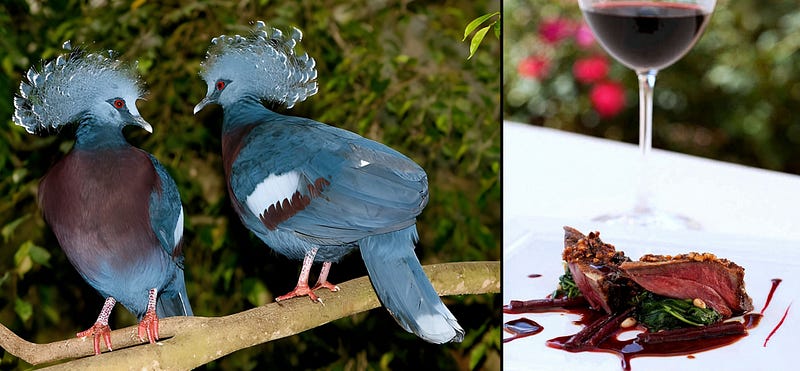
In the shadowy lowland rainforests of New Guinea, beneath canopies pierced by shafts of gold and green, strides a bird unlike any other. With a sapphire crest that shivers like lace in a breeze and eyes the color of ripe pomegranate seeds, the crowned pigeon evokes a sense of forgotten royalty. Neither pigeon nor peacock, yet somehow both, it is a creature of regal bearing and ecological significance. And while its elegance has captured the hearts of ornithologists and artists alike, it also raises pressing questions about conservation, culture, and even cuisine.
Taxonomy
The crowned pigeons belong to the genus Goura, comprising four distinct species: the western crowned pigeon (Goura cristata), the Victoria crowned pigeon (Goura victoria), the southern crowned pigeon (Goura scheepmakeri), and the Sclater’s crowned pigeon (Goura sclaterii). These are not your backyard city pigeons. They are ground-dwelling giants, each measuring around 29 to 33 in (74 to 84 cm) long and weighing up to 5.5 lb (2.5 kg). The Victoria crowned pigeon, with its lacy fan-shaped crest and rich blue plumage, is the most widely known and admired of the group.
Despite their shared genus, each species has subtle distinctions — variations in the patterns of their crests, breast coloration, and geographic distribution across the diverse regions of New Guinea. While none of the Goura pigeons are legally consumed in widespread global markets, they are technically edible. In some remote communities, they are hunted for food, though this practice now comes at an ecological cost.

Biology
Crowned pigeons are the largest surviving members of the Columbidae family, which includes doves and pigeons worldwide. But where the average rock pigeon is unassuming and fleet, Goura pigeons are striking, deliberate, and almost eerily calm. Their courtship displays are rituals of grace — slow bows, tail-fanning, and the deep resonant “boom” of a mating call that echoes like a distant drum.
They nest close to the forest floor, often in the fork of a low branch. Each clutch typically contains a single egg. The chick hatches in just under 30 days and is nurtured with a nutrient-rich secretion known as “crop milk” — a unique adaptation shared with flamingos and emperor penguins. Lifespan in the wild can exceed 15 years; however, in captivity, some individuals have surpassed 25 years.
Ecology
The crowned pigeon is a forest sentinel. As a ground forager, it feeds on fallen fruit, seeds, and small invertebrates, playing a vital role in seed dispersal and forest regeneration. These birds thrive in the dense undergrowth and swampy margins of tropical rainforests, often near riverbanks or sago palm groves.
Unfortunately, their slow reproductive rate and ground-nesting habits make them extremely vulnerable to habitat loss and overhunting. Deforestation, driven by palm oil plantations and logging, has fragmented their range. The IUCN currently classifies all Goura species as Near Threatened or Vulnerable, depending on the subspecies and region.
Conservation efforts hinge on habitat preservation and the enforcement of anti-poaching laws. Ecotourism offers one solution — when locals can derive economic benefit from the birds’ continued existence, incentives shift toward protection rather than exploitation.
Uses
In traditional Papuan societies, crowned pigeons are sometimes hunted for their meat or ceremonial feathers. The plumes, especially those of the Victoria crowned pigeon, have historically adorned headdresses and tribal garb. Today, feathers from captive birds are occasionally used in sustainable artisanal crafts, but international trade is heavily restricted to prevent illegal trafficking.
Captive breeding programs in Europe and North America — particularly in zoological gardens — aim to preserve genetic diversity and educate the public. However, the economic use of the species remains limited due to their slow breeding, low clutch size, and increasingly fragile populations.
Culinary Aspects
Though modern gastronomy seldom features Goura pigeons, historical accounts suggest their meat was once prized for its tenderness and dark, earthy flavor. In taste and texture, it may resemble squab or game birds like guinea fowl, with dense muscle fibers and a slightly sweet, iron-rich finish.
If one were to speculate on preparation, slow-roasting with native aromatics such as pandan leaf or lemongrass might coax out the richness. A wild forest mushroom reduction could complement its robust profile, or a taro root mash might echo the starchy terrain of its homeland. But such culinary flights must remain theoretical — the future of the crowned pigeon is far more precious than its flavor.
Wine Pairings
Should an ethical, sustainable source of Goura pigeon ever emerge — which is currently unfeasible — the wine pairing would demand a bold but nuanced bottle. A Rhône-style red blend, perhaps a Grenache-Syrah-Mourvèdre with notes of black plum and cracked pepper, would echo the bird’s earthy complexity. For those imagining a lighter pairing, a structured Pinot Noir from Oregon, with its mushroom and cranberry undertones, could also resonate.
Yet perhaps the most fitting pairing is symbolic: a glass raised in their honor rather than over their plate. For the crowned pigeon is not simply an ingredient; it is a symbol of wilderness, of regal beauty surviving in the shadows of ferns and fog.
Conclusion
In the Goura pigeons, we glimpse what might have been lost had evolution taken another turn. They are a window to a time when birds ruled the forest floor with feathers instead of claws, when spectacle was survival, and when even a pigeon could wear a crown.
Their story is one of balance — between beauty and fragility, utility and reverence, consumption and conservation. Let us be wise enough to preserve their world, if only so we may continue to be humbled by the blue-laced royalty of the rainforest floor.