Drumming Through the Forest: The Ruffed Grouse’s Secret Life from Canopy to Cast Iron
Introduction In the hush of early autumn, just before the leaves burst into flame, a sound echoes through North America’s hardwood forests…
Introduction
In the hush of early autumn, just before the leaves burst into flame, a sound echoes through North America’s hardwood forests — a low, rhythmic drumming like a distant motorcycle struggling to start. This isn’t machinery or weather, but a bird: the ruffed grouse. Known to woodsmen and birders alike for its elusive nature and haunting call, the ruffed grouse (Bonasa umbellus) is far more than a forest phantom. It’s a keystone of temperate woodland ecology, a culinary delicacy, and a living echo of the ancient interplay between humans and the wild. With populations waxing and waning on mysterious cycles and forests under threat from development and climate instability, the fate of this hardy bird now hangs in delicate balance. Let’s delve into the textured world of the ruffed grouse — from taxonomy to taste.
Taxonomy
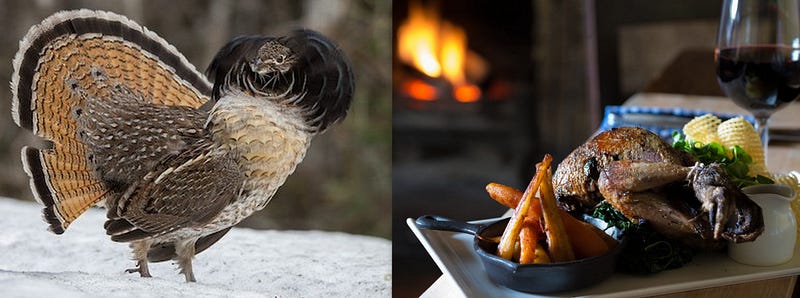
The ruffed grouse belongs to the order Galliformes and the family Phasianidae, which includes pheasants, partridges, and turkeys. Its scientific name, Bonasa umbellus, captures its essence: “Bonasa” comes from Latin for “good when roasted,” and “umbellus” refers to its ruff — a striking, fan-like collar of black feathers that the male flares during courtship. Several subspecies occur across its range, from the Appalachian ruffed grouse in the East to the darker-plumed Canadian variants in the boreal woods. While they differ slightly in size and coloration, all share the same earthy flavor and ecological niche. Though not traditionally “farmed,” wild-caught birds offer the most authentic experience, both on the plate and in the ecosystem.
Biology
Physically, the ruffed grouse is an artist of camouflage. About the size of a small chicken, it blends seamlessly into the dappled underbrush with its mottled brown, gray, and rust plumage. In spring, males take to fallen logs, performing their famous drumming display — a non-vocal percussive wingbeat sequence that serves as both mating call and territorial warning. Females nest on the ground, laying a dozen or more eggs in leaf-lined depressions, relying solely on stealth and luck to avoid predators like foxes, hawks, and humans. One of the few game birds that doesn’t migrate, the ruffed grouse is uniquely adapted to survive harsh winters, thanks to comb-like scales called pectinations that grow on its toes, turning them into natural snowshoes. It browses on buds, leaves, insects, and — come winter — catkins from birch and aspen.
Ecology
The ruffed grouse is more than just a woodland resident — it’s a vital participant in the forest’s pulse. Thriving in young, early-successional forests born from natural disturbance (fire, logging, or storm), the bird’s presence signals ecological renewal. Its foraging spreads seeds and stirs soil, contributing to undergrowth health. But the story isn’t all pastoral harmony. As large tracts of land age beyond the bird’s prime habitat or fall to suburban sprawl, populations decline. Forestry practices that once unintentionally benefited grouse now often emphasize monocultures or preservation over disturbance, creating a habitat paradox: we love the mature forest but need the wild chaos of youth to sustain its beating heart. Sustainable forestry practices — like rotational clearcutting and controlled burns — may offer a hopeful middle ground.
Uses
To hunters and rural communities, the ruffed grouse has long been a symbol of self-reliance and abundance. It’s one of the most pursued upland game birds in North America, not for sport alone, but for sustenance. Its harvest supports local economies through hunting tourism, conservation stamps, and game management funding. Unlike industrial poultry, the grouse is entirely wild — its life shaped by landscape, not feedlots. This makes it a sustainable food source when taken within regulated limits. As interest grows in foraged and wild-harvested fare, the bird finds new relevance among chefs and locavores seeking authenticity on the plate.
Culinary Aspects
Ruffed grouse meat is unlike anything you’ll find wrapped in cellophane. The breast is pale, tender, and mild, often likened to veal or rabbit, while the legs, though tougher, boast rich, dark notes reminiscent of duck. Because the bird is lean, dry heat cooking — especially roasting or pan-searing — demands care. It shines best when quickly browned in butter, paired with forest ingredients like wild mushrooms, juniper, or ramps. In rural households, it’s often served with thick gravy over biscuits, while more refined kitchens might elevate it with beurre blanc and a wine reduction. Unlike domesticated meat, its flavor reflects the terroir of its home woods — an honest expression of place and season. There’s something profoundly intimate about consuming a creature that fed on the same foliage that brushes your boots.
Wine Pairings
Given its nuanced, earthy flavor, ruffed grouse pairs beautifully with wines that mirror the forest. A Pinot Noir from Oregon, with its woodland berry notes and silky tannins, can highlight the delicacy of the breast. For darker preparations, such as braised legs with root vegetables, a rustic Barbera or Côtes du Rhône brings warmth and depth without overwhelming. Those favoring white should look to an aged Chardonnay — preferably one with subtle oak — to echo the autumnal profile of the bird. As with any pairing, the wine should honor the bird’s wild origins, never mask it.
Conclusion
The ruffed grouse is not merely a bird; it’s a metaphor for balance — between forest youth and maturity, between culinary tradition and ecological stewardship. Its survival depends not just on the forest but on our ability to value wildness in all its forms, from the crackle of fallen leaves underfoot to the quiet thunder of wings on a log. To taste the ruffed grouse is to taste the forest itself, and in doing so, to remember that conservation is not always about protection alone — it’s also about participation, ritual, and respect. So next time you hear that distant drumbeat in the trees, pause. The woods are speaking.