Fawzi al-Qawuqji: Arab Nationalist and Nazi Collaborator
“We will have to initiate total war. We will murder, wreck and ruin everything standing in our way, be it English, American, or Jewish”.
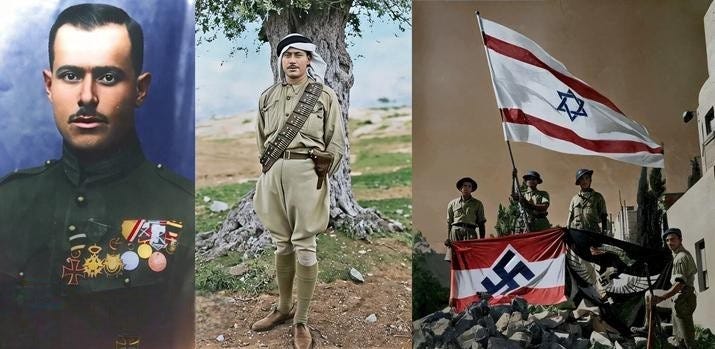
“We will have to initiate total war. We will murder, wreck and ruin everything standing in our way, be it English, American, or Jewish”.
Fawzi al-Qawuqji (Arabic: فوزي القاوقجي, Turkish: Fevzi Kavukçu; 19 January 1890–5 June 1977) was a Lebanese-born Arab nationalist military figure in the interwar period. He served briefly in Palestine in 1936, fighting the British Mandatory suppression of the Palestinian Revolt. A political decision by the British enabled him to flee the country in 1937. He was a colonel in the Nazi Wehrmacht during World War II and served as the Arab Liberation Army (ALA) field commander during the 1948 Palestine War.
Early Ambitions and the Seeds of Hatred
Fawzi al-Qawuqji was born in 1890 in Tripoli, then part of the Ottoman Empire, and embarked early on a life of military adventurism and rebellion. Trained as an Ottoman officer, he fought in World War I and was even decorated by the German Kaiser’s forces for bravery against the British. This formative experience — serving alongside German troops — foreshadowed the alliances he would later seek. After the war, al-Qawuqji’s identity crystallized around Arab nationalism and anti-colonial militancy. He participated in revolts against the French in Syria and eventually became an instructor in Iraq’s military. By the 1930s, his fierce anti-British, anti-Zionist zeal was well known. He first made a name leading bands of Arab fighters in the 1936–1939 Arab Revolt in Palestine, directing guerrilla attacks against both British authorities and Jewish communities. It was during this period that the seeds of his virulent antisemitism began to fully sprout. He increasingly framed the struggle not merely as anti-colonial resistance but as a war against the Jewish presence in Palestine. Even at this early stage, al-Qawuqji’s nationalist fervor carried a deeply hateful edge toward Jews — an animus that would harden into the defining feature of his ideology.
According to the book “O Jerusalem!” by Collins and Lapierre, al-Qawuqji told his troops that his aim was “to drive all the Jews into the sea” and that the purpose of his mission was “ridding Palestine of the Zionist plague”. This quote appears in multiple sources referencing his 1948 Arab Liberation Army command.
Al-Qawuqji’s writings and recorded statements from the 1930s reveal his adoption of a grandiose, incendiary narrative. In his memoirs and correspondence, he cast himself as a heroic Arab avenger, relentlessly fighting imperialists and the “Zionist invaders.” The themes that recurred were those of righteous vengeance, uncompromising struggle, and an existential battle for the Arab nation’s purity. He presented the presence of Jews in Palestine as an intolerable affront to Arab honor and religion, echoing ancient hatreds. His style was at once florid and brutal: describing Jews as a disease, a plague, a malevolent force that had to be uprooted by violence. Already by 1936, al-Qawuqji sought support from Nazi Germany’s local representatives, sensing in Hitler’s regime an ideological ally. In a telling episode, he contacted the German consul in Jerusalem and later met with Fritz Grobba, the Nazi envoy in Baghdad, pleading for arms and funds for the Arab Revolt. Though initially rebuffed — Berlin was not yet ready to overtly challenge the British in the Middle East — al-Qawuqji’s overture signaled his eagerness to align Arab nationalism with the rising fascist powers. Here was a decorated former Ottoman officer, now an Arab guerrilla chieftain, reaching out to the Nazi regime barely three years after Hitler took power. It was an early harbinger of the collaboration to come. More importantly, it underscored that al-Qawuqji’s anti-Zionism was never a purely local or nationalist sentiment; from the start, it plugged into the global web of antisemitic conspiracy thinking. He saw the Jewish presence in Palestine as part of a world-enemy, and thus naturally gravitated toward Nazi Germany — the world power then most openly dedicated to waging war on Jews everywhere.
Alliance with the Third Reich
By the early 1940s, Fawzi al-Qawuqji had cemented his reputation as a fervent Arab nationalist fighter — and a man consumed by hatred for the Jewish people. World War II opened the door for him to act on his hatred on a grander scale. In 1941, he became a key participant in the pro-Nazi coup in Iraq led by Rashid Ali al-Gaylani. Alongside his sometime rival, the Grand Mufti of Jerusalem, Hajj Amin al-Husseini, al-Qawuqji helped orchestrate and then fought in the short-lived rebellion to overthrow British influence in Baghdad.
Al-Qawuqji was highly critical of some Arab leaders, particularly the Mufti of Jerusalem. In his personal notes, he wrote that the Mufti “never fought on the battlefield of any country. He lays claim to leadership whenever he feels that his life is threatened, then he steals the money and retreats in defeat”.
This was not merely a power grab; it was ideologically driven. The coup leaders explicitly aligned themselves with the Axis, broadcasting slogans identical to Nazi propaganda and inciting violence against Iraq’s Jewish population. Al-Qawuqji led about 500 irregular fighters in western Iraq, clashing with British forces and reportedly showing no mercy to those he captured. His cruelty in this campaign was noted — he had prisoners executed and even mutilated — reflecting a psychology that had grown ever more ruthless and unrestrained. Here was a man so driven by conviction in his cause that ordinary laws of war or humanity meant nothing if the victims were among his designated enemies. The failure of the Iraqi coup forced al-Qawuqji to flee for his life, but it also bound him irrevocably to Nazi Germany. Wounded by British strafing and on the run, he found refuge first in Vichy-controlled Syria and then, by late 1941, in Germany itself.
Thus began the period of al-Qawuqji’s life when he became an open collaborator of the Nazi regime. In Berlin, he was welcomed as a valuable asset — a bona fide Arab war hero who could be trotted out to rally support for the Axis among Muslims. The Germans bestowed upon him the nominal rank of colonel in the Wehrmacht and provided him with all the trappings of prestige: an honorary command, a personal aide, a chauffeured car, a stipend, and housing in Berlin. For the Nazis, Fawzi al-Qawuqji was a propaganda treasure. They trumpeted his presence in Germany as proof that the Arab world stood with Hitler. His name was plastered across Arabic-language leaflets and echoed in Radio Berlin broadcasts directed at the Middle East. Al-Qawuqji’s own ideological arguments dovetailed perfectly with Nazi needs. He became one of the loudest Arab voices urging total war on the Jews.
“The Arabs are Germany’s natural friends because they shared the same enemies: the English, the Jews, and the Communists.”
With an air of a man fulfilled, he cooperated with Nazi authorities in efforts to recruit and train Arab volunteers for the German cause. German records show that by mid-1941 al-Qawuqji was officially attached to “Sonderstab F,” the special German unit for Middle East operations commanded by General Hellmuth Felmy. From a seaside headquarters in Athens, General Felmy coordinated plans to spread Nazi influence across the Arab East, and Fawzi al-Qawuqji was at his side as an eager partner. He even penned a memorandum to Felmy outlining strategies for a German-Arab alliance in Iraq and recommending coordinated propaganda “directed against Jews.” In one conversation with a fellow Arab officer, al-Qawuqji boasted, “I will come with Arab and German troops to help you,” a chilling promise that he would return to the Middle East at the head of a joint Nazi-Arab force to drive out the British and annihilate the Jews of Palestine.
Al-Qawuqji’s personal life in Nazi Germany also reflected his embrace of the Reich. He married a German woman, Anneliese Müller, during the war — a symbolic union bridging his Arab identity with the Aryan world he admired. This marriage was more than romantic; it was a statement of loyalty to Germany. It occurred even as Nazi racial ideologues proclaimed Arabs to be inferior — an inconsistency Hitler’s regime was willing to overlook for useful allies. Al-Qawuqji’s time in Berlin was marked by frequent consultations with the Mufti al-Husseini and former Iraqi premier al-Gaylani, the two other figureheads of the Axis-aligned Arab exile community. Though these men sometimes squabbled for prominence, they were united in a common ideological vision: an Arab world cleansed of Jews and freed from Western colonial rule, in partnership with a Nazi Europe cleansed of its Jews. Al-Qawuqji played his part diligently. He helped Felmy and other German officers identify Arab recruits and potential leaders for Nazi-backed units. In 1943–44, as the tide of war turned, he remained at his post in Germany, still churning out fiery rhetoric against the Allies and the Jews. German propaganda milked his presence for all it was worth — here was the “Arab Liberation Army commander” standing with Hitler’s Reich, proof of a global anti-Jewish alliance.
Yet even amid his collaboration, Fawzi al-Qawuqji nursed frustrations. In his later memoirs, he would recount that Nazi officials pressured him to publicly swear unconditional allegiance to Hitler — something he claimed to resist unless Germany formally endorsed full Arab independence. He recounted a tense altercation with an SS officer who demanded fealty to the Führer; when al-Qawuqji demurred and instead insisted the Nazis first recognize Arab rights, the officer threatened him. Shortly after, al-Qawuqji’s young son died mysteriously by poisoning. He was convinced the Nazi secret police murdered the boy as a warning. In protest, he refused to attend the funeral that the German authorities staged. This episode, if his recollection is to be believed, reveals a streak of pride and defiance — but not a rejection of Nazi ideology so much as impatience that the Axis was not moving aggressively enough to grant Arabs their desired dominion. In truth, al-Qawuqji never wavered from his decision to throw in his lot with the Axis. He simply chafed at the idea of Arabs being treated as junior partners. He wanted a fully Nazi-aligned Arab army, not Arabs scattered as foot soldiers under German command. He envisioned a fascist Arab state allied with Hitler as an equal. This fantasy of an independent but Nazi-allied Arab power guided his actions. Even as the Nazi leadership dragged its feet on formal promises, al-Qawuqji remained a passionate cheerleader for their shared cause: exterminating the Jews and smashing the British Empire in the Middle East.
As the war neared its end, the colonel-in-name saw his hopes collapse. Germany never did liberate the Arab lands as promised. Al-Qawuqji was in Germany when Hitler’s regime fell. He was briefly captured by Soviet forces in 1945 and held prisoner for over a year — a twist of fate that saved him from Allied prosecution and perhaps from retribution at home. By 1947, Stalin’s gulag unceremoniously disgorged him, and he made his way back to the Middle East. Remarkably, instead of being discredited by his Nazi service, Fawzi al-Qawuqji was greeted by many Arabs as a returning hero. In a measure of how deep fascist sympathies ran among segments of Arab society, al-Qawuqji did not have to hide his past. On the contrary, he openly boasted of his time in Berlin as a badge of honor. He arrived in Cairo and declared that he stood ready “at the disposition of the Arab people” should they call on him to take up arms again. He lost no time in resuming his old quest — the war against the Jews — now under the banner of opposing the newly proposed partition of Palestine.
Militant Antisemitism as Ideology and Practice
Throughout his career, Fawzi al-Qawuqji’s motivations went far beyond ordinary nationalism. He was animated by a militant antisemitic ideology as poisonous and fanatical as any in the fascist world. While he cloaked his rhetoric in the language of Arab nationalism and anti-colonial struggle, at its core, his worldview was indistinguishable from Nazi-style Jew-hatred. Over the years, in his writings and speeches, he depicted Jews not just as political adversaries but as an insidious racial and religious enemy of the Arab nation. Like the Nazis, he portrayed Jews as a contaminant, a “plague” to be eradicated. During the 1948 Palestine war, al-Qawuqji told his forces that their mission was nothing less than “ridding Palestine of the Zionist plague.” He urged them on with vivid imagery of purification through violence, effectively casting the conflict as a holy war to cleanse the land of Jewish presence. This was genocidal language, barely disguised as military aspiration. According to some accounts, he proclaimed that his aim was “to drive all the Jews into the sea.” Whether or not he used those exact words in public, it is clear from his pattern of rhetoric that he envisioned the elimination of Jewish life in Palestine if his side won. His propaganda and the slogans of his Arab Liberation Army left no room for coexistence: the Jews were to be wiped out or expelled en masse, a goal identical to that of his Nazi mentors in Europe.
Al-Qawuqji’s justifications for violence were drenched in the same fevered arguments Hitler and Goebbels peddled. He depicted Jews as the root of all evils — the agents of British imperialism, the conspirators behind Arab suffering, a demonic force deserving destruction. On the eve of the United Nations partition decision in 1947, he publicly threatened “total war” if a Jewish state were approved. In a blood-curdling vow, he declared, “We will have to initiate total war. We will murder, wreck and ruin everything standing in our way, be it English, American, or Jewish.” This was not the rhetoric of a mere political dispute over territory; it was the language of annihilation, targeting an entire people with indiscriminate violence. By explicitly including “Jewish” along with the foreign powers, al-Qawuqji signaled that every Jewish man, woman, and child in Palestine was a valid target for slaughter. He felt licensed — even duty-bound — to unleash horrific brutality in the name of Arab nationalism. His threats were not idle. When war did break out after the partition vote, his forces indeed carried out atrocities. Jewish communities that fell under his militia’s brief control were met with looting, arson, and massacre. Al-Qawuqji’s psychology by this time was one of total dehumanization of Jews. In his eyes, they were not civilians or innocents; they were a collective pestilence. Witnesses recall that he exhorted Arab villagers to join the fight by warning that Jews would “violate your women, kill your children and destroy you” unless the Arabs struck first — a direct echo of Nazi propaganda lines. He mirrored the paranoid style of fascist anti-Jewish propaganda, accusing the Jews of plotting genocide even as he himself was planning it against them.
What drove Fawzi al-Qawuqji to such extremes? Psychologically, he exhibited a combustible mixture of fierce pride, fanatical conviction, and a penchant for violence unbridled by moral constraint. By all accounts, he thrived in chaos and warfare — a man who felt most alive when commanding irregular troops on campaign. He had a mercurial temperament prone to fury and vengeance. Those who met him noted a certain charisma: tall, imposing, with fiery eyes and a dramatic flair for oratory. He could whip up the emotions of a crowd or a detachment of fighters with passionate appeals to honor and faith. But beneath the patriotic bombast lay an almost pathological hatred. Al-Qawuqji seemed to need an enemy to define himself, and the Jews filled that role to an obsessive degree. Over years of conflict, he nursed every grievance and humiliation — the loss of Palestine to the Zionists, the exile from Iraq, the defeats by the British — and blamed them all on a grand Jewish conspiracy. In this, he differed little from his ally, the Grand Mufti, who famously ranted that Jews were behind both Western capitalism and Soviet communism and had to be fought everywhere. Al-Qawuqji fully subscribed to this paranoid worldview. He truly believed that his personal destiny and the fate of the Arab world hinged on vanquishing “International Jewry.” This belief gave him a sense of heroic mission and absolved him of any guilt. In his mind, extreme measures were not only justified but sanctified. To murder Jews was, in his words, to “please God, history, and religion.” Such chilling sentiments, in fact, were broadcast by the Axis Arabic radio, where al-Qawuqji’s name featured prominently. The psychological profile that emerges is of a fanatic for whom hatred became a source of meaning. He was not content merely to win political rights or sovereignty; he sought the utter destruction of those he saw as racial-religious foes. This genocidal impulse, far from being incidental, was central to his philosophy.
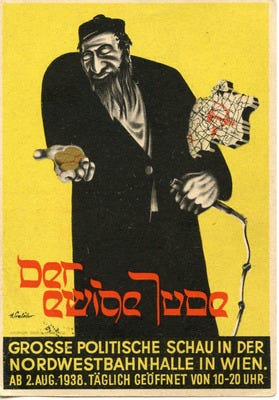
War on the Jews Under the Banner of Arab Nationalism
With the defeat of Nazi Germany in 1945, one might expect Fawzi al-Qawuqji’s brand of fascist Arab militancy to fade. Instead, he re-emerged in the late 1940s as a central military leader in the Arab war against the nascent state of Israel — essentially carrying the torch of Nazi antisemitism into the post-war Middle East. In 1947–48, as the United Nations moved to partition Palestine, al-Qawuqji became the field commander of the Arab Liberation Army, a volunteer force sponsored by the Arab League to prevent the establishment of Israel. He stepped seamlessly from one war into another, scarcely pausing in his lifelong crusade against the Jews. Under his command, thousands of irregulars from across the Arab world invaded Palestine even before the British Mandate ended. Al-Qawuqji orchestrated campaigns to besiege Jewish communities, cut off supply routes, and terrorize civilians — all with the open aim of strangling the infant Jewish state at birth. He coordinated with his old colleagues: the Grand Mufti, just returned from Nazi exile, and other ex-Axis collaborators like Hasan Salama and Abd al-Qadir al-Husayni (a kinsman of the Mufti). This cohort had spent the war years in Nazi Germany alongside al-Qawuqji. Now they applied the lessons learned and the hatreds stoked in Berlin to the battlegrounds of Galilee and Judea. Inside the councils of the Arab League, these men argued stridently against any compromise or diplomatic solution. They pushed for an uncompromising jihad, insisting that the only acceptable outcome was the complete elimination of the Jewish foothold in Palestine. The secretary-general of the Arab League at the time went so far as to publicly declare that the coming war would be a “massacre” that would resemble the Mongol slaughter of the Crusaders — an openly genocidal boast. Al-Qawuqji wholeheartedly agreed with this sentiment. In his field headquarters, he rallied his disparate fighters — Syrian, Iraqi, Lebanese, Palestinian, even a contingent of Bosnian Muslim veterans of the SS — by painting the conflict in starkly existential terms: us or them, Arab survival versus Jewish survival.
During the 1948 war, al-Qawuqji’s personal communications continued to reflect his fascist mindset. Even as his forces suffered setbacks, he churned out triumphant communiqués laced with anti-Jewish invective. At one point, he exultantly (if prematurely) claimed to have overrun a Jewish town, announcing that “not a single Jew remains alive.” When reality contradicted him, he resorted to wild conspiracy theories — after a defeat at the hands of Israeli forces, he disseminated propaganda insisting that it was not Jews who beat him but rather foreign infidel powers and even “non-Jewish Soviet” soldiers who had tipped the scales. This inability to credit Jews with any legitimate victory or humanity was telling. To al-Qawuqji, Jews were sub-humans, incapable of genuine nationhood or martial prowess, mere puppets of great powers. This was precisely the Nazi line he had absorbed. The irony, of course, is that by 1948 the Jews of Israel were in fact fighting for survival partly because of the very real threat figures like al-Qawuqji posed — a threat modeled on Nazi genocide. Jewish fighters who intercepted Arab radio broadcasts heard familiar refrains urging Arabs to “kill the Jews wherever you find them” and claiming that to do so was a divine command. These were echoes of the propaganda that al-Qawuqji and his colleagues had helped craft in Berlin. The ideological imprint of Nazism was plain to see on the Arab side of the 1948 war. Arab militias adopted fascist-style names and salutes; some wore uniforms modeled on those of Axis forces; their rhetoric blended Islamic themes with Nazi-like demonization of Jews.
Al-Qawuqji proved to be a mediocre general — his forces were plagued by disorganization, rivalry, and poor supply — but his impact was felt in the war’s ferocity. Wherever his Arab Liberation Army operated, the fighting tended to be especially merciless. Villages changed hands with no quarter given. In one notorious episode, his artillery pounded the kibbutz of Mishmar HaEmek for days, and his troops signaled their intent by painting their armored cars with an emblem of a dagger stabbing through a Star of David. Such imagery encapsulated the essence of al-Qawuqji’s approach: this was a war of extermination, not politics. In public, he cast himself as the commander of a grand pan-Arab “Liberation Army,” wrapping genocide in the flag of freedom. But the concept of “liberation” he pursued was chillingly narrow — it meant a Palestine liberated of Jews, not a multiethnic freedom. His political vision for a post-war Palestine was essentially fascist: an Arab nationalist regime with no Jewish presence and no tolerance for dissent. He had no tolerance for pluralism or democratic ideals. In the areas his forces occupied, he deferred to the authority of the exiled Mufti’s followers, who imposed a harsh rule. Al-Qawuqji was comfortable operating in a milieu of terror and dictatorial control; indeed, he flourished in it.
Legacy of Hate in Arab Nationalist Garb
When the guns fell silent in 1949, Fawzi al-Qawuqji had failed to achieve his ultimate dream — Israel survived, and he was forced to slip away into exile once more. He lived out his remaining years quietly between Damascus and Beirut, writing memoirs in which he attempted to justify his long war. In those writings, he never abandoned the ideology that had guided him. He continued to rail against the “treachery” of Jews and imperialists, blaming them for every setback. Unrepentant and unapologetic, al-Qawuqji portrayed himself as a misunderstood patriot, even as the pages of his memoirs drip with contempt for Jews and glorifications of fascist regimes. He asserted that his collaboration with the Nazis had been a logical and honorable choice, given their “support” for the Arab cause. He glossed over the Holocaust or implied that the Jews had brought their misfortune on themselves — reciting the classic victim-blaming arguments common to antisemites. In one bitter passage, he suggested that Hitler’s actions against the Jews were driven by Jewish machinations against Germany, essentially parroting Nazi justifications. Such claims showed that even after witnessing the devastation of World War II, al-Qawuqji’s mindset remained firmly anchored in the fascist conspiratorial view of history. He had learned nothing and forgotten nothing. To the end of his days, he championed a vision of Arab nationalism that was inseparable from militant antisemitism.
Al-Qawuqji’s life thus stands as a stark illustration of how fascist ideology found purchase far beyond Europe. He was in many ways the personification of Arab fascism — combining the tropes of European Nazism with local nationalist and Islamic motifs. His uniform might have been a keffiyeh and khaki tunic instead of an SS jackboot, but the essence was the same: authoritarianism, cult of violence, racism, and eliminationist hatred of Jews. He believed in a purified nation and a heroic leader (at times himself, at times figures like the Mufti or even Hitler). He disdained liberalism, democracy, and any notion of coexistence. Instead, he exalted “blood and soil” — the defense of Arab land by force of arms and blood sacrifice. Under the garb of Arab pride, he legitimized atrocities that mirrored those of his Nazi allies. Over the decades, he also helped to transmit this toxic mix to future generations. Many postwar Arab nationalist and Islamist movements quietly revered men like Fawzi al-Qawuqji as pioneers. His unyielding refusal to compromise and his glorification of martyrdom in the fight against Jews became a template for later extremists. Even as mainstream historians have come to condemn his role as that of a fanatic and collaborator in evil, in some Arab circles, he was long hailed as a “freedom fighter.” This lingering adulation, however marginal, is a testament to how deeply the poison he spread took root. The legacy of al-Qawuqji is a cautionary tale: he showed how easily a cause that purports to seek national liberation can be perverted into a vehicle for genocidal hatred. By the time of his death in 1977, the Middle East had seen decades more of conflict — some of it stoked by the very ideologies he had championed.
History remembers Fawzi al-Qawuqji as much for his ideology as for his deeds. He was a man consumed and ultimately defined by hate. In him burned the same ferocious antisemitism that darkened Europe, finding a new battlefield under Middle Eastern suns. He seamlessly aligned Arab nationalism with Nazi goals, proving that fascism was not a uniquely European pathology but a transferable plague. Al-Qawuqji’s story is compelling and horrifying: an Ottoman-trained officer turned guerrilla, who swore fealty to Hitler’s Reich and later led armies under the green banner of Arab revolt — yet all along, his true banner was the black flag of fascist fanaticism. He journeyed from Tripoli to Berlin to Galilee in pursuit of his private holy war. And though he failed to achieve the genocidal victory he sought, the scars of his campaign — the lives lost, the hatreds inflamed — remain part of the tragic legacy of the Arab-Israeli conflict. Fawzi al-Qawuqji’s life is a stark reminder that antisemitism, once loosed, can take root anywhere and wrap itself in any flag, even that of anti-colonial freedom. His profile is one of a virulent ideologue who cloaked himself in the righteousness of nationalism while walking hand in hand with the architects of the Holocaust. It stands as one of the 20th century’s more unsettling profiles of evil: the Nazi collaborator in Arab nationalist garb, forever zealously advocating a war of annihilation as if it were a war of liberation.