Guardians of the Rainforest: The Cassowary’s Hidden Role
Introduction
Introduction
In the mist-drenched forests of northern Australia, New Guinea, and the surrounding islands, a bird unlike any other strides silently through the undergrowth. The cassowary, a living relic of the dinosaur age, is both revered and feared. With its towering stature — reaching up to 6 ft 6 in (198 cm) — and dagger-like claws capable of inflicting serious injury, it has earned a reputation as the “world’s most dangerous bird.” Yet beyond the headlines lies a remarkable ecological steward whose survival is inextricably linked with the health of tropical rainforests. To understand the cassowary is to uncover the delicate balance of biodiversity, cultural history, and sustainability in some of the planet’s richest ecosystems.

Taxonomy
Cassowaries belong to the genus Casuarius within the family Casuariidae. There are three recognized species: the Southern cassowary (Casuarius casuarius), the Northern cassowary (Casuarius unappendiculatus), and the Dwarf cassowary (Casuarius bennetti). Commonly called the “cassowary” across cultures, these flightless birds share lineage with emus, ostriches, and kiwis — collectively known as ratites. While no “edible varieties” exist in the culinary sense, local traditions have historically incorporated cassowaries into subsistence hunting, making their classification not merely biological but also cultural.
Biology
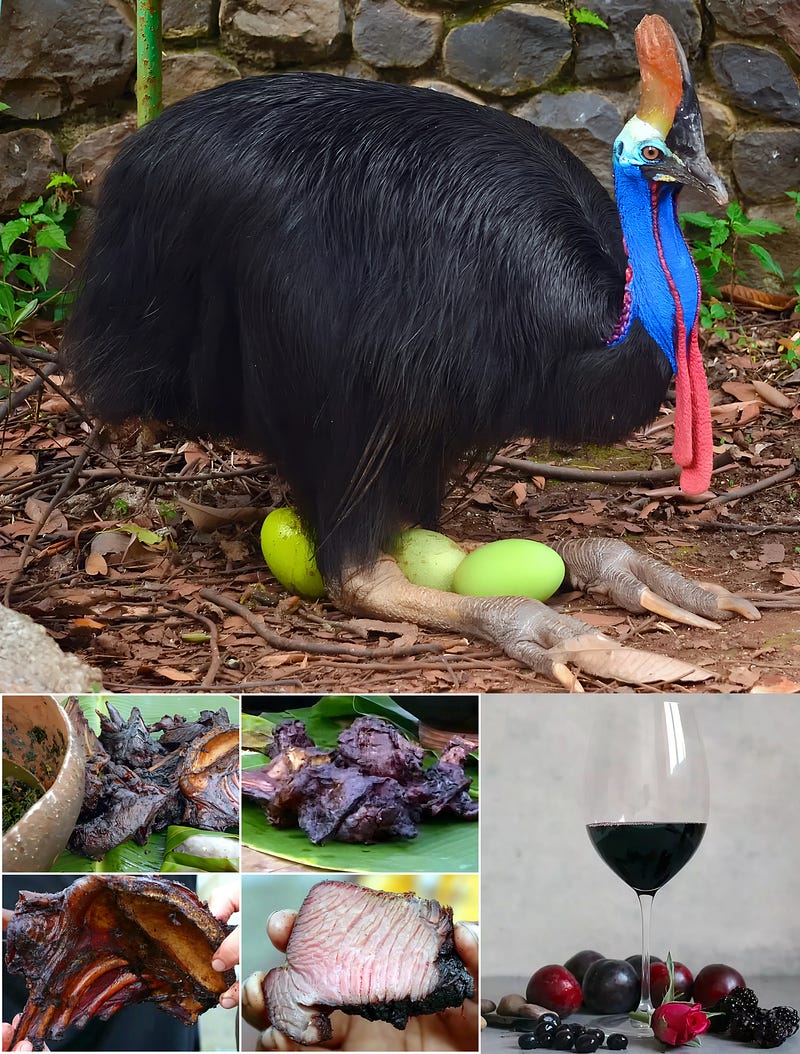
The cassowary’s biology is a study in evolutionary marvels. Cloaked in glossy black plumage, with a vivid blue neck and scarlet wattles, its most striking feature is the casque — a helmet-like crest atop its head, which may reach 7.5 in (19 cm) in height. This bony structure likely aids in sound resonance and movement through dense vegetation. Adults can weigh up to 130 lb (59 kg), with females larger than males, an inversion of many bird species. Their powerful legs, equipped with a middle claw that can grow up to 4 in (10 cm), make them both swift sprinters — capable of 31 mph (50 km/h) — and formidable defenders. Cassowaries mature slowly, reaching breeding age at around 3 to 4 years, with males uniquely taking on the role of incubating eggs and rearing chicks.
Ecology
The cassowary is not just a creature of the rainforest — it is one of its architects. These birds are frugivores, consuming hundreds of rainforest fruit species. Their digestive systems are uniquely adapted to pass large seeds intact, dispersing them over distances that can exceed 0.6 miles (1 km). Without cassowaries, many tree species would struggle to regenerate, making the bird a keystone species. Deforestation, road construction, and dog predation, however, threaten their numbers. Conservation programs increasingly stress sustainable coexistence: protecting corridors of forest, controlling invasive species, and supporting Indigenous custodianship.
Uses
Historically, cassowaries held significance beyond their ecological role. Indigenous communities in New Guinea valued cassowary bones for tools and plumage for ceremonial dress. Their meat was considered a rare source of protein, though modern conservation laws now restrict hunting. Economically, cassowaries contribute indirectly: by ensuring rainforest regeneration, they safeguard the ecological services — carbon storage, fresh water, biodiversity — that underpin global sustainability. Their presence attracts ecotourism, blending conservation with livelihood support for local communities.
Culinary Aspects
Although cassowary meat is no longer widely consumed, it has an enduring place in cultural memory. In traditional accounts, the flesh was described as rich, dark, and gamey, similar to lean beef or ostrich. The eggs, massive at up to 1.5 lb (700 g), were a valued food source. Nutritionally, cassowary meat is high in protein and low in fat, akin to modern “alternative meats” like venison or emu. Today, culinary engagement with cassowaries takes the form of symbolic feasts and storytelling rather than consumption, underscoring the shift from exploitation to preservation.
Wine Pairings
Were cassowary meat were ethically available, its deep, game-like profile would pair well with bold, structured reds. A Shiraz from Australia’s Barossa Valley, with its peppery finish, would harmonize with the meat’s richness, while a Cabernet Sauvignon would complement its intensity with tannic depth. For cassowary eggs, if imagined in a custard or quiche, a crisp Chardonnay with citrus notes would balance the creaminess. These pairings are not prescriptions but thought experiments — reminders that the culinary world often intersects with cultural ethics and conservation.
Conclusion
The cassowary stands at the intersection of myth, menace, and ecological necessity. It is a guardian of the rainforest, ensuring the survival of countless plant species through its quiet wanderings. To lose the cassowary would be to unravel the very fabric of tropical ecosystems. In appreciating its biology, cultural resonance, and even its culinary echoes, we glimpse a profound truth: sustainability is not merely about protecting species, but about safeguarding the intricate web of life they sustain. The cassowary, once feared as dangerous, reveals itself as indispensable.