If Black Holes Exist, White Holes Must Exist — So Where Are They?
Unraveling the Geometric, Thermodynamic, and Quantum Contradictions of a Time-Symmetric Cosmos
Introduction
Black holes are no longer just the stuff of science fiction — they’re observable, detectable, and mathematically necessary in the structure of our universe. But if Einstein’s general relativity equations are time-symmetric, then shouldn’t white holes — time-reversed counterparts to black holes — also exist? Strangely, while black holes devour everything in their path, including light, white holes would be cosmic geysers, spewing matter and energy outward. The math insists on their existence. Physics, so far, refuses to comply. This paradox invites us to rethink how geometry, time, and thermodynamics intersect in our evolving understanding of spacetime.
The Mathematical Symmetry: When Geometry Demands Duality
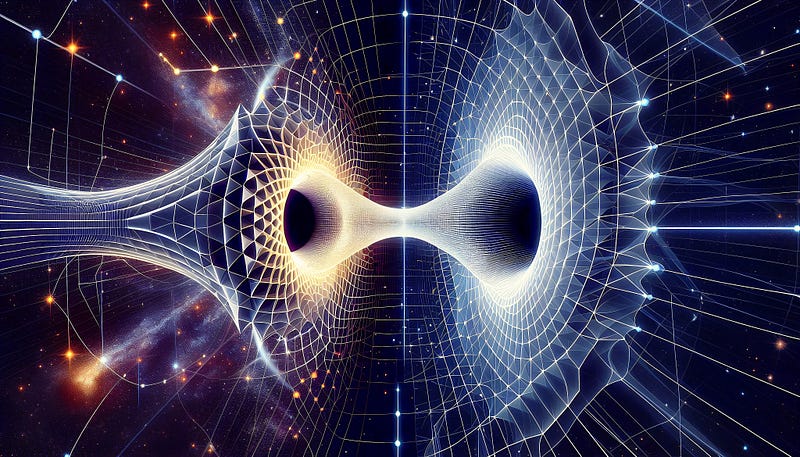
Einstein’s field equations in general relativity are indifferent to the direction of time. If a black hole is a solution to these equations, so too is its mirror image — a white hole. The Kruskal-Szekeres extension of the Schwarzschild metric reveals four distinct regions, including a white hole and a “parallel universe,” both mathematically necessary to avoid a spacetime edge.
This geometric symmetry is not theoretical fluff — it’s hardwired into the spacetime fabric. The time-reversal transformation (T → –T) doesn’t alter the validity of the equations. It merely flips the causal structure: where black holes pull everything in, white holes erupt, disallowing entry. According to the math, both must exist to complete the manifold.
The Paradox of Physical Realism: Why the Universe Plays Favorites
Here lies the contradiction. While black holes form from stellar collapse — a clearly defined astrophysical process — white holes require a past singularity from which matter spontaneously bursts forth. This demands either a finely tuned initial condition or a physical process we’ve never observed.
The problem deepens when thermodynamics enters the equation. Black holes obey the second law by absorbing high-entropy matter. A white hole, on the other hand, would eject low-entropy matter from nowhere, effectively decreasing the universe’s total entropy. This defies the arrow of time and the very thermodynamic fabric of our cosmos.
In essence, while general relativity is symmetric, our universe is not.
Beyond Classical Physics: The Quantum Case for White Holes
Quantum gravity may offer an escape hatch. In loop quantum gravity (LQG), black hole singularities could “bounce,” transitioning into white holes. Theoretical constructs suggest that the intense curvature at a black hole’s core might trigger a quantum repulsion, reversing the collapse into an expansion — a white hole. Some physicists speculate that Hawking radiation itself could be a whisper of this process.
Penrose’s Conformal Cyclic Cosmology (CCC) goes further, postulating that white holes are the seeds of new cosmic epochs — what evaporates from a black hole in one universe could ignite the next. These are not just poetic notions; they imply observable consequences, such as imprints on the cosmic microwave background or subtle echoes in gravitational wave data.
Thermodynamics Reimagined: Could Entropy Be Reversible?
To accommodate white holes within the laws of thermodynamics, we must extend them. Consider a black hole/white hole pair as a closed system. The entropy absorbed by the black hole could be counterbalanced by the entropy ejected by the white hole, but in a causally disconnected universe or time frame.
This dual-system thermodynamics challenges our current definitions but preserves the second law globally. The universe might not violate its own rules — it might simply obey them across a broader canvas than we currently observe.
Geometry as Destiny: Unifying Equations for Black and White Holes
Theoretical frameworks like Einstein-Cartan theory, which incorporates torsion, or the Wheeler-DeWitt equation, which allows for quantum superpositions of entire spacetimes, provide the scaffolding to unify black and white holes into one object with two temporal faces.
Such a structure could be governed by a combined metric where spacetime itself chooses which “face” to present, depending on the direction of causality. In this view, white holes aren’t independent entities but the unseen half of a whole — concealed behind the horizon of quantum indeterminacy.
Conclusion: Symmetry Without Reality?
The equations are clear. Black holes and white holes are symmetrical necessities within the full solution set of general relativity. But the universe, it seems, doesn’t care about mathematical elegance. White holes may exist only on paper — unless quantum gravity or a radical rethink of entropy opens the door.
So, where are the white holes? Perhaps they’re buried in the quantum foam of evaporating black holes. Perhaps they birthed our universe. Or perhaps they exist only in a cosmos that obeys different rules — a place where time itself folds in both directions and the past can erupt as furiously as the future collapses.
Until then, the white hole remains a ghost in the equations, a reminder that nature doesn’t always play by the rules we write.