
Inside the Planck-Length Microscope: Imagining a Device to See the Quantum Fabric of Spacetime
Introduction What if we could peer into the very grain of spacetime? Not atoms, not quarks, but the indivisible building blocks of reality…
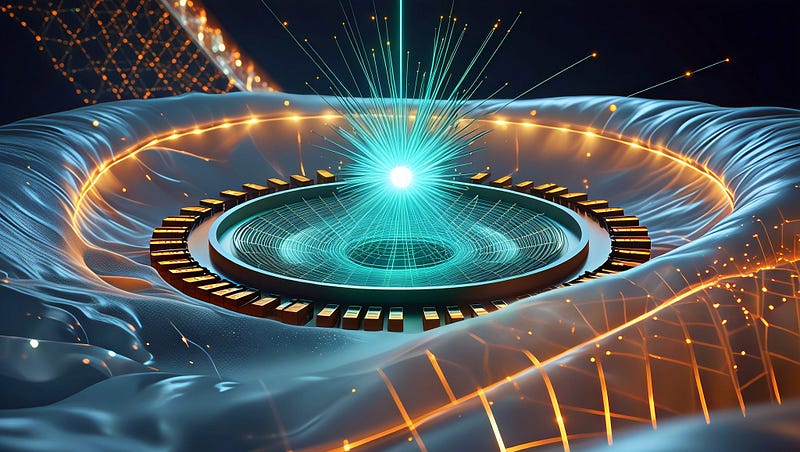
Introduction
What if we could peer into the very grain of spacetime? Not atoms, not quarks, but the indivisible building blocks of reality itself — the flickering quantum foam predicted to churn at the tiniest imaginable scale. At the heart of this lies the Planck length, 1.616×10⁻³⁵ meters — a scale so small it defies not only engineering but logic, where physics as we know it breaks down. But what if we could build a microscope to see it?
This article presents a speculative blueprint for such a device: a thought experiment that pushes physics, engineering, and imagination to their absolute limits. We’re not just talking about a better telescope or a stronger collider. We’re envisioning a tool that may never be realized in a lab — but one that, by its very design, illuminates the deepest riddles of quantum gravity, holography, and the architecture of spacetime.
The Physical Barriers to Ultimate Resolution
At its core, the Planck microscope confronts a paradox: to see smaller, you need more energy. But add too much energy into too small a space, and you don’t sharpen your image — you collapse it into a black hole.
The Planck length is where two titans of modern physics collide: general relativity and quantum mechanics. According to the Generalized Uncertainty Principle, there’s a hard floor to how finely space can be resolved. Cram more momentum into a probe to improve resolution, and spacetime itself starts pushing back — bending, rippling, even hiding the very thing you’re trying to see. Go too far and your microscope becomes a gravitational grenade.
This is the arena where our hypothetical device must operate — delicately balanced at the edge of catastrophe, trying to gather light from a universe that may be fundamentally discrete.
Blueprint for a Hypothetical Planck Microscope
1. The Probe: Planck-Energy Particles
Our primary illumination source is a photon or particle with an energy of 1.22×10²⁸ electron volts — the Planck energy. No laser on Earth comes close. Imagine condensing the energy of a small bomb into a single pulse the size of a proton. Even that isn’t enough. You’d need a beam focused to a spot a hundred million trillion times smaller.
Speculative technologies include:
- Kugelblitz lasers: beams of pure light so intense they could generate black holes.
- Linear particle accelerators stretching across solar systems, designed to smash particles together with surgical precision.
- Coherent graviton beams: if such things exist, they’d poke directly at spacetime’s geometry rather than matter within it.
2. The Target: Matter or Vacuum
Whether probing a subatomic particle or the structure of space, the microscope must control the environment with almost metaphysical delicacy. Every shot is a high-stakes gamble: hit too hard and you create a black hole; miss the mark and you learn nothing. Even vacuum — “nothingness” — might reveal subtle lattice structures or holographic limits if tickled just right.
3. The Detectors: Reconstructing the Unseeable
After each pulse, detectors gather the echoes:
- Scattered high-energy particles form angular patterns that betray the structure within.
- Hawking radiation bursts from micro black holes carry imprints of the target’s internal state.
- Gravitational wave sensors capture tremors in the spacetime fabric itself.
- Quantum entanglement monitors track coherence loss from interactions with spacetime’s foam.
These readings are then assembled into a probabilistic reconstruction — not a photograph, but a statistical ghost of what lies below.
What Might We Discover?
A. Pointlike Simplicity
If particles and spacetime remain smooth down to the Planck scale, our microscope will only reveal fuzz: a featureless glow, blurred by uncertainty, and punctuated by stochastic black hole flashes.
B. Sub-Planck Structure: Preons or Strings
But if particles are composite — made of preons or strings — we might glimpse interference fringes or diffraction peaks that suggest inner architecture. Think of it as seeing the faint lattice shadows cast by unknown constituents.
C. Discrete Spacetime
If spacetime is a grid, as loop quantum gravity proposes, we could spot periodic Bragg scattering — light diffracting off a cosmic crystal. Or perhaps we detect random jitter — quantum foam — that blurs our readings irreducibly.
The Limits of the Ultimate Microscope
Even the most radical instrument must obey reality’s deepest constraints:
- Energy: We need more energy in a probe than humanity has ever harnessed.
- Safety: Micro black holes could become existential risks if not perfectly controlled.
- Theory: We may interpret fuzz as discreteness — or vice versa.
- Blur: Noncommutative geometry implies that spacetime is not a clean canvas but a jittering sea of uncertainty. Every image, no matter how advanced the tool, comes out with a Planck-sized blur.
This is the bittersweet truth: the universe may be structured in such a way that the smallest scales are forever hidden behind quantum veils and gravitational masks.
Conclusion: Why This Matters — Even If Never Built
A Planck-scale microscope may never exist. But conceiving one teaches us what nature allows — and forbids. It reveals that information, energy, and geometry are intertwined at the most intimate levels. It suggests that the same equations governing black holes must govern the building blocks of space itself.
And it reminds us that seeing is not always possible — but imagining is. To envision this microscope is to trace the outlines of a deeper reality we’re only beginning to grasp.